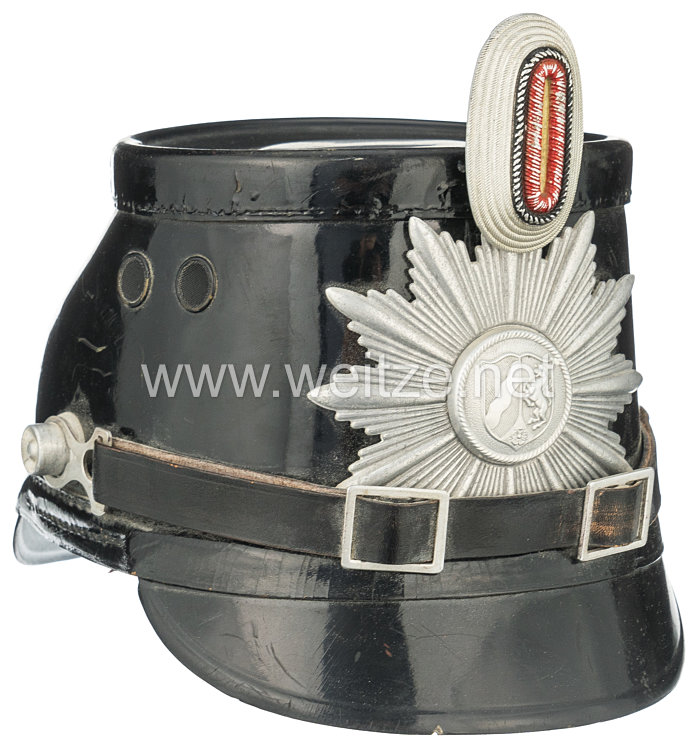
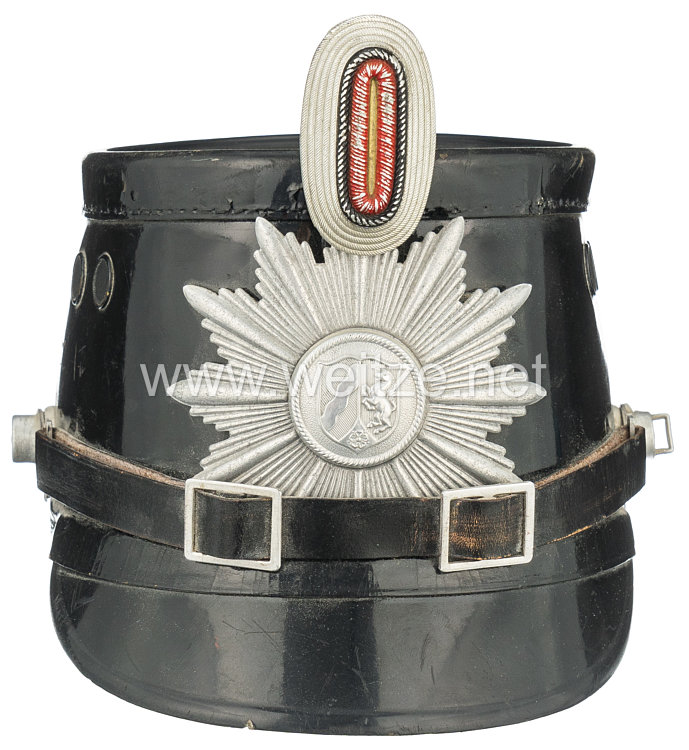
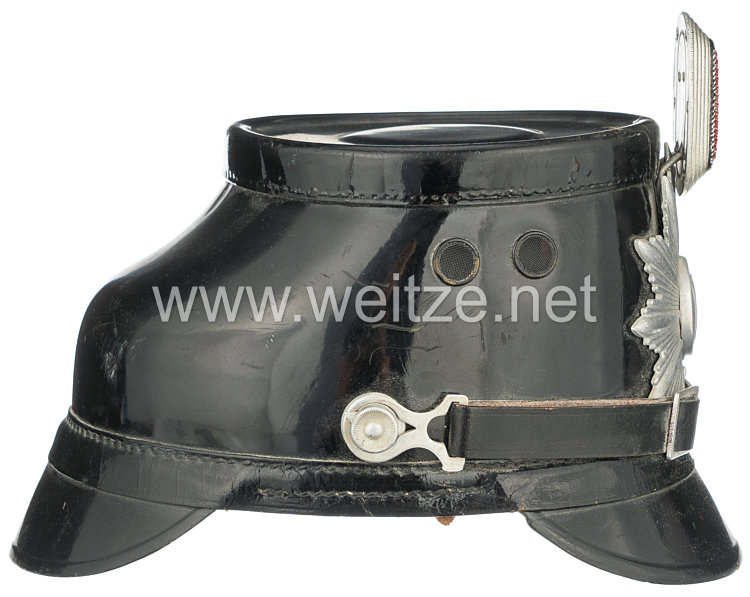
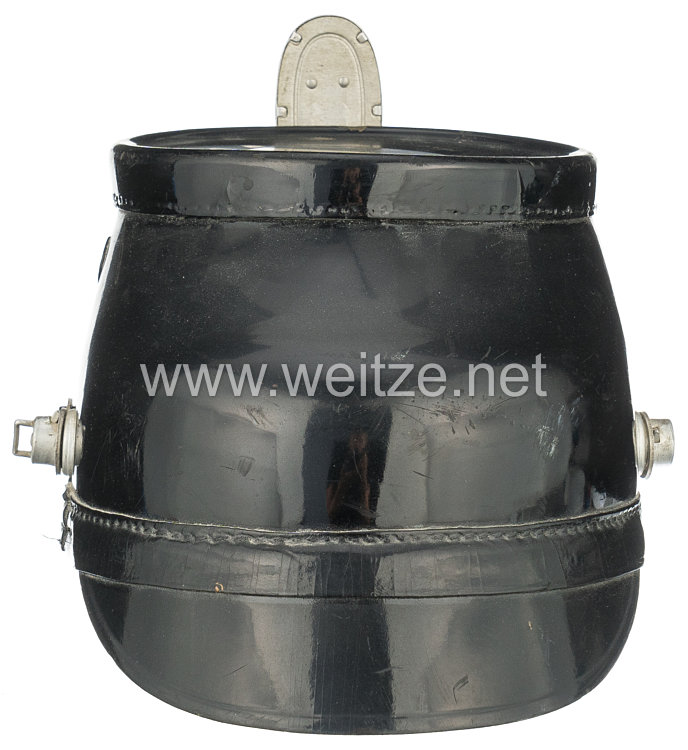
Federal Republic of Germany (FRG) Police Shako for Enlisted Men, Nordrhein Westfalen

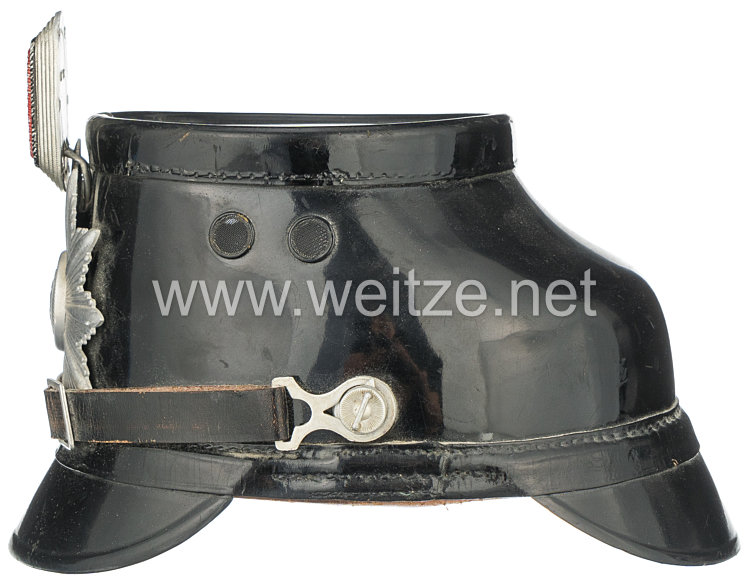
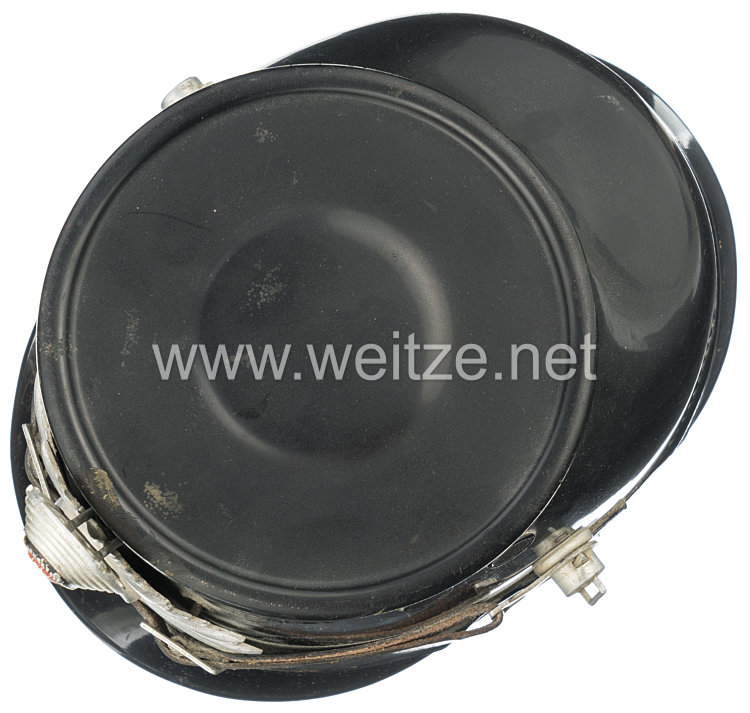
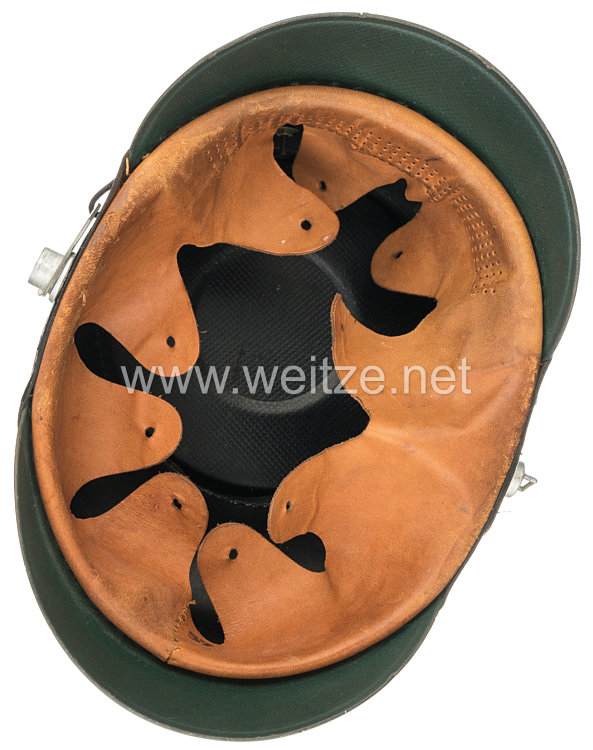
Worn circa 1950. Black shako made of vulcanized fiber. Front features the large silver-colored police star, with the coat of arms of Nordrhein Westfalen in the center, black leather chin strap attached to button 91. Complete with cockade. Interior with reinforced lining. Size 57. Condition 2.
433448
180,00

Federal Republic of Germany (FRG) Police Shako for Enlisted Men, Nordrhein Westfalen

The police shako from North Rhine-Westphalia represents a significant artifact from the early post-war period of the Federal Republic of Germany. As headgear for enlisted police personnel around 1950, this object embodies a transitional phase in German police history, during which new democratic structures were being established while traditional uniform elements were retained.

After the end of World War II in 1945, the police in the western occupation zones had to be completely reorganized. The Allied occupation powers insisted on decentralization of police structures to prevent a concentration of power as had existed under the Nazi state. This led to the formation of state police forces subordinate to the newly established federal states. North Rhine-Westphalia, created in 1946 by the British occupation authority from the Prussian provinces of North Rhine and Westphalia as well as the state of Lippe, developed one of the largest state police forces in the young Federal Republic.

The shako as headgear has a long tradition in German police and military history. Originally arriving from Hungary in the early 19th century, this cylindrical headpiece was quickly adopted by European armies and police units. In Prussia and later in the German Empire, the shako was part of the standard equipment for many formations. After 1945, this tradition was deliberately continued to symbolize continuity and authority, albeit under democratic auspices.

The specimen described here made of vulcanized fiber reflects the material conditions of the post-war period. Vulcanized fiber, a material developed in the 19th century from multiple glued and pressed layers of paper or textile, was inexpensive, relatively lightweight, and sufficiently stable for headgear. In the economically strained situation of the early 1950s, this was a practical solution for mass-equipping the newly established police forces.

The large silver-colored police star on the front of the shako was the central identifying mark of the German police. This star, traditionally with five, six, or seven points, had already served as a police symbol in the Weimar Republic and was adopted again after 1945 to establish a connection to democratic tradition while simultaneously distancing itself from the Nazi eagle symbol.

The coat of arms of North Rhine-Westphalia in the center of the star clearly identifies the state police. The North Rhine-Westphalian state coat of arms, officially introduced in 1948, combines symbols of historical territories: the Rhineland river, the Westphalian horse, and the Lippe rose. This regional identification on police uniforms emphasized the federal structure of the Federal Republic and state sovereignty in police matters.

The black leather chin strap, attached to a button, served the practical purpose of securing the headgear in wind or during physical activity. The designation “button 91” likely refers to a standardized uniform component or catalog number from the post-war period. The cockade, traditionally a rank insignia or national symbol, completes the equipment.

The quilted lining inside, an inserted fabric padding, significantly increased wearing comfort. The indicated size 57 corresponds to head circumference in centimeters and was a standard size for male wearers.

The wearing period around 1950 marks a specific phase in German police history. The police regulations of the early Federal Republic were oriented toward pre-war traditions but had to simultaneously meet the requirements of the occupation powers and democratic renewal. The shako was worn primarily at representative occasions, parades, and guard duty, while more practical headgear such as peaked caps were used for patrol duty.

During the 1950s, shakos were gradually withdrawn from active service and replaced by more modern uniform pieces. Economic recovery enabled better materials and more functional designs. Nevertheless, the shako remained in use for certain honor formations and ceremonial occasions, in some cases until the 1960s.

Today, such police shakos from the early Federal Republic are sought-after collectibles that are significant not only in terms of uniform history but also as evidence of Germany's democratic reconstruction. They document the attempt to restore state authority and order while simultaneously distancing from the totalitarian legacy.