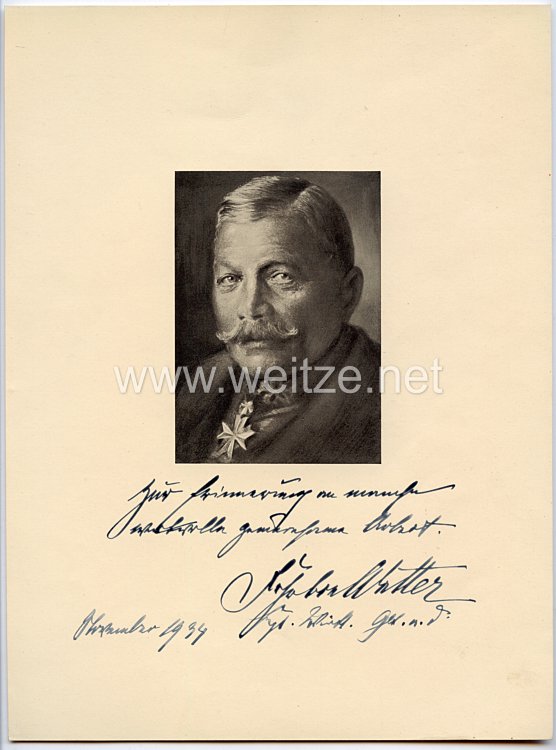
World War I - Original Signature of Pour le Mérite with Oak Leaves Recipient Lieutenant General Freiherr Oskar von Watter

on a printed photograph measuring 21 x 28 cm, with beautiful dedication and ink signature “In remembrance of our valuable joint work. Frhr.von Watter Royal Württemberg Lt.Gen. (ret.) December 1934”, condition 2.

http://de.wikipedia.org/wiki/Oskar_von_Watter
355348
180,00

World War I - Original Signature of Pour le Mérite with Oak Leaves Recipient Lieutenant General Freiherr Oskar von Watter

Generalleutnant Freiherr Oskar von Watter (1861-1939) was one of the most distinguished Württemberg officers of World War I and a recipient of the Pour le Mérite with Oak Leaves, Prussia's highest military decoration for valor.

This signed photographic portrait from 1934 represents an important category of military historical collectibles: personally dedicated and signed photographs of high-ranking officers from the Imperial era. The dedication “In memory of our valuable joint work” suggests a personal relationship between von Watter and the recipient, likely in the context of military or veterans' organizational activities during the Weimar Republic.

The Pour le Mérite was instituted in 1740 by Frederick the Great and remained Prussia's highest military decoration until 1918. The Oak Leaves (Eichenlaub) to the Pour le Mérite, introduced in 1810, were awarded only for further outstanding achievements after the initial bestowal of the order. Von Watter received the Pour le Mérite on August 18, 1916, for his services as commander of the 54th Infantry Division, and the Oak Leaves on November 8, 1916.

Oskar von Watter came from a Württemberg noble family and pursued a classical military career in the Royal Württemberg Army. During World War I, he distinguished himself first as a divisional commander on the Western Front, particularly during the Battle of the Somme in 1916. He later assumed command of the XXIV Reserve Corps and from 1917 onward the XIII Army Corps. His leadership qualities and tactical abilities made him one of the most respected senior officers in the Württemberg Army.

After the war's end, von Watter played a controversial role during the revolutionary upheavals of 1918/19. As commander of Reichswehr Brigade 16, he participated in the violent suppression of the Munich Soviet Republic in May 1919. This phase of his career remains historically contentious, as the operations were conducted with considerable brutality.

The signature's dating to December 1934 places the document in the early phase of the National Socialist regime. At this time, many former Imperial officers were active in veterans' organizations and cultivated memories of their military past. Von Watter himself lived until 1939 as a retired Generalleutnant.

The collector value and historical significance of such signed photographs rest on several factors: First, they document the continuation of military networks beyond the collapse of the monarchy. Second, personal dedications provide insight into relationships between former comrades. Third, authentic signatures of Pour le Mérite recipients are rare today, as these officers represented an exclusive group - only about 5,500 awards of the order were made in total, with even fewer including Oak Leaves.

The use of printed photographs with personal signatures was a widespread practice among former officers in the 1920s and 1930s. They served both personal remembrance and the maintenance of social and professional networks. The quality of the ink signature and the formulation of the dedication suggest a carefully executed, appreciative gesture.

For military historians and collectors, such documents offer valuable insight into the postwar period of the Imperial officer corps. They illustrate how the military elite of the Kaiserreich preserved their identity and social bonds in the changed political landscape of the Weimar Republic and early Third Reich. The designation “Kgl.Württ. Glt.a.D.” (Royal Württemberg Lieutenant General retired) shows that von Watter maintained his royal Württemberg titles years after the abolition of the monarchy - a typical phenomenon among the conservative military elite of this era.

The object is thus not merely an autograph of a highly decorated officer, but also a document of contemporary history that reflects the continuities and ruptures of German military history between the Kaiserreich and the Nazi period.