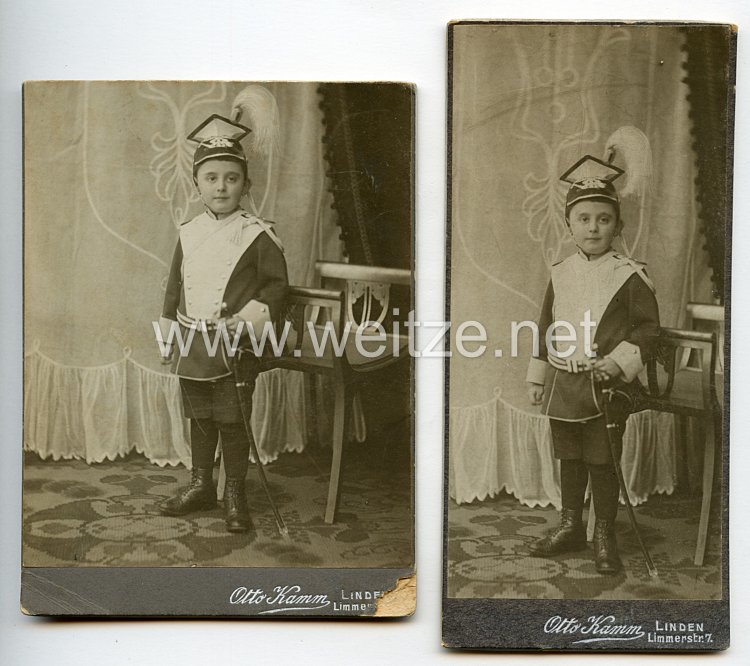
Portrait Photographs German Reich: Child in Uhlan Uniform
The photographs presented here depict a child wearing a Uhlan uniform and represent a fascinating phenomenon of German military culture in the late 19th and early 20th centuries. Such children's portraits in military uniforms were widespread in the German Empire (1871-1918) and reflect the deep rootedness of military values in society at that time.
Uhlans were light cavalry units that originally came from Poland and were adopted into the Prussian and other German armies in the 18th century. Their characteristic distinguishing feature was the Czapka, a square-topped cap with a flat crown that became the iconic silhouette of the Uhlans. Numerous Uhlan regiments existed in the German Empire, including the famous Guard Uhlan Regiments as well as line Uhlan regiments in Prussia, Bavaria, Saxony, and Württemberg.
The tradition of photographing children in military uniforms was a significant aspect of Wilhelmine culture. This practice had several dimensions: on one hand, it expressed the close connection many families had to the military, especially when fathers or other relatives served in corresponding units. On the other hand, it was an expression of a general militarization of society, in which soldierly virtues such as discipline, obedience, and patriotism were considered desirable educational goals.
Photographic studios frequently offered children's military uniforms as props that were modeled after the original uniforms of various military units. These miniature uniforms were crafted with considerable attention to detail and typically included the characteristic Ulanka (the fitted uniform jacket), the Czapka with its specific regimental insignia, and often also sabers or lances in child-appropriate sizes. The quality of these uniforms varied considerably—from simple, symbolic representations to elaborate, tailor-made copies of genuine uniform pieces.
In the context of the time, this practice was by no means unusual. The Empire cultivated a pronounced cult of uniforms, and military parades, imperial maneuvers, and public appearances by military units shaped social life. Children grew up in an atmosphere where military role models played a central role. Toy soldiers, picture books with military motifs, and indeed photographs in uniform were part of the childhood of many German boys of this era.
The photographic technology of the time required relatively long exposure times, which is why the portrayed children had to remain still. This often explains the serious, stiff poses in such photographs. Photographic studios were established in all major cities between approximately 1890 and 1914 and offered a standardized repertoire of backgrounds, furniture, and uniforms as costumes.
The military-historical significance of such photographs lies less in the military than in the cultural-historical realm. They document the history of mentalities of an era in which military identity and national belonging were closely interwoven. After World War I (1914-1918) and the collapse of the monarchy, this tradition largely disappeared, though it experienced a problematic revival in modified form during the Nazi era.
Today, such photographs are important contemporary historical documents. They provide insights into the visual culture of the Empire, educational ideals, and social norms. For uniform scholars, they also offer valuable details about the nature and appearance of historical uniforms, even though they are reproductions. The condition of such photographs varies greatly; the mentioned slight damage is not unusual for objects of this age and may have resulted from improper storage, moisture, or mechanical stress.