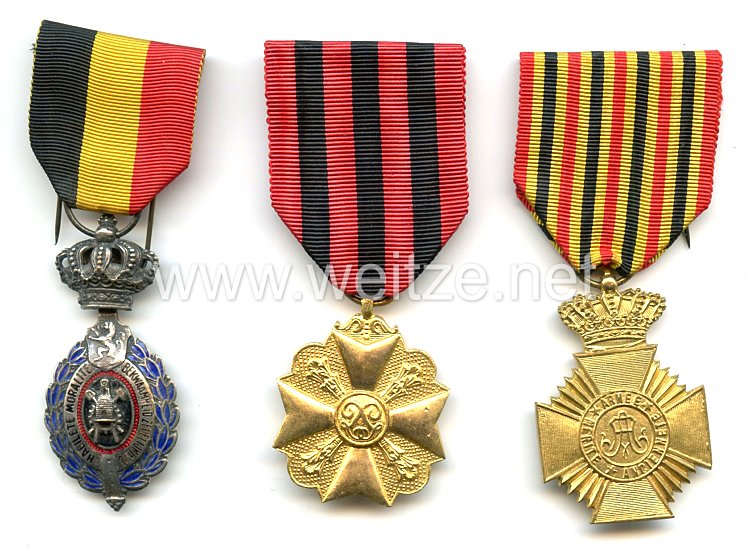
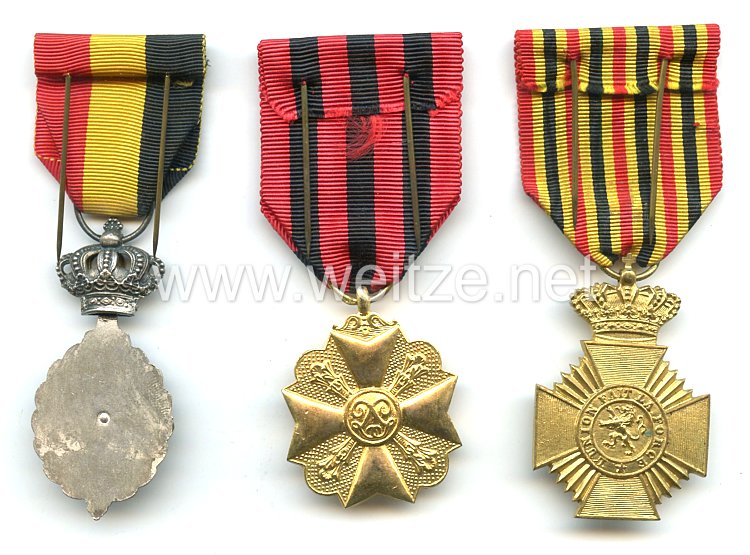
Kingdom of Belgium - Group Lot
The Kingdom of Belgium has developed a rich tradition of honoring military and civil merit through medals and orders since its independence in 1830. A collection of Belgian medals, such as the one described here, offers a fascinating insight into the military history and honors system of a nation that, despite its small size, played a significant role in European conflicts of the 19th and 20th centuries.
The Belgian tradition of awards was significantly shaped by King Leopold I, who ascended to the throne after the Belgian Revolution of 1830. The Belgian order system was influenced by French and Dutch models but quickly developed its own characteristic features. Among the most important Belgian decorations are the Order of Leopold (founded 1832), the Order of the Crown (founded 1897), and various war and commemorative medals.
Particularly significant in Belgian military history are the decorations related to World War I. Belgium, whose neutrality was violated by the German invasion in August 1914, offered fierce resistance. The defense of Liège and Antwerp, as well as the four-year struggle at the Yser Front, led to the creation of numerous war decorations. The Yser Medal, the Victory Medal 1914-1918, and various commemorative crosses document this heroic period of Belgian history.
The Belgian medal system distinguishes between various categories: orders for special merit, combat decorations, commemorative medals, and service awards. The awarding criteria were strictly regulated and established by royal decrees. The medals were typically manufactured by renowned Belgian mints such as the Royal Mint of Belgium in Brussels.
During World War II, Belgium again experienced a German invasion in May 1940. Although the country was quickly occupied, Belgian troops continued to fight alongside the Allies, particularly in the Belgian Brigade Piron. The Resistance also offered significant opposition. After the war, numerous new decorations were created, including the War Medal 1940-1945 and various resistance awards.
The quality and preservation of Belgian medals is typically evaluated according to a condition grading system, where condition 2 indicates very good preservation with only minimal signs of wear. This suggests that the medals were carefully preserved and their details, striking, and any enameling remain well-maintained.
Belgian medals are characterized by distinctive design features: frequently the portrait of the reigning monarch on the obverse, Belgian national symbols such as the Belgian Lion, and inscriptions on the reverse often in both national languages (French and Dutch). The ribbons often follow the Belgian national colors of black, yellow, and red, with various color combinations distinguishing different decorations.
A collection of three medals could include various combinations: commemorative medals from both world wars, service decorations, colonial medals from the Belgian Congo, or civil merit medals. Each combination tells an individual story about the bearer and their life journey through significant historical events.
The collection and study of Belgian militaria has a long tradition among historians and collectors. Specialized catalogs and standard references document the various versions, variants, and awarding criteria. The Belgian Society for Phaleristics is dedicated to the scientific study of these decorations.
For historical research, such collections are of inestimable value, as they not only document military events but also provide insights into individual biographies, social structures, and a nation's culture of remembrance. They are material witnesses to Belgium's turbulent history in the 19th and 20th centuries and commemorate the sacrifices and achievements of those who wore them.