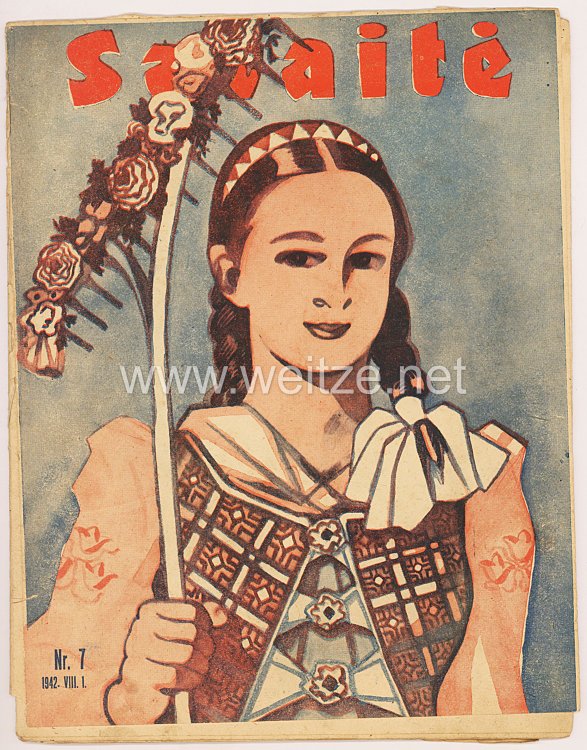
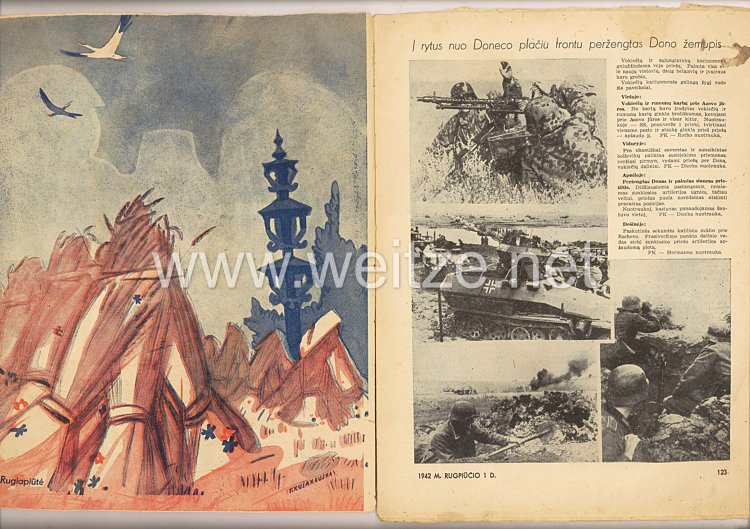
Third Reich / Lithuania - Magazine "Savaitė" - Volume 1942 No. 7
The Magazine "Savaitė" in Occupied Lithuania, 1942
This issue of the Lithuanian magazine "Savaitė" (English: "The Week") from 1942, number 7, represents a significant historical document from the period of German occupation of Lithuania during World War II. This publication belongs to a category of press materials that appeared under the supervision of German occupation authorities in the Reichskommissariat Ostland.
Historical Context of the German Occupation of Lithuania
Following the German invasion of the Soviet Union in June 1941 as part of Operation Barbarossa, Lithuania was conquered by the Wehrmacht within a few weeks. The country, which had been under Soviet rule since 1940, was incorporated into the Reichskommissariat Ostland, established on July 17, 1941. This administrative territory included Lithuania, Latvia, Estonia, and parts of Belarus. The seat of Reich Commissioner Hinrich Lohse was located in Riga.
The Press Landscape Under German Occupation
The German occupation administration established a comprehensive system of press control and censorship in the occupied eastern territories. Magazines and newspapers were subject to strict supervision by the Reich Ministry for Public Enlightenment and Propaganda under Joseph Goebbels, as well as local propaganda departments of the civil administration. Publications were intended to serve multiple objectives: disseminating National Socialist ideology, legitimizing German rule, mobilizing local labor for the German war economy, and combating Soviet partisan activity.
Lithuanian publications like "Savaitė" appeared in the local language but were editorially controlled by German authorities. They served as instruments for influencing the local population and attempted to foster cooperation with the occupation authorities. The editorial line had to conform to German propaganda directives, with local editors often performing a difficult balancing act between occupier demands and the interests of the Lithuanian population.
The Year 1942 in Lithuania
The year 1942 marked a phase of consolidation of German occupation rule in Lithuania. The initial hope of parts of the Lithuanian population for restoration of state independence had given way to the realization that the Third Reich would grant no autonomy. Simultaneously, the systematic persecution and murder of the Jewish population intensified. Most Lithuanian Jews had already been murdered by the end of 1941 in mass shootings, primarily by Einsatzgruppen and Lithuanian collaborators.
In 1942, the German administration focused on economic exploitation of the occupied territories. Forced labor services were established, agricultural products requisitioned, and workers recruited for deployment in the German Reich. The magazine "Savaitė" likely also served to communicate and justify these measures.
Significance as Historical Source Material
Magazines like this issue of "Savaitė" are today important sources for researching the occupation period. They provide insights into the propaganda strategies of the occupying power, the living conditions of the population, and the cultural situation under German rule. Historians use such publications to examine the mechanisms of collaboration and resistance, as well as to reconstruct the everyday history of this dark period.
The indicated condition of 2- suggests a well-preserved issue, which is of considerable significance for publications from this era, as many such documents did not survive the war or were deliberately destroyed. Collectors and archives preserve such copies as part of the documentary heritage indispensable for processing the history of World War II and National Socialist occupation policy.
Research Perspectives
Scholarly engagement with occupation publications like "Savaitė" has increased in recent decades. Researchers analyze not only obvious propaganda but also subtler aspects such as the language used, visual representations, and the selection of topics covered. These sources help understand the complex relationships between occupiers and occupied and explore the gray zones between coercion, adaptation, and collaboration.