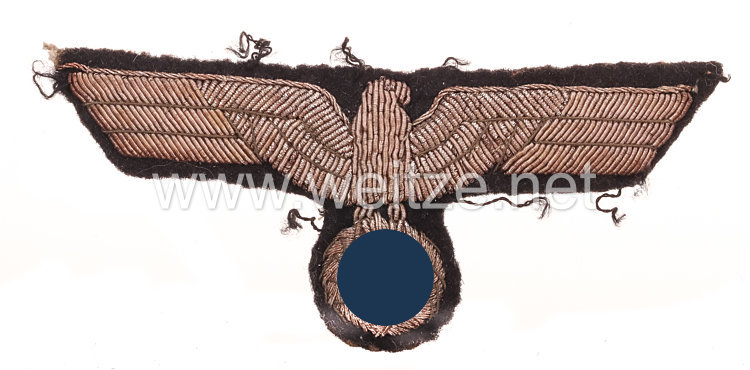
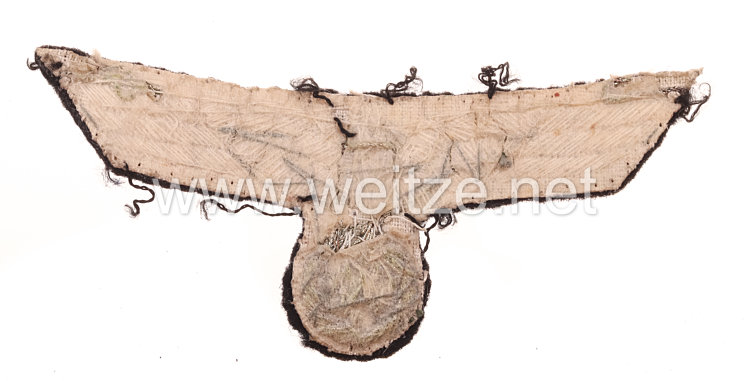
Kriegsmarine Breast Eagle for Naval Officials
The Kriegsmarine Breast Eagle for Naval Officials represents a significant example of maritime uniform insignia from the German Reich during the period from 1935 to 1945. This hand-embroidered version in silver on dark blue background embodies the strict hierarchy and pronounced rank system of the German Navy of that era.
The Kriegsmarine was officially founded on June 1, 1935, when National Socialist Germany rejected the provisions of the Treaty of Versailles and began building a modern war fleet. This new foundation was accompanied by the introduction of a comprehensive system of uniforms, badges, and rank insignia that differed significantly from the traditions of the Imperial Navy and the Reichsmarine of the Weimar Republic.
The breast eagle, also referred to as the service eagle, was an essential component of the uniforms of all Wehrmacht branches. Specific versions existed for the Kriegsmarine, which differed in material, workmanship, and authorization to wear. The eagle described here was specifically intended for naval officials, a group that was clearly distinct from military ranks.
Naval officials were civilian specialists who worked within the military organizational structures of the Kriegsmarine. They did not hold military ranks in the proper sense but carried official civil service titles. These included administrative officials, technical specialists, naval architects, supply officers, and other experts whose expertise was indispensable for operating a modern navy. These officials wore special uniforms that, while similar to military clothing, differed in details.
The hand-embroidered execution of the breast eagle indicates high-quality manufacture. While enlisted ranks frequently wore woven or machine-made eagles, hand-embroidered specimens were typically reserved for higher-quality uniform pieces. The embroidery was done with silver thread on dark blue cloth background, with the eagle depicted with outstretched wings and the swastika in its talons – the standardized form of the national emblem for the Kriegsmarine.
The coloring of the background is of particular significance. The dark blue was the characteristic color of the Kriegsmarine and clearly distinguished the naval forces from the field-gray uniforms of the Army and the blue-gray of the Air Force. This color tradition dated back to the Imperial Navy and symbolized the maritime orientation and tradition of the German naval forces.
The wearing of the breast eagle was precisely regulated in the uniform regulations of the Kriegsmarine. The eagle was placed on the right breast above the breast pocket and had to maintain certain distances from other uniform components. The exact position varied depending on the type of uniform – whether service dress, mess dress, or walking-out uniform.
The production of such hand-embroidered breast eagles was carried out by specialized insignia embroidery workshops and military suppliers. Well-known manufacturers such as the Erel company from Berlin or various other licensed businesses produced these uniform components according to prescribed patterns. The craftsmanship quality varied depending on the manufacturer and the time of production. Toward the end of the war, as materials became scarce, the quality of many uniform components noticeably declined.
The described lightly worn condition suggests that this specimen was actually used in service. The preservation of such insignia is of historical interest today, as they bear witness to the material culture and organizational structures of the Kriegsmarine. For military historical research, such objects are important sources for understanding the everyday reality in the German armed forces.
After the end of World War II in 1945, the Kriegsmarine was dissolved, and all its symbols and insignia lost their official significance. The Allied Control Council laws prohibited the wearing of such uniform components. Today, such objects possess exclusively historical and collectible value and serve the scholarly examination of World War II history and German military history.
The study of these artifacts provides valuable insights into the complex administrative and organizational structures of the Kriegsmarine, the distinctions between military and civilian personnel within the naval hierarchy, and the attention to detail that characterized German military traditions. They remain important material evidence of a significant period in maritime military history.