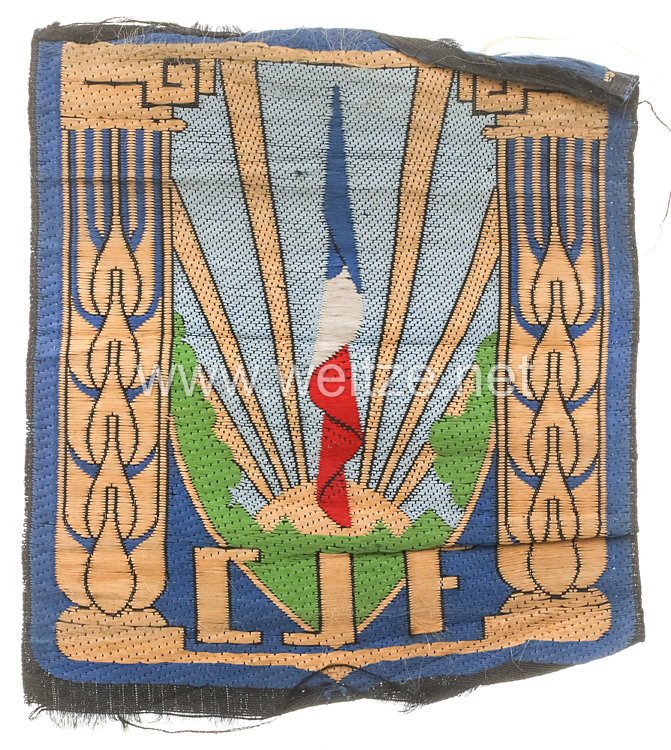
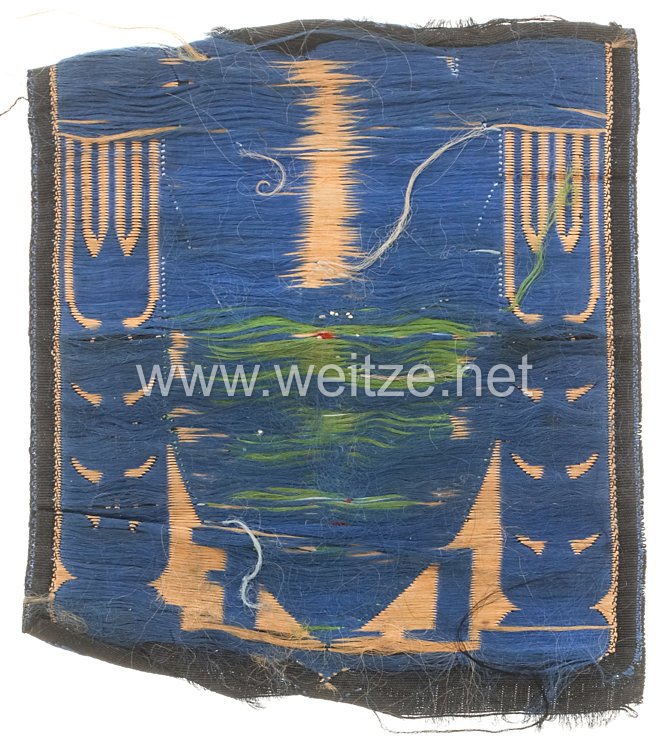
France World War II Vichy Government, Cloth Insignia of the Youth Organization “Chantiers de la Jeunesse”
The cloth badge of the Chantiers de la Jeunesse (Youth Workshops) represents a significant artifact from one of the most controversial periods in French history – the era of the Vichy Regime during World War II. These badges, manufactured using the Bevo weaving technique, embody the complex political and social reality of occupied France between 1940 and 1944.
The Chantiers de la Jeunesse Française were established by law on July 30, 1940, just weeks after the French capitulation and the establishment of the Vichy regime under Marshal Philippe Pétain. The organization emerged as a direct replacement for compulsory military service, which had been prohibited by the armistice conditions with Germany. Its founder and Commissioner-General was Joseph de la Porte du Theil, a French general who led the organization until his arrest by the Gestapo in January 1944.
The present badge with its blue background corresponds to the typical coloring of this organization. The Bevo weaving technique, named after the German company Bandfabrik Ewald Vorsteher from Wuppertal, was an advanced weaving method that allowed complex designs and inscriptions to be woven directly into fabric. This technique was frequently used during World War II for military and paramilitary insignia, both in Germany and in occupied territories.
The Chantiers de la Jeunesse was a compulsory organization for all young men aged 20 in the unoccupied zone of France. Each young man had to serve eight months, which consisted mainly of forestry work, road construction, and other infrastructure projects. The organization was divided into Groupements (groups), each comprising approximately 2,000 to 3,000 young men and named after French provinces.
Ideologically, the organization operated under the motto of Pétain's Révolution Nationale (National Revolution) with the famous triad “Travail, Famille, Patrie” (Work, Family, Fatherland), which replaced the republican motto “Liberté, Égalité, Fraternité”. The Chantiers de la Jeunesse aimed to educate French youth in the spirit of traditional values, promote physical fitness, and provide a substitute for prohibited military training.
Between 1940 and 1944, an estimated 400,000 young Frenchmen passed through the Chantiers de la Jeunesse. The organization maintained camps in rural areas, predominantly in forests and mountains, where young men lived and worked under spartan conditions. Despite the official line of the Vichy regime, many of these camps developed into centers of quiet resistance, and numerous former members later joined the Résistance.
Uniforming and the use of insignia played an important role in the organization. Members wore characteristic uniforms with berets and various badges that identified their affiliation with specific Groupements and their functions. The blue cloth badge, such as the example described here, was typically attached to the uniform and identified the wearer as a member of this organization.
After the occupation of the previously free zone by German troops in November 1942, the organization came under increasing German pressure. The Nazis attempted to use the Chantiers de la Jeunesse as a recruitment source for forced laborers under the Service du Travail Obligatoire (STO). This led to growing tensions and caused many young men to go underground.
The organization was finally dissolved in June 1944 after the Allied landing in Normandy. The historical assessment of the Chantiers de la Jeunesse remains ambivalent. On one hand, it was an institution of the collaborating Vichy regime; on the other, it offered many young men an alternative to forced labor in Germany and partly became a refuge for future resistance fighters.
Today, badges like this are important historical documents that bear witness to a complex and painful period in French history. They are valued by collectors and historians as material remnants of an organization that was both part of Vichy collaboration and, paradoxically, a sanctuary for future Résistance fighters.