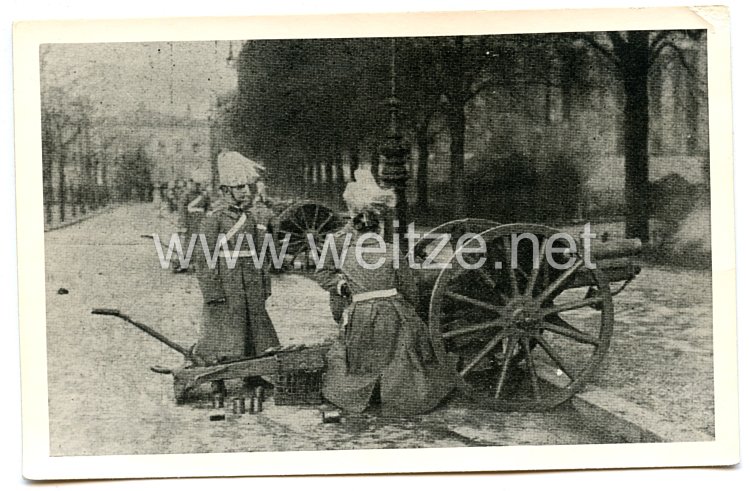
German Empire 1871-1918 Postcard Salute Firing Garde-Feld-Artillerie-Regiment

Circa 1910. 14 x 8.9 cm. Condition 2.
429246
15,00

German Empire 1871-1918 Postcard Salute Firing Garde-Feld-Artillerie-Regiment

This historical postcard from around 1910 documents a salute firing ceremony of the Garde-Feld-Artillerie-Regiment (Guards Field Artillery Regiment) and offers a fascinating glimpse into the military traditions of the German Empire (1871-1918). Such postcards were extraordinarily popular during the Wilhelmine era and reflected the deep integration of the military into German society.

The Garde-Feld-Artillerie-Regiment belonged to the Prussian Guards, the elite formation of the imperial army. The Guards artillery comprised several regiments that reported directly to the Kaiser and played a prominent role in ceremonial occasions as well as in wartime. The regiment was stationed in Potsdam, the garrison town in immediate proximity to the imperial capital Berlin, where the Kaiser's residence was also located.

Salute firings were ceremonial honors fired during significant state occasions, imperial birthdays, throne jubilees, or when receiving high-ranking state guests. The number of salute rounds corresponded to the rank of the person being honored: the Kaiser received 31 shots, members of the imperial family 21 shots, and foreign monarchs according to their status. This tradition originated from maritime customs and was practiced by all European armies.

The picture postcard as a medium experienced its golden age between 1890 and 1914. Military postcards were particularly popular and formed their own category within postcard production. They showed troops on parade, during maneuvers, in their quarters, or at ceremonial occasions. For soldiers, they were a way to express pride in their unit and maintain contact with family. For the civilian population, they documented the military splendor of the German Empire.

Wilhelmine society was strongly militaristic in character. The officer corps enjoyed high social prestige, and military service was considered an honorable duty. Kaiser Wilhelm II (1888-1918) frequently appeared in uniform and actively promoted militarism. The Guards regiments embodied this military spirit in a special way and were always present at parades and state receptions.

The field artillery differed from foot artillery through its greater mobility. It was equipped with field guns drawn by horses that were meant to support the infantry in battle. Around 1910, the German field artillery possessed modern guns such as the Feldkanone 96 n.A. (new model), a 77mm quick-firing gun with recoil mechanism that was among the most advanced weapons of its time.

Postcards like this were produced in large editions by specialized publishers. They were sold at parades, in barracks, or through normal postcard retail. Collectors acquired them systematically, and extensive albums with military motifs were created. The cards also served patriotic education and the population's identification with the military.

The years around 1910 were a time of growing international tensions. The European powers were arming themselves, and the German Empire under Admiral von Tirpitz massively expanded its fleet, leading to rivalries with Great Britain. Artillery was modernized and strengthened, maneuvers became larger and more realistic. The seemingly peaceful salute firings and parades concealed preparation for a great war that would break out in 1914.

After World War I and the collapse of the monarchy in 1918, such postcards lost their immediate function but gained historical value. They document a vanished world and are today important sources for the military, social, and cultural history of the German Empire. For collectors and historians, they offer insights into the visual culture and social significance of the military in the Wilhelmine era.

r