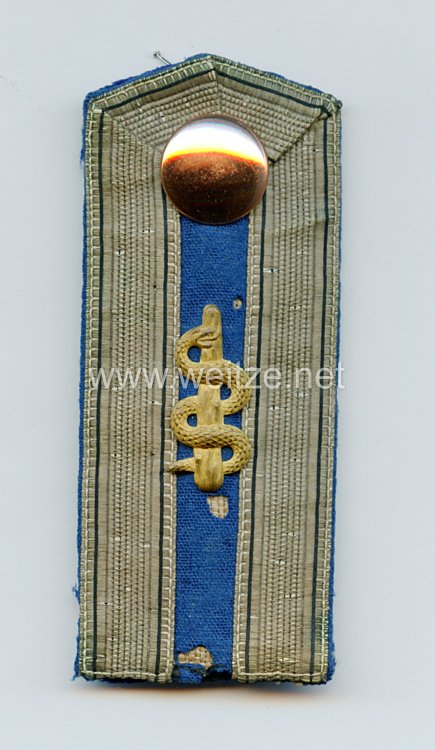
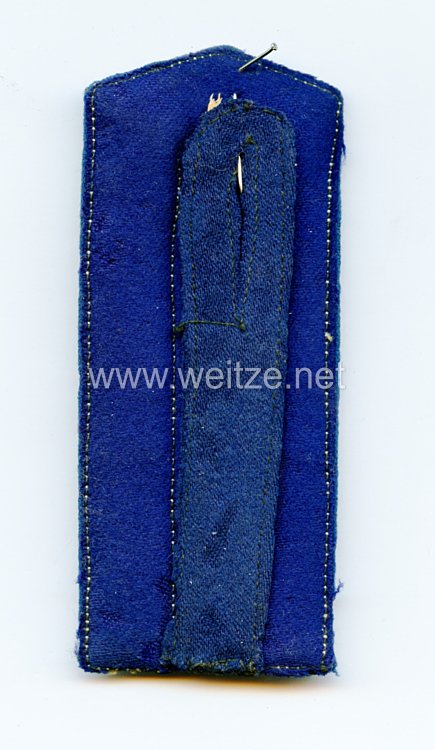
Prussia Single Shoulder Strap for a Junior Medical Officer (Unterarzt)
The Prussian single shoulder board for an Unterarzt (Junior Surgeon) from around 1910 represents an important aspect of military medical rank insignia in the German Empire. This epaulette embodies the carefully structured hierarchy of the Prussian Medical Corps and the special position of military physicians within the Imperial Army.
The Prussian Medical Corps had developed into a highly professionalized organization during the 19th century. The rank of Unterarzt was an entry-level position for academically trained physicians in the military medical service. In terms of rank, the Unterarzt corresponded approximately to a first lieutenant in line troops and stood at the beginning of a possible career that could lead to the position of Surgeon General.
The construction of this shoulder board followed the precise regulations of Prussian Army uniform regulations. The blue cloth base was characteristic of the Medical Corps and clearly distinguished medical personnel from other branches of service. Blue had been the service color of medical personnel in the Prussian Army since the mid-19th century and was also adopted by other German states.
The silver braids with black inlays were distinctive for officer ranks in the Medical Corps. The braiding followed an established pattern that indicated the exact rank through the number and arrangement of braid windings. The combination of silver and black was typical for Prussian officer insignia and reflected the Brandenburg-Prussian colors.
The most significant element of this shoulder board is the golden Rod of Asclepius, the universal symbol of medicine. The Rod of Asclepius, named after the Greek god of healing Asklepios, consists of a staff with a snake entwined around it. This ancient symbol became the internationally recognized sign for the medical profession in the 19th century. In the Prussian Army, the Rod of Asclepius was executed in gold on the shoulder boards of medical officers to emphasize their academic education and special status.
The distinction between physicians of different ranks was made through the precise design of the braids and additional rank insignia. An Unterarzt, as a junior medical officer, wore a relatively simple design, while higher ranks such as Oberarzt (Senior Surgeon), Stabsarzt (Staff Surgeon), or Generalarzt (Surgeon General) wore more elaborate versions with additional stars or other rank insignia.
Around 1910, the dating of this object, the German Empire was in a phase of intensive military buildup. The Medical Corps was continuously expanded, as the experiences of modern wars – particularly the Franco-Prussian War of 1870/71 – had underscored the importance of well-organized military medicine. The Geneva Conventions, first signed in 1864 and revised in 1906, had internationally regulated the role and protection of medical personnel in wartime.
The Medical Corps of the Prussian Army enjoyed high prestige. The training of military physicians took place at renowned universities and in special military medical academies such as the Kaiser Wilhelm Academy for Military Medical Education in Berlin, which was founded in 1895. Unterärzte had to have completed a full medical degree and passed the state examination.
The manner of wearing such shoulder boards was precisely regulated. They were attached to the uniform at the shoulder through the loop fastened to the underside. Different versions could be prescribed for various uniform types – dress coat, greatcoat, or field uniform.
The mentioned moth holes in the described specimen testify to the organic nature of the materials used and the age of the object. Wool and silk, from which such uniform pieces were made, were susceptible to insect damage if not properly stored.
With the end of World War I in 1918 and the collapse of the monarchy, these rank insignia lost their official function. The Reichswehr of the Weimar Republic introduced a new system, and the magnificent shoulder boards of the Imperial Army became historical witnesses of a vanished era.
Today, such shoulder boards are sought-after collector's items that provide important insights into uniform studies, military history, and the development of medical services. They document the professionalization of military medicine and the complex hierarchy of the Prussian-German armed forces in the age of imperialism.