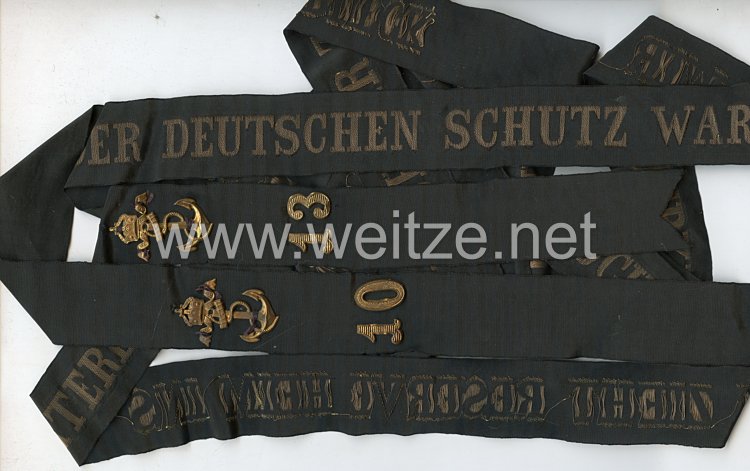
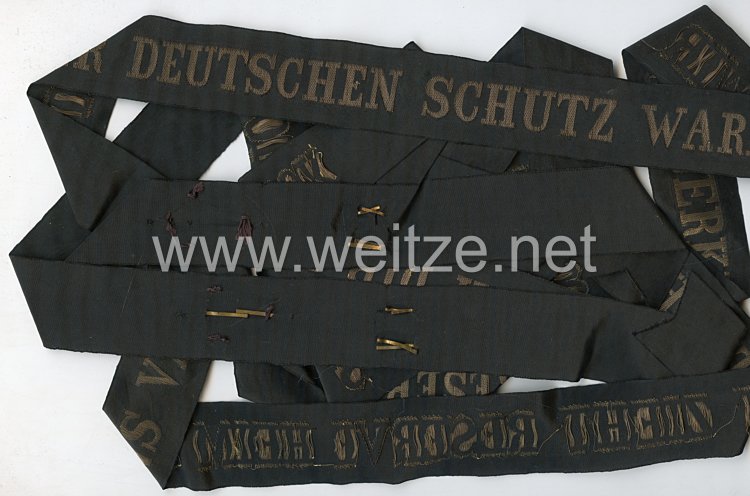
Cap Tally "Reserve S.M.S. Rheinland" in Gold

Length 370 cm, metal thread woven, worn condition. Woven year numerals 11 and 14 at the ends. Condition 2

O golden freedom of youth highest joy we often longed to return to you.
The hour has come the war game is over as reservists we march home to the fatherland.

306945
220,00

Cap Tally "Reserve S.M.S. Rheinland" in Gold

The Reserve Cap Ribbon of S.M.S. Rheinland in gold represents a fascinating testament to German naval history from the era of World War I. These golden metal ribbons, worn by reservists of the Imperial German Navy, combined practical function with symbolic significance and document the maritime tradition of the German Empire.

S.M.S. Rheinland was a battleship of the Nassau class, built between 1908 and 1910 at the AG Vulcan shipyard in Stettin. The ship was commissioned on April 1, 1910, and was one of four ships of this class that represented Germany's first dreadnought battleships. With a displacement of approximately 18,900 tons and an armament of twelve 28-cm guns, the Rheinland represented the technological pinnacle of German battleship construction of her time.

The woven dates 11 and 14 on this ribbon mark the wearer's service period: 1911 presumably indicates the beginning of active service, while 1914 represents the fateful year of the war's outbreak. This temporal marking was typical for reservist ribbons and served as a personal memento of completed service time.

The verses woven into the ribbon reveal the ambivalent attitude of German sailors toward their service: “O golden freedom of youth, highest happiness, we often longed to return to you. The hour has come, the war game is over, as reservists we return to our homeland.” These lines reflect the longing for the end of service time and return to civilian life – an irony of history, as 1914 marked not the end but the beginning of a devastating four-year war.

The production of such gold cap ribbons was carried out by specialized weaving mills that processed metal threads – usually gilded or brass-colored wires – with elaborate handwork. The length of 370 cm was standardized so that the ribbon could be wrapped twice around the sailor's cap, with the ends bearing the dates hanging visibly. These golden ribbons were significantly more expensive than the regular black ribbons of active crew members and were usually privately purchased.

S.M.S. Rheinland herself participated in several significant operations during World War I. The ship was stationed in the II Division of the I Squadron of the High Seas Fleet and participated in various sorties into the North Sea. Most notably, she took part in the Battle of Jutland on May 31 and June 1, 1916, the largest naval battle of World War I. During this battle, Rheinland received several hits but was able to maintain her position and return to base.

Reservists of the Imperial Navy played a crucial role in warfare. While active crew members formed the core complement, reservists were called up at the outbreak of war to bring ship crews to full strength. Many of these men had already completed their two-year active service period and had returned to civilian life when they were recalled in 1914.

The tradition of cap ribbons in the German Navy dates back to the 19th century. While active sailors wore black ribbons with gold inscription of the ship's name, reservists developed the custom of having more elaborate, often completely gold or silver ribbons made. These served not only as decorative items but also as mementos and identifying marks of service time shared together.

After the end of World War I, S.M.S. Rheinland was handed over to the Allies according to the provisions of the Treaty of Versailles. The ship was scrapped in England in 1920, marking the end of the era of German dreadnoughts. The cap ribbons, however, survived as material witnesses of this epoch and were preserved by veterans as valuable mementos.

Today, such reservist cap ribbons are sought-after collector's items that provide important insights into the social and military history of the German Empire. They document not only the technical development of the navy but also the personal fates of the men who served on these ships. The preserved specimens in public and private collections help historians reconstruct and understand the everyday culture and mentality of Imperial German naval soldiers.