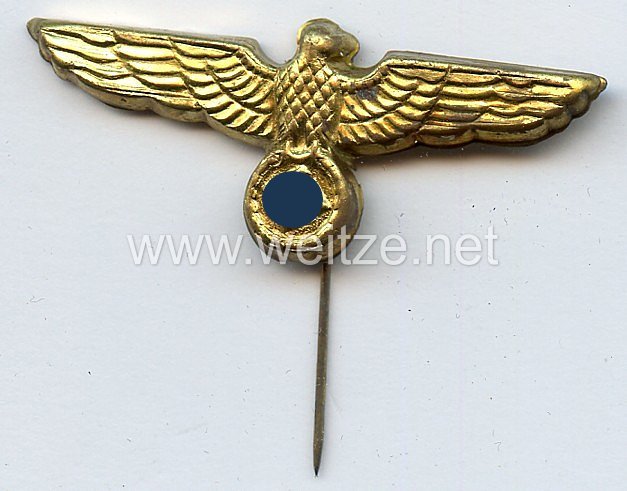
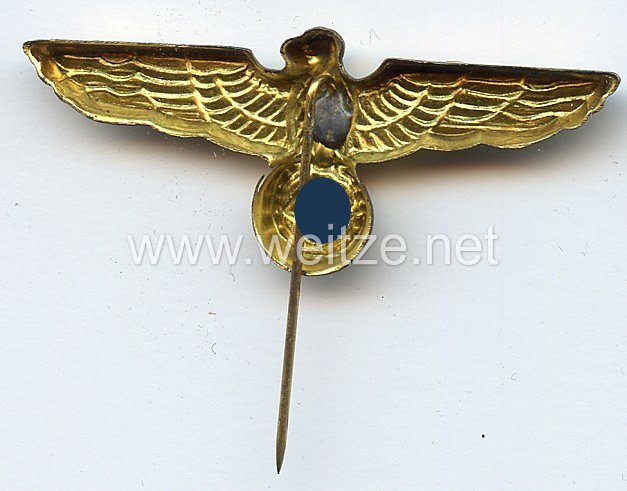
Kriegsmarine Cap Eagle for Visor Cap

small version, on long pin fastener, condition 2.
314245
50,00

Kriegsmarine Cap Eagle for Visor Cap

The Kriegsmarine cap eagle for the peaked cap (Tellermütze) represents a characteristic insignia of the German Navy during the Second World War. These small metal badges were essential components of uniform regulations and embodied both maritime tradition and National Socialist symbolism of that era.

The Kriegsmarine, officially founded on June 1, 1935, as the successor to the Reichsmarine, introduced comprehensive uniform regulations that were detailed in the dress regulations (Anzugordnungen). The cap eagle formed a central element of headgear for officers, non-commissioned officers, and enlisted men. The peaked cap (Tellermütze), also known as the visor cap, was the official headgear for shore leave and representative occasions.

The design of the cap eagle followed strict specifications: The Reich Eagle with spread wings held an oak wreath in its talons, in whose center the swastika was placed. This combination of traditional German symbol and National Socialist emblem was prescribed for all Wehrmacht branches, though details varied between different service arms.

The small version of the cap eagle was specifically designated for certain ranks and cap types. While higher-ranking officers often wore larger, elaborately crafted eagles, non-commissioned officers and enlisted men used smaller versions. The attachment was achieved by means of a long pin that was pushed through the cap fabric and secured on the reverse side by a split pin or counter-plate.

The production of these badges was carried out by various state-approved manufacturers. The eagles were mostly made from zinc die-cast or aluminum and subsequently silver-plated or lacquered. Higher-quality versions for officers could also be made from non-ferrous metal. Each manufacturer had its own production characteristics, which today helps collectors with identification and dating.

The manner of wearing was precisely regulated in the Dress Regulations for the Kriegsmarine of September 1, 1939, as well as in later supplements. The eagle had to be attached centrally above the visor, with the exact distance from the upper cap edge prescribed. This standardization was intended to ensure a uniform appearance of the Navy.

During the course of the war, material shortages occurred that also affected the production of cap eagles. Later wartime productions often showed simplified execution with fewer details and inferior materials. Nevertheless, the basic form of the badge remained largely unchanged until the end of the war in May 1945.

After the unconditional surrender, the wearing of all National Socialist symbols was prohibited by Directive No. 30 of the Allied Control Council. Many of these badges were destroyed or had their swastikas removed. Surviving examples ended up as souvenirs in the hands of Allied soldiers or were kept by German veterans.

Today, such cap eagles represent important contemporary historical documents that contribute to the study of uniform history and military history in museums and collections. The condition of such objects is evaluated in collector circles according to a scale from 1 (mint) to 5 (heavily damaged), with condition 2 indicating a well-preserved example with slight signs of use.

Scientific engagement with such military-historical objects serves the understanding of uniform history, the organizational structure of the Wehrmacht, and the visual propaganda of the Nazi regime. The historically critical contextualization of these objects within their origin context is always of utmost importance.