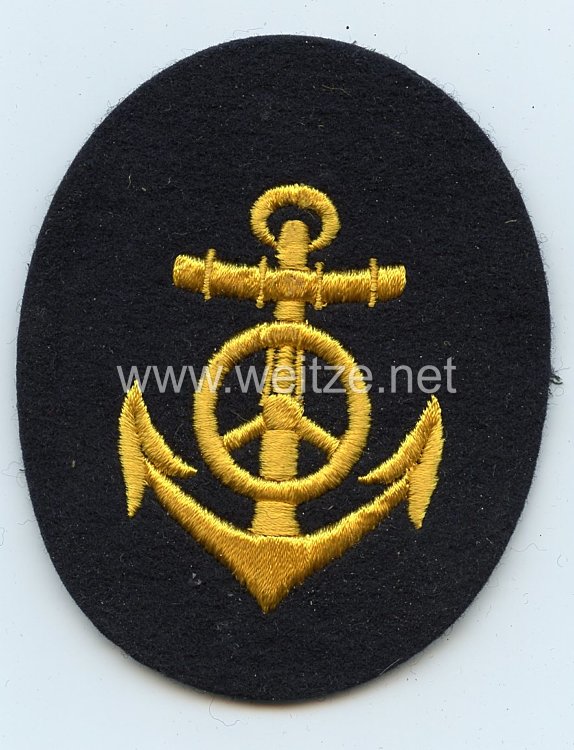
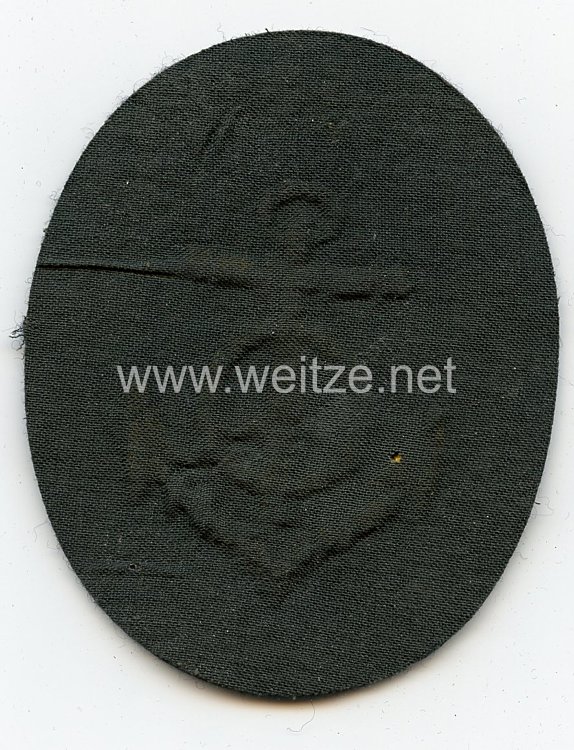
Kriegsmarine Sleeve Insignia for a Kraftfahrmaat (Motor Transport Petty Officer)

for the blue jumper, condition 2.
376845
10,00

Kriegsmarine Sleeve Insignia for a Kraftfahrmaat (Motor Transport Petty Officer)

The Kriegsmarine sleeve insignia for a Kraftfahrmaat (Motor Vehicle Petty Officer) represents a fascinating example of the complex rank insignia and specialization system developed in the German Kriegsmarine during World War II. This particular badge was worn on the blue blouse, the everyday service uniform of enlisted ranks in the Kriegsmarine.

The Kriegsmarine introduced a comprehensive system of career badges to identify the various technical specializations within its forces. The Kraftfahrmaat was a petty officer (Maat rank) responsible for operating, maintaining, and servicing motor vehicles. This specialization became particularly important as the Navy increasingly required motorized transport for land operations, harbor operations, and supply of coastal fortifications.

The Kriegsmarine rank structure distinguished between enlisted men, petty officers, and commissioned officers. The Maat rank corresponded roughly to the petty officer of the Wehrmacht and was an important lower-level leadership grade. Maate typically had several years of service and carried considerable responsibility for training younger sailors and performing specialized duties.

The sleeve badge was worn on the left upper arm according to the Kriegsmarine dress regulations. These badges were typically embroidered and displayed symbolic representations indicating the respective specialization. For motor vehicle specialists, this was usually an automobile or wheel symbol, executed in the characteristic yellow color of naval insignia on a dark blue background.

The blue blouse (officially designated as working dress or service dress) was the standard garment for daily duty ashore and in harbor facilities. Unlike the white summer uniform or the dark blue parade uniform, the blue blouse was designed for practical work. It consisted of sturdy, navy blue cotton fabric and was worn with a garrison cap.

The introduction of specialized career badges in the Kriegsmarine began during the Weimar Republic and was systematically expanded after 1935, when Germany massively expanded its navy as part of rearmament. The Naval Motor Transport Troops gained particular importance through the establishment of naval bases, administration of large harbor areas, and support of naval units ashore, especially in occupied territories during the war.

Kraftfahrmaate were responsible not only for passenger cars and trucks but often also for specialized vehicles such as tanker trucks, workshop vehicles, and other technical vehicles essential for naval operations. Their training included mechanics, vehicle operation, and often administrative knowledge for managing vehicle pools.

The badge in Condition 2 indicates good preservation, with possibly slight signs of wear typical for worn uniform items. Such badges were either delivered already sewn onto the uniform or had to be attached by the wearers themselves or by uniform tailors.

After the war ended in 1945, all insignia and uniforms of the Wehrmacht and Kriegsmarine were banned by the Allies. Today, these objects represent important historical evidence that documents the structure and organization of German armed forces during this period in museums and collections. They serve historical research and education about this significant, albeit tragic, epoch of German and European history.

r