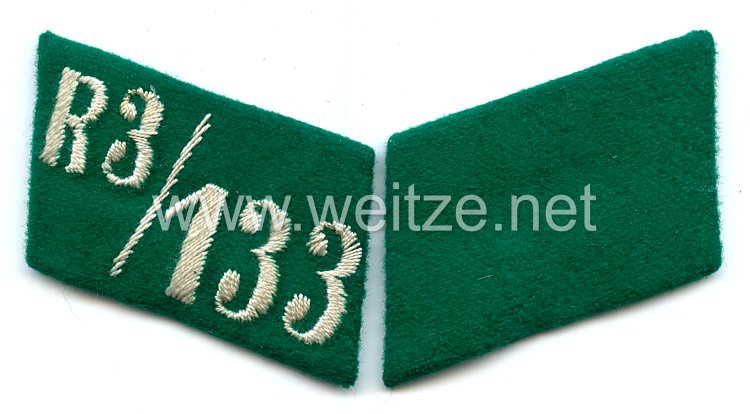
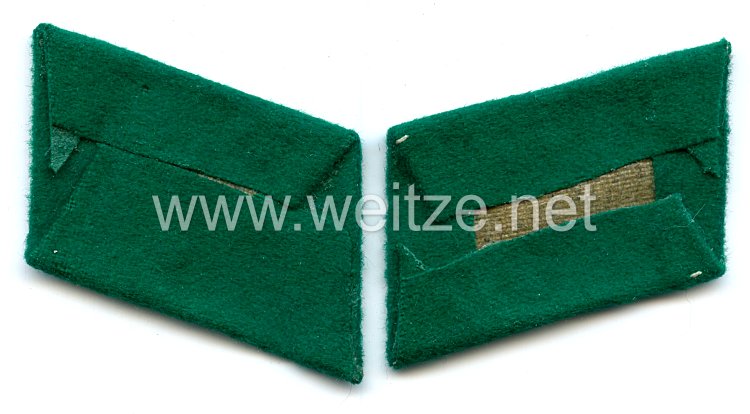
SA Pair of Collar Tabs for Enlisted Men SA-Gruppe Sachsen Reserve-Sturm 3 of Standarte 133
These SA collar tabs represent significant evidence of the organizational structure of the Sturmabteilung (SA) during the early phase of the National Socialist regime. This pair of enlisted men's collar tabs belonged to SA-Gruppe Sachsen, specifically to Reserve-Sturm 3 of Standarte 133 based in Zwickau, dating to approximately 1933.
The SA, founded in 1921, developed into a paramilitary organization of the NSDAP with a complex system of rank insignia and uniforms. After the seizure of power in 1933, the SA experienced massive expansion, leading to the establishment of numerous reserve units. SA-Gruppe Sachsen was one of the regional divisions encompassing the territory of the Free State of Saxony, subdivided into several Standarten.
Standarte 133 was one of these local formations, with Standarten typically comprising several Sturmbanne organized according to geographical considerations. The term Reserve-Sturm designates a unit that did not belong to the active core division but consisted of reservists or later-joining members. The number 3 identifies the specific Storm unit within the Standarte.
The technical execution of these collar tabs corresponds to the regulations of early SA uniform directives. The green cloth base color was characteristic of SA-Gruppe Sachsen. The SA collar tab color system followed a regional scheme whereby different SA groups could be identified by distinct base colors. The white embroidery on green background was the designated color combination for Saxon units.
Collar tabs were worn in pairs, one on each side of the brown SA shirt. For enlisted men, the insignia were typically designed more simply than those for leaders. The embroidery typically displayed the Storm number or other identifying features of the unit. These insignia served not only for identification but were also an expression of the SA's rigid hierarchical organization.
The location of Zwickau was a significant center of SA activities in Saxony during the early NS period. The city, known for its industry and labor movement, was the scene of intense political conflicts during the Weimar Republic. The SA played a central role here in the NSDAP's consolidation of power at the local level.
The year 1933 marks a turning point in SA history. After Hitler's appointment as Reich Chancellor in January 1933, the SA became an instrument of power consolidation. Its membership grew explosively from approximately 400,000 at the end of 1932 to over 4 million by 1934. This rapid expansion led to the establishment of numerous new units, including Reserve-Sturms like the one represented here.
The preserved moth damage is characteristic of textiles from this period and attests to the authentic age of the object. Such damage results from decades of storage under non-optimal conservation conditions. The indicated condition documents the typical aging process of SA uniform parts made from natural fibers.
The historical significance of such collar tabs lies in their function as material witnesses to the NS organizational structure at the local level. They document the comprehensive presence of the SA throughout the German Reich and illustrate the sophisticated system of rank insignia and unit identifications. For military-historical research, they offer insights into the uniforming practices and organizational development of the SA during its peak phase before the Röhm Putsch of 1934.
After the events of June 30, 1934, when the SA leadership was eliminated, the organization lost considerable importance. Many units were dissolved or restructured, making objects from the pre-1934 period particularly valuable for historical understanding. These collar tabs thus represent a specific, time-limited phase of SA history spanning only about one year.
From a museum and scholarly perspective, such uniform parts serve as primary sources for reconstructing the SA organization and its regional structure. They complement written sources and photographic material, enabling a more comprehensive understanding of National Socialism's paramilitary structures at the local level.