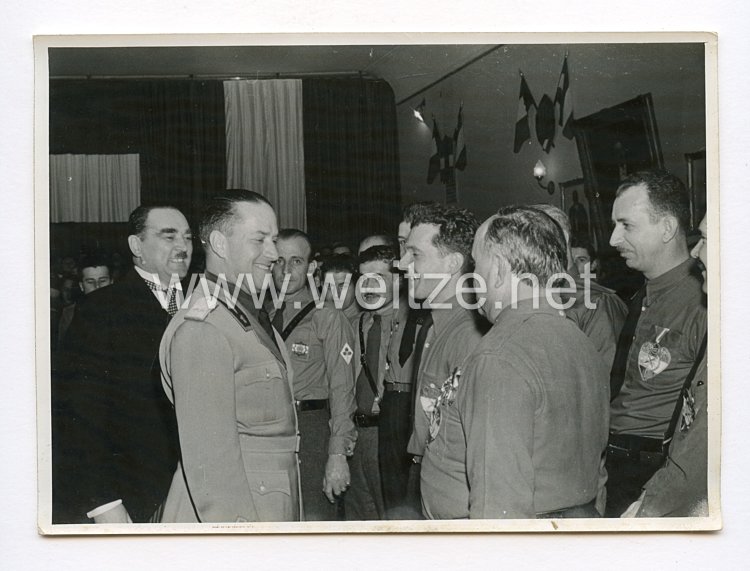
Third Reich Press Photograph. Galeazzo Ciano with Italian Fascists
This press photograph from the Third Reich era depicting Galeazzo Ciano accompanied by Italian Fascists represents a fascinating testament to German-Italian relations during the National Socialist period. Such press photographs formed an essential component of the propaganda machinery of both fascist regimes and document the intensive diplomatic and ideological cooperation between Nazi Germany and Fascist Italy.
Galeazzo Ciano (1903-1944) was one of the key figures of Italian Fascism. As the son-in-law of Benito Mussolini, he served as Italian Foreign Minister from 1936 to 1943 and played a central role in relations between the Axis powers. Ciano was instrumental in drafting the Pact of Steel of 1939, the military alliance between Germany and Italy that formally bound the two fascist powers together.
Press photographs of this type were distributed by the Deutsches Nachrichtenbüro (DNB) and other official press agencies of the Third Reich. The DNB, founded in 1933, was the central National Socialist news agency and controlled photographic reporting throughout the Reich. Photographs of diplomatic meetings, state visits, and official ceremonies served to demonstrate the strength and unity of the Axis powers and to convince the population of the regime's legitimacy.
German-Italian relations intensified after Mussolini's rise to power in 1922 and especially after Hitler's assumption of power in 1933. Despite initial tensions, particularly regarding the Austrian question, a close partnership developed. The Axis Agreement of October 1936, the so-called “Berlin-Rome Axis,” marked the beginning of formal cooperation. This was further consolidated by the Pact of Steel in May 1939, which established a comprehensive military and political alliance.
Ciano himself was a contradictory figure. Although initially a convinced Fascist, he increasingly developed doubts about Germany's war course. His diaries, published after the war, offer unique insights into the internal power struggles of Fascist Italy and the complex dynamics of Axis relations. They document his growing disillusionment with the German alliance, especially after Italy became embroiled in catastrophic military campaigns.
The use of press photographs was an essential element of the National Socialist propaganda strategy. Under the direction of Joseph Goebbels and his Reich Ministry of Public Enlightenment and Propaganda, images were carefully controlled and distributed. Photographers had to be members of the Reichspressekammer (Reich Press Chamber), and all images were subject to censorship. Photos of foreign dignitaries and allies were intended to suggest international recognition of the regime.
The reverse side of such press photographs typically contained detailed descriptions in German, often with stamps from the issuing agency, dates, and sometimes censorship marks. These inscriptions are invaluable to historians as they provide context about the occasion, the people depicted, and the intended use of the photograph.
The format of approximately 13 x 18 cm corresponds to the standard dimensions for press photographs of that era. This size was practical for archiving and reproduction in newspapers and magazines. The photos were developed on special photographic paper suitable for mass production.
After Mussolini's fall in July 1943 and Italy's capitulation in September of the same year, Ciano's fate took a dramatic turn. He was among those members of the Grand Council of Fascism who had voted for Mussolini's deposition. After his arrest by the German SS and transfer to the Italian Social Republic (Mussolini's puppet state in northern Italy), he was executed in Verona in January 1944 for high treason.
Today, such press photographs are important historical documents. They serve researchers, historians, and museums as primary sources for understanding the visual propaganda of the Third Reich and the Axis powers. Collectors and institutions preserve these materials as testimonies to a dark period in European history. The used condition of such photos – with possible archive stamps, creases, or inscriptions – often increases their documentary value, as these signs of use demonstrate authentic employment in the contemporary press.