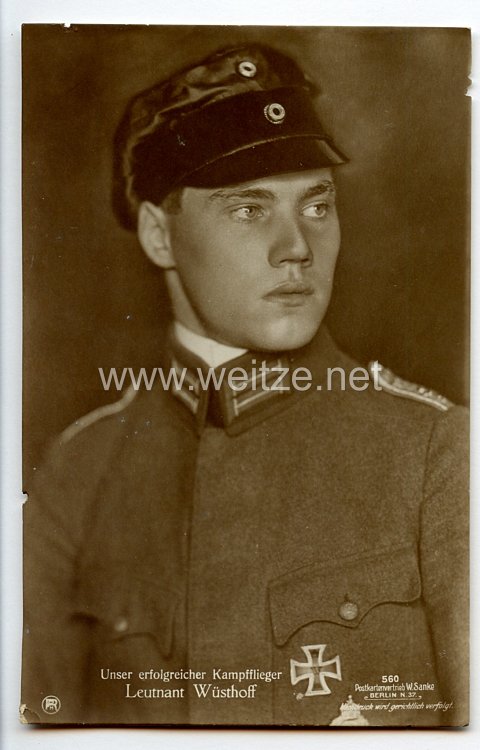
World War I Aviation - Photo Postcard - German Flying Ace "Lieutenant Wüsthoff"

on Sanke card No. 560, unmailed. Damaged, condition 2-.
330344
20,00

World War I Aviation - Photo Postcard - German Flying Ace "Lieutenant Wüsthoff"

The Sanke postcards of World War I represent a significant cultural and propaganda phenomenon of German warfare between 1914 and 1918. The Berlin firm Photochemie, operating under the name Sanke, produced an extensive series of photographic postcards that glorified German military heroes and contributed to maintaining morale on the home front.

Lieutenant Kurt Wüsthoff (1897-1926) was one of the most famous German fighter pilots of World War I and was immortalized on Sanke card No. 560. He was among the successful pilots of the Imperial Flying Corps and achieved 27 confirmed aerial victories during the war, earning him the Pour le Mérite, Prussia's highest military order. Wüsthoff served in Jagdstaffel 4 and later in Jagdstaffel 15, where he distinguished himself through exceptional flying skills and courage.

The Sanke card series comprised several hundred different designs and focused particularly on the new branch of the Flying Corps. The air force was still a young military innovation during World War I, and fighter pilots were quickly stylized as modern knights of the air. This romanticization served not only propaganda purposes but also reflected public fascination with the technological developments in warfare.

The photographic postcards by Sanke followed a standardized format: they typically showed portrait photographs of the pilots in uniform, often displaying their medals and decorations. The cards were professionally produced and of high quality, making them coveted collector's items. The numbering of the cards, such as No. 560, enables precise cataloging and dating of these historical documents today.

In the context of war propaganda, these postcards fulfilled multiple functions. They served hero worship, strengthened national identity, and were meant to maintain the population's willingness to sacrifice. Simultaneously, they were commercial products purchased by collectors and patriots. The fact that this card is unused suggests it may have been acquired and preserved as a collector's item rather than serving as an actual means of communication.

The German Flying Corps evolved during World War I from a reconnaissance unit to an independent combat formation. Fighter squadrons were systematically established from 1916 onwards, and pilots like Wüsthoff became national celebrities. The most famous among them, such as Manfred von Richthofen, Max Immelmann, or Oswald Boelcke, achieved legendary status that extended far beyond their military accomplishments.

From a collector's perspective, Sanke cards today are significant military-historical documents. The preservation and condition of such cards vary considerably, as they were originally designed as functional items not intended for eternity. Damage from storage, moisture, or handling is common and affects both the historical and monetary value of these objects.

The culture of field postcards during World War I was an essential component of communication between the front and home. Millions of cards were sent, with the propagandistic Sanke cards representing a special category. They combined personal communication with patriotic symbolism and contributed to constructing a heroic narrative that often obscured the reality of industrialized mass warfare.

Kurt Wüsthoff survived the war but died in a flying accident in 1926, underscoring the dangerous life of early aviation even in peacetime. His legacy, captured on cards like this one, is part of the complex memory culture surrounding World War I and the development of military aviation.

r