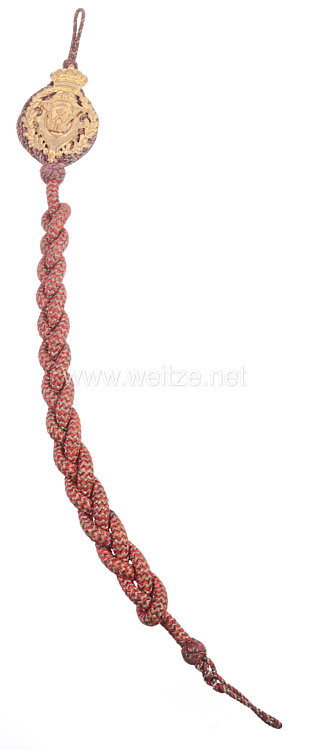
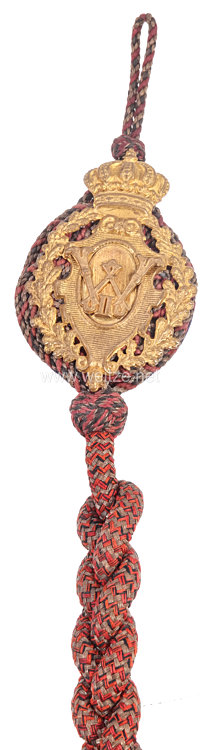
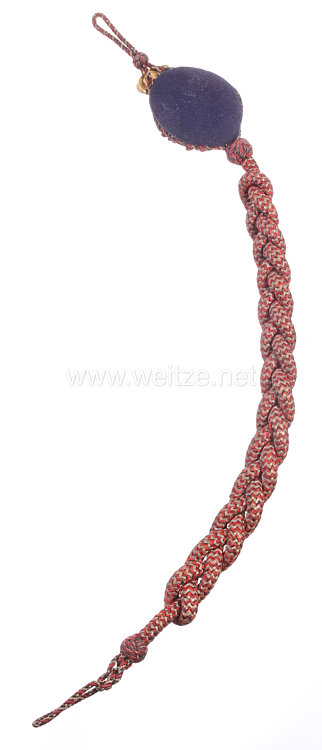
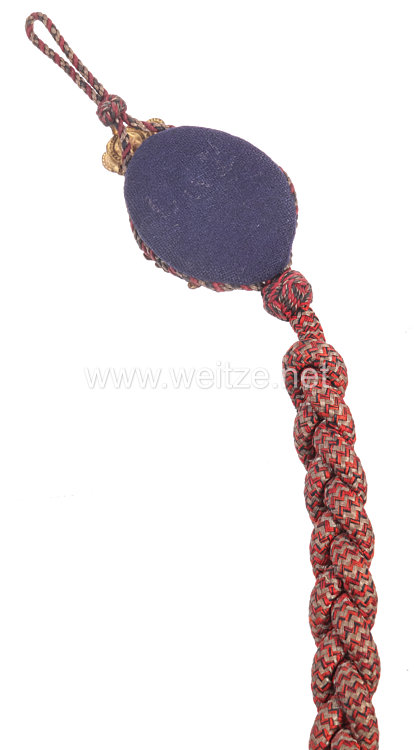
Prussian Marksmanship Lanyard 5th Class for Infantry
The Prussian shooting cord of the 5th grade for infantry from around 1900 represents a significant element of the military awards system in the German Empire. This decoration testifies to the high value placed on marksmanship within the Prussian army and documents the systematic promotion of military achievement during the Wilhelmine era.
The Prussian shooting cord system was officially introduced by the Supreme Cabinet Order of July 6, 1895, and represented a development of earlier awards for shooting proficiency. The introduction of this graduated decoration occurred at a time when the technical modernization of infantry armament – particularly through the introduction of the Gewehr 88 and later the Gewehr 98 – necessitated considerable improvement in shooting training.
The shooting cord was awarded in six different grades, with the 5th grade already documenting considerable shooting achievement. The grades were hierarchically ordered: the first grade represented the lowest decoration, while the sixth grade signified the highest attainable award for shooting performance among enlisted ranks. Each grade required passing demanding shooting tests over several years, demonstrating the bearer's consistency and continuous performance.
The present shooting cord is braided in silver and Reich colors, which was typical for higher grades. The Reich colors of black-white-red symbolized allegiance to the German Empire, while the silver emphasized the military character of the decoration. The gilded overlay with the ruler's monogram – probably the interlaced “W” for Kaiser Wilhelm II (reigned 1888-1918) – lent additional dignity to the award and documented the direct connection to imperial authority.
The shooting cord was worn on the uniform on the right sleeve or shoulder strap, making it visible to all. It served not only as a personal decoration but also as an incentive for other soldiers to improve their marksmanship. In the hierarchically structured Prussian army, wearing a shooting cord of higher grade carried considerable prestige and could positively influence one's military career.
The award criteria for the various grades were strictly regulated. For the 5th grade, a soldier had to consistently deliver above-average shooting performance over several years. The tests comprised various shooting exercises at different ranges, both in individual and group shooting. Evaluation followed a point system precisely defined in military regulations.
The craftsmanship of such shooting cords was remarkable. They were manufactured by specialized military equipment manufacturers who often worked for the army over generations. The braiding required considerable skill, and the integration of the Reich colors and gilded appliqués had to precisely conform to military regulations. Each shooting cord was a unique piece of handcrafted work.
In the context of Prussian-German military history, the shooting cord documents the professionalization of the army in the late 19th century. The increasing importance of firepower in modern combat made well-trained marksmen indispensable. The shooting cord was part of a comprehensive system for performance motivation that also included other decorations such as service badges, commemorative medals, and merit crosses.
After the end of World War I and the collapse of the monarchy in 1918, the imperial shooting cord lost its official significance. In the Reichswehr and later in the Wehrmacht, new award systems were introduced that nevertheless built upon the traditions of the Empire. Today, such shooting cords are sought-after collector's items that document an important aspect of German military history and provide insight into the training system and culture of honor of the imperial army.