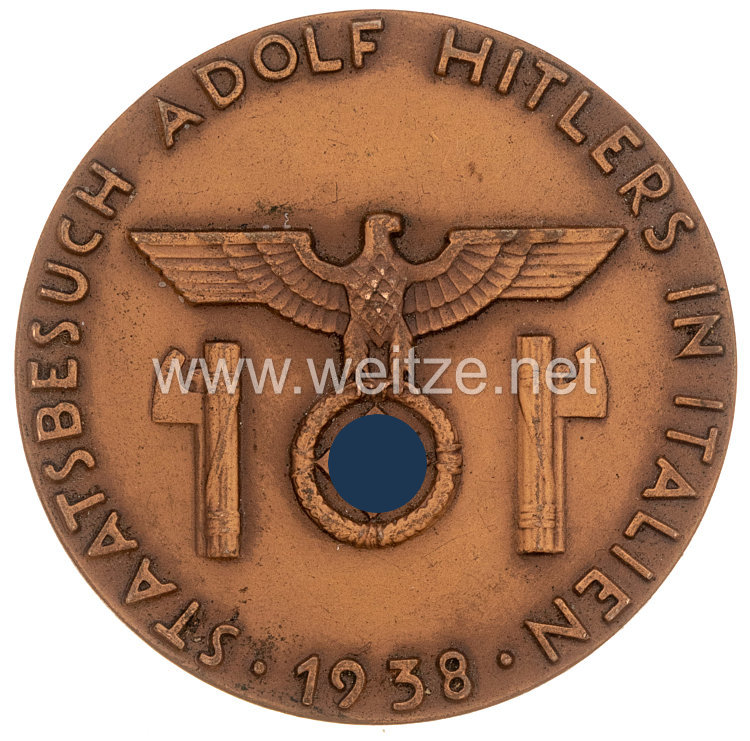
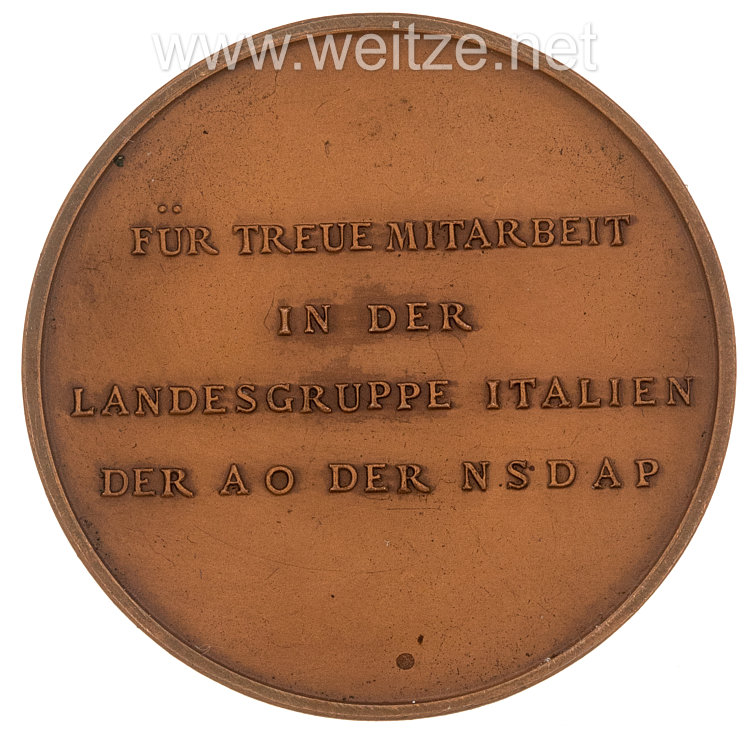
NSDAP Non-Wearable Award Plaque of the NSDAP AO Landesgruppe Italien for “Adolf Hitler's State Visit to Italy 1938”
This non-wearable commemorative plaque of the NSDAP Foreign Organization (AO) Country Group Italy represents a significant chapter in German-Italian relations during the National Socialist era. The plaque was created to commemorate Adolf Hitler's state visit to Italy in May 1938, an event that marked the pinnacle of Axis policy between the German Reich and Fascist Italy under Benito Mussolini.
The state visit from May 3-9, 1938 was of extraordinary political and propaganda significance. Hitler visited Rome, Naples, and Florence, where elaborate military parades, festivities, and cultural events were staged in his honor. This visit followed Mussolini's trip to Germany in September 1937 and was intended to further solidify the Berlin-Rome Axis, which had been proclaimed in October 1936. The two fascist regimes used this occasion to demonstrate their political and military alliance.
The Foreign Organization of the NSDAP was founded in 1931 and led from 1934 by Ernst Wilhelm Bohle. The AO was responsible for all German citizens living abroad, organizing them into so-called Country Groups (Landesgruppen). The Country Group Italy was among the most important of these organizations, as Italy was the German Reich's most significant ally. By 1939, the AO encompassed approximately 50,000 members worldwide in over 600 local groups across more than 80 countries.
The obverse of this plaque displays the official badge for guests of the state visit: a large imperial eagle with two fasces (lictor's bundles). This symbolism combines National Socialist and Fascist emblems, visually representing the political axis between both regimes. The fasces, an ancient Roman symbol of magisterial authority, was the central symbol of Italian Fascism. The inscription “Staatsbesuch Adolf Hitlers in Italien 1938” (State Visit of Adolf Hitler to Italy 1938) clearly dates the object.
Particularly noteworthy is the reverse inscription “Für treue Mitarbeit in der Landesgruppe Italien der AO der NSDAP” (For Loyal Service in the Country Group Italy of the AO of the NSDAP). This makes clear that this plaque was not conceived as an official state gift, but as an internal award of the NSDAP Foreign Organization. It was likely presented to deserving party members who had distinguished themselves in organizing and executing the state visit or in the general work of the Country Group.
As a non-wearable decoration, this plaque belongs to the category of commemorative and honorary insignia that were not worn on uniforms but served as collectibles or mementos. Such plaques were common during the NS era and document the regime's extensive awards practice, which rewarded loyalty through a complex system of honors and manifested hierarchy within party organizations.
The bronze finish and 45mm diameter correspond to typical specifications for such plaques from this period. Production was likely carried out by specialized firms that manufactured decorations for the NSDAP and its affiliated organizations. The quality and execution of such objects varied considerably depending on the significance of the award and available resources.
The historical context of the 1938 state visit is of particular importance: just two months earlier, the German Reich had annexed Austria (the so-called “Anschluss” in March 1938), which Mussolini had tacitly accepted. The state visit was also meant to acknowledge Italian consent to this expansion. Simultaneously, Europe was already heading toward the Sudeten Crisis, which would culminate in the Munich Agreement in September 1938.
Objects like this plaque are today important historical sources for researching the NS Foreign Organization, German-Italian relations, and the everyday history of National Socialism. They document the mechanisms of political penetration of German communities abroad and the instrumentalization of awards to secure loyalty. At the same time, they are materialized testimonies of a criminal regime and its alliance politics that ultimately led to World War II and immeasurable suffering.
The study of such artifacts provides valuable insights into the organizational structure and functioning of Nazi institutions abroad, the cult of personality surrounding Hitler, and the ways in which totalitarian regimes used symbolic objects to create bonds of loyalty and ideological commitment among their followers in foreign countries.