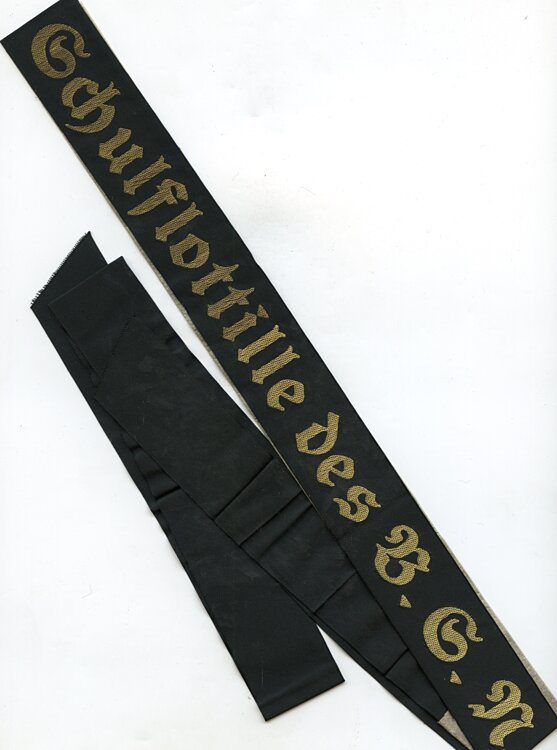
Kriegsmarine Cap Tally "Schulflottille des B.S.N."

mint condition with original paper packaging, 144 cm long. Condition 1 (B.S.N. = Befehlshaber der Schulschiffe der Nordsee - Commander of Training Ships North Sea).
134143
150,00

Kriegsmarine Cap Tally "Schulflottille des B.S.N."

The Kriegsmarine cap tally bearing the inscription “Schulflottille des B.S.N.” represents a significant aspect of the maritime training structure of the German Navy during World War II. The abbreviation B.S.N. stands for Befehlshaber der Schulschiffe der Nordsee (Commander of Training Ships of the North Sea), an important administrative and training unit within the German naval organization.

The Kriegsmarine maintained an extensive training system that was necessary to meet the constant personnel requirements of the expanding fleet. Training ships played a central role in the practical education of naval personnel. While theoretical knowledge was imparted ashore, practical seamanship training took place aboard special training vessels under realistic conditions.

The cap tally itself was a traditional element of naval uniform that had been worn in various navies worldwide since the 19th century. In the German Navy, it served not only as a decorative element but primarily as an identification feature indicating affiliation with a particular ship, formation, or unit. The standard length of 144 cm corresponded to the standardized manufacturing specifications of the Kriegsmarine.

The tallies were manufactured from black ribbon with golden-yellow inscription, with the script executed in Gothic letters. Production was carried out by specialized textile manufacturers who worked according to precise naval specifications. The lettering was frequently embroidered in gold thread or printed, with embroidered variants considered of higher quality.

The Commander of Training Ships of the North Sea was responsible for coordinating and supervising training activities in this important sea area. The North Sea was a preferred training area due to its strategic importance and proximity to German naval bases. The training flotilla comprised various ship types used for training purposes, including older cruisers, torpedo boats, and units specially converted for training purposes.

Training in the Schulflottille was strictly structured and followed an established curriculum. Recruits progressed through various training stages, from basic training to specialized training for particular ship types or weapon branches. Practical training on the training ships included navigation, seamanship, weapons technology, engine knowledge, and other maritime skills.

The present specimen is in mint condition and retains its original paper packaging, indicating careful storage. Such unworn examples are rare today, as most cap tallies were actually used during the war. The paper packaging corresponds to the usual storage practices of the Kriegsmarine, in which uniform parts and equipment items were properly packaged and held in depots.

The maritime training tradition symbolized by such cap tallies reaches far back into the history of the German Navy. The Imperial Navy of the German Empire had already established a sophisticated system of training ships. This tradition was continued by the Reichsmarine of the Weimar Republic and adopted and expanded by the Kriegsmarine.

Historically, such cap tallies document the complex organizational structure of the Kriegsmarine and the importance attached to training. Today they are important witnesses to naval history and are valued by collectors and museums as authentic relics of this era. The tally connects maritime tradition with the specific historical reality of the German Kriegsmarine during World War II.

r