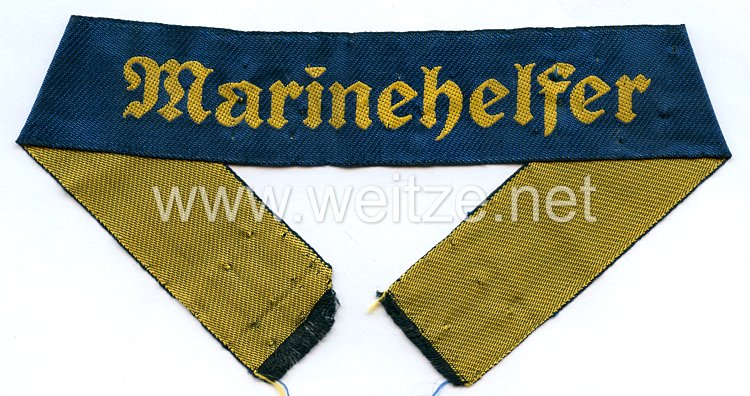
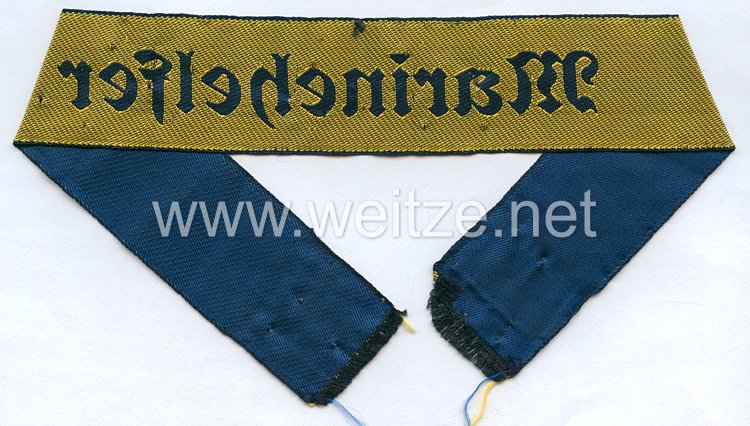
Kriegsmarine Cuff Title "Marinehelfer"

Yellow woven on blue base, length 34cm. Worn, removed from uniform, condition 2.
The Marinehelfer of the Kriegsmarine were members of the Marine-HJ.
333243
250,00

Kriegsmarine Cuff Title "Marinehelfer"

The Kriegsmarine Cuff Band "Marinehelfer" - A Testament to the Naval Hitler Youth in World War II

The cuff band "Marinehelfer" of the Kriegsmarine represents a significant piece of equipment that documents the intensive integration of youth into the military structures of National Socialist Germany during World War II. This badge, woven in yellow on a blue background, was worn by members of the Marine-Hitler-Jugend (Naval Hitler Youth), who were increasingly recruited to support the Kriegsmarine from 1943 onwards.

The Marinehelfer (Naval Auxiliaries) were young helpers, typically aged between 15 and 17 years, recruited from the Naval Hitler Youth. With the increasing duration of the war and rising personnel requirements of the Wehrmacht, the leadership was forced to draw upon increasingly younger age groups. The systematic registration and mobilization of youth intensified from 1943 onward, as personnel losses on all fronts continued to mount.

The cuff band itself followed the traditional design principles of the Kriegsmarine. The use of yellow text on a blue background corresponded to the established color combinations of the Navy, with blue serving as the traditional service color of naval forces. The weaving quality and execution of such cuff bands varied depending on the time of manufacture and producer, with increasingly simplified versions appearing toward the end of the war.

The Naval Hitler Youth as a division of the Hitler Youth existed before the war and served for pre-military training. Young people were instructed in nautical skills, navigation, signaling, and other naval-relevant activities. With the outbreak of war, this training intensified, and the Naval Hitler Youth developed into an important reservoir for Kriegsmarine recruits.

The Marinehelfer were deployed in various capacities. Primarily, they served as anti-aircraft auxiliaries (Flakhelfer) with the naval flak units, both on land and aboard ships. Additional areas of deployment included communications services, administrative duties, workshop tasks, and auxiliary services at naval bases. Despite their young age, these helpers were frequently employed in dangerous situations, particularly in the air defense of port facilities and naval bases, which were preferred targets of Allied bombing raids.

The wearing of the "Marinehelfer" cuff band occurred on the naval service uniform, usually on the left forearm. It clearly identified the wearer as a member of this special category of auxiliary personnel and distinguished him from regular naval soldiers. Regulations regarding wearing were specified in corresponding service regulations of the Kriegsmarine.

The legal status of the Marinehelfer was complex. Formally, they did not belong to the Wehrmacht in the actual sense but retained their status as Hitler Youth members, yet were factually integrated into military structures and subjected to military discipline. This construction was intended to circumvent international law issues but had little relevance in practice.

After the war's end, all insignia and badges of the Wehrmacht and its organizations were banned by the Allies. Many uniform items were destroyed or disposed of by their wearers themselves. Cuff bands that were removed from uniforms are among the preserved testimonies of this era today. They document the comprehensive militarization of German society and the systematic integration of even children and adolescents into the war apparatus.

From a military-historical perspective, such cuff bands are important primary sources that provide insights into the organizational structures, hierarchies, and increasing personnel shortages of the Kriegsmarine in the final years of the war. They simultaneously serve as reminders of the tragic fates of many young people who were robbed of their youth and drawn into a devastating war.

The preservation and scholarly documentation of such objects in museums and collections serves historical investigation and education. They serve as warnings for critical engagement with the National Socialist past and the mechanisms of totalitarian rule that permeated all areas of society.