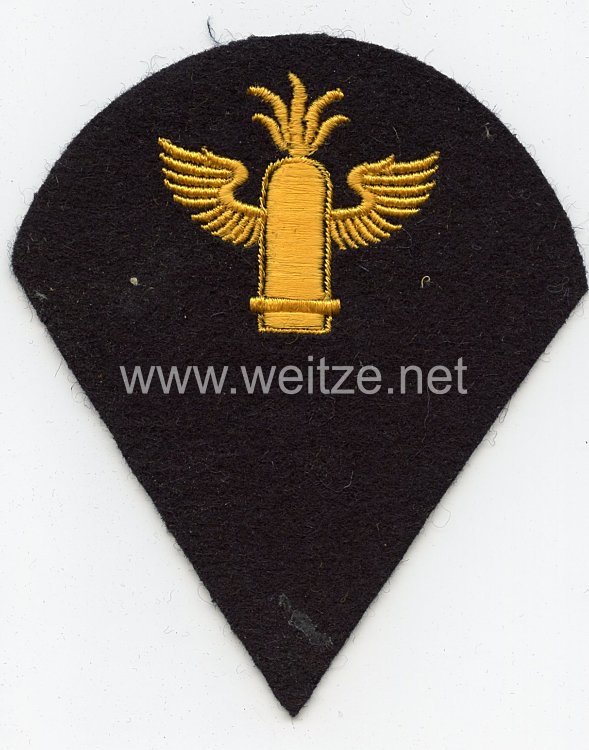
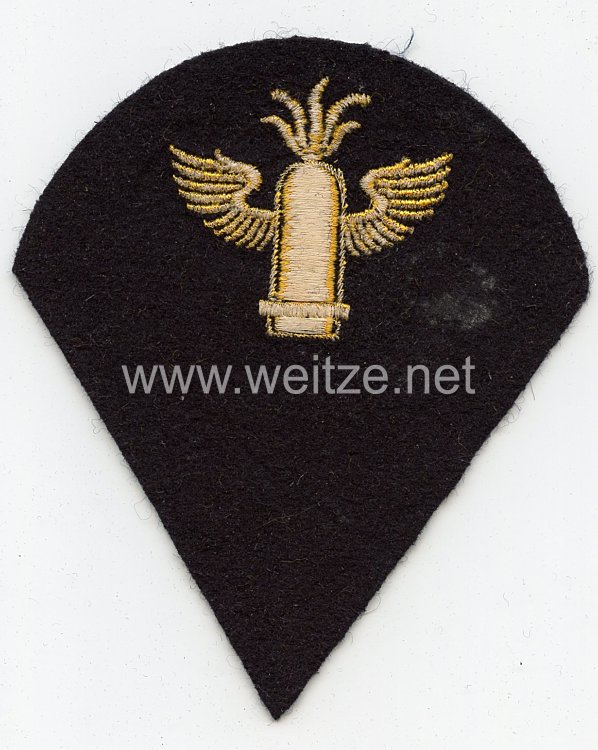
Kriegsmarine Enlisted Personnel Sleeve Insignia Naval Artillery Career Path

Version for the colani uniform, condition 2.
376643
20,00

Kriegsmarine Enlisted Personnel Sleeve Insignia Naval Artillery Career Path

The Kriegsmarine sleeve badge for enlisted men of the naval artillery career path represents a fascinating artifact of the complex rank system and career identification system of the German Kriegsmarine during World War II. These specialized badges served for quick visual identification of a naval soldier's specialization and were an integral component of the German Navy's uniform regulations between 1935 and 1945.

The Kriegsmarine, officially established on June 1, 1935, replaced the Reichsmarine of the Weimar Republic and developed a sophisticated system of rank and career badges. The various career paths were identified by specific sleeve badges worn on the blue naval uniform fabric. The naval artillery career path encompassed all enlisted men and non-commissioned officers trained in the field of naval gunnery, anti-aircraft weapons, and coastal artillery systems.

The badge for the naval artillery career typically displayed an embroidered grenade or crossed gun barrel motif, executed in the traditional color yellow on a dark blue background. This coloring corresponded to the Waffenfarbe (branch color) of the artillery, which was golden yellow across all German armed forces. The version for the Colani (also called Koller) refers to the variant for the blue working uniform of enlisted men, worn during daily shipboard life and work duties.

The manufacture of such badges was subject to strict quality standards and was carried out by various specialized companies. The badges were either machine-embroidered or hand-stitched onto cloth backing. The embroidery usually consisted of artificial silk or cotton, with higher-quality versions also using metallic threads. Attachment was accomplished by sewing directly onto the uniform sleeve, with the exact position specified by uniform regulations.

Within the framework of the uniform and clothing regulations of the Kriegsmarine, career badges were mandatory for enlisted men from the rank of Matrosengefreiter (Able Seaman) upward. They were worn on the right upper arm, typically about 10 centimeters below the shoulder seam. Correct placement and maintenance of badges was regularly checked during uniform inspections and was part of maritime discipline.

The artillery career path was one of the most important and numerically strongest career paths in the Kriegsmarine. Training as a naval artilleryman included theoretical and practical instruction on various gun types, from light anti-aircraft cannons to heavy naval guns of the main armament. Enlisted men underwent multi-stage training programs at naval artillery schools, such as the Naval Gunnery School in Kiel-Wik or the Coastal Artillery School in Wilhelmshaven.

The use of career badges had a long tradition in the German Navy. The Imperial Navy had already introduced a system of specialization badges in the late 19th century, which was adopted and further developed by the Reichsmarine after World War I. The Kriegsmarine refined this system further and created a multitude of badges for the various technical and weapons-related career paths.

The condition of such a badge today can provide valuable information about its use. Badges that were actually worn often show signs of use such as slight fading from sunlight and saltwater, wear at the edges, or sewing marks from transferring to new uniform pieces. Unissued stocks or replacement badges, on the other hand, are often found in unworn condition.

For collectors and military historians, these badges offer important insights into the organization and structure of the Kriegsmarine. The variety of preserved variants documents the different manufacturing methods, quality levels, and temporal developments during the war years. Toward the end of the war, material and production shortages often led to simplified versions with reduced material requirements and simpler manufacturing techniques.

Scientific examination of such uniform components contributes to understanding maritime military history and makes it possible to reconstruct the daily reality of naval soldiers. The sleeve badges were more than mere decoration – they were an expression of specialization, pride in one's career path, and part of maritime identity.