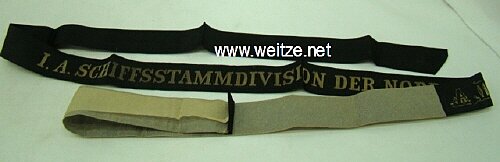
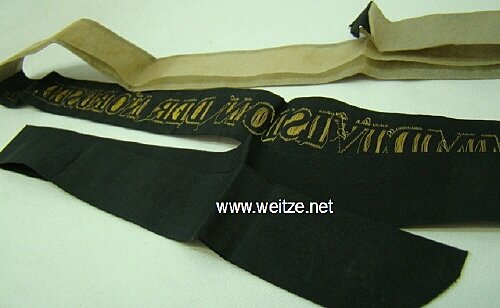
Reichsmarine Cap Tally “1.A. Schiffsstammdivision der Nordsee 1.A.”
This cap tally represents a significant artifact from the era of the Reichsmarine, the German Navy during the Weimar Republic period from 1919 to 1935. Executed in metal-thread weaving, this headgear ribbon documents the organizational structure and maritime tradition of German naval forces during the interwar period.
The Schiffsstammdivisionen (Ship Crew Divisions) formed a specific organizational structure of the Reichsmarine that was established after World War I and the restrictive provisions of the Treaty of Versailles of 1919. The treaty drastically limited the German Navy to a maximum of 15,000 personnel, six battleships, six cruisers, twelve destroyers, and twelve torpedo boats. Submarines were completely prohibited. These restrictions led to a fundamental reorganization of the maritime armed forces.
The designation “1.A. Schiffsstammdivision der Nordsee 1.A.” refers to a unit assigned to the North Sea station. The Reichsmarine was territorially divided into two main commands: the Marinestation der Nordsee (North Sea Naval Station) based in Wilhelmshaven and the Marinestation der Ostsee (Baltic Sea Naval Station) based in Kiel. The Schiffsstammdivisionen served as recruitment, training, and personnel reserve units for the active fleet formations.
The cap tallies of the Imperial Navy and later the Reichsmarine possessed a long tradition dating back to the 19th century. They served for identification and fostered esprit de corps within individual ship crews and shore units. While in the Imperial Navy the ship's name typically appeared on the tally, this changed partially in the Reichsmarine, where divisional and unit designations were also used.
The metal-thread weaving technique was a high-quality manufacturing method in which gold or silver metal threads were woven into the black base fabric. This elaborate technique created raised, shining lettering that appeared particularly representative. In contrast to simpler versions with embroidered or printed inscriptions, metal-thread woven tallies were significantly more durable and were preferred for parade uniforms and official occasions.
The cap tallies were attached to the peaked cap (Schirmmütze or “plate cap”) of naval personnel and encircled the cap just above the peak. They were typically made from black ribbon with gold lettering for enlisted men and petty officers. The length was standardized and usually ended with two hanging ribbon ends at the back of the head, finished with black bows.
The condition of this specimen as “mint” is remarkable, as many of these tallies were subjected to considerable wear during active service from weather conditions, seawater, and mechanical stress. The preservation in this condition suggests that it was either a reserve piece, an unissued depot item, or a tally worn only on special occasions.
The Schiffsstammdivisionen played an important role in the personnel management of the Reichsmarine. They were responsible for basic training of recruits, continuing education of regular crews, and provided replacement personnel for active ships. The organization into divisions enabled efficient administration and rapid mobilization when needed.
With the Nazi seizure of power in 1933 and the official renaming of the Reichsmarine to Kriegsmarine on May 21, 1935, the era of this organizational form ended. Systematic rearmament in violation of the Treaty of Versailles led to a complete reorganization of German naval forces. Many of the old cap tallies were replaced with new designations, making historical specimens from the Reichsmarine period important historical documents.
Such cap tallies are today valued collectors' items that possess not only military-historical value but are also interesting from a craft perspective. They document the textile craftsmanship of their time and the complex organizational structure of the German Navy between the world wars. For maritime historical research, they provide important clues about unit structures, deployments, and the development of naval organization during this transitional period of German history.
The weaving quality and preservation state of such items offer insights into the manufacturing standards and supply systems of the Reichsmarine. The use of metal threads was not merely decorative but also served practical purposes, as the reflective quality made identifying personnel easier during formations and ceremonies. The standardization of these items reflects the Reichsmarine's efforts to maintain professional military traditions while adapting to the severe limitations imposed by the postwar order.