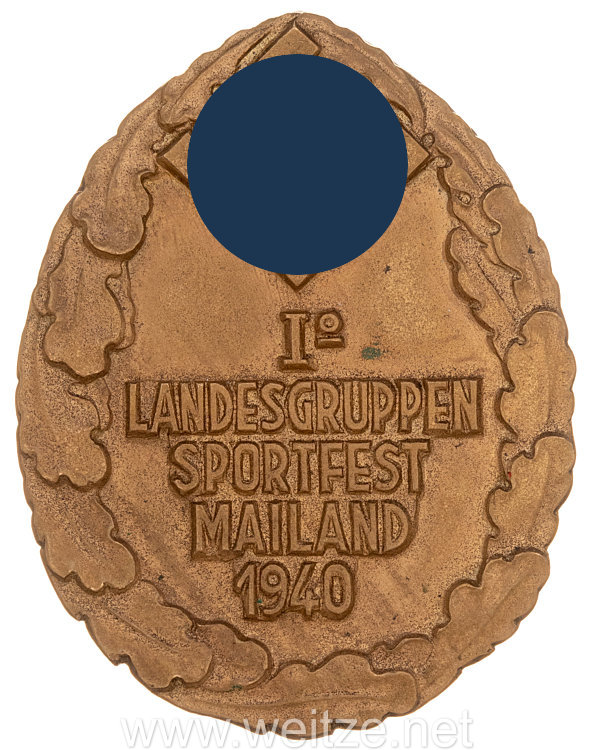
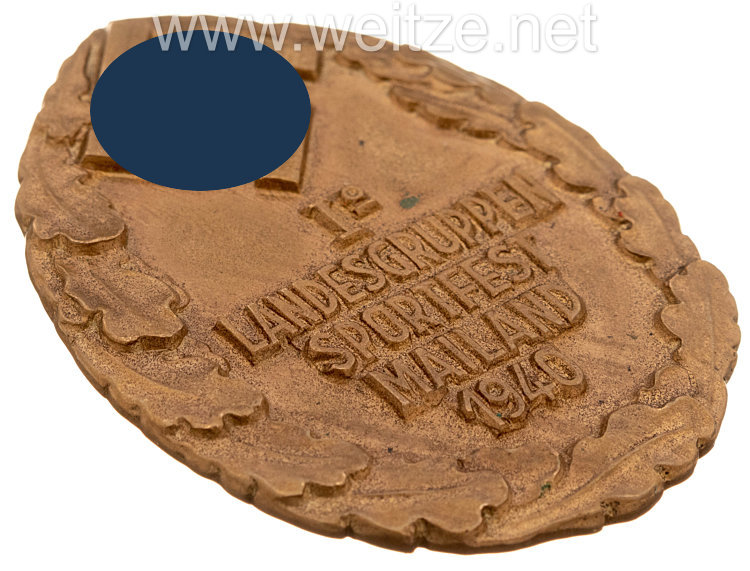
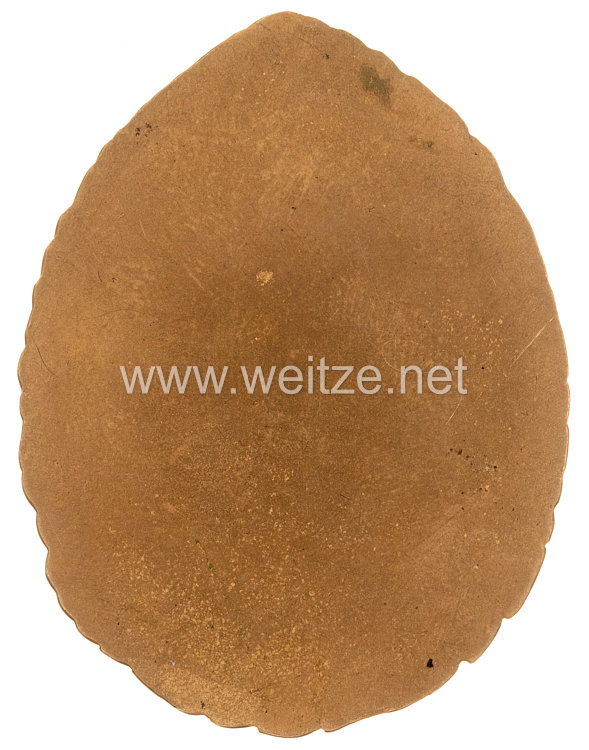
NSDAP Auslandsgruppe Italien: Participant Medal “1st Regional Group Sports Festival Mailand 1940”
The Participant Medal of the 1st Regional Group Sports Festival Milan 1940 represents a remarkable testament to the activities of the NSDAP Foreign Organization in Italy during the early phase of World War II. This bronze-plated base metal medal, measuring 55 mm in height, documents the sporting and propaganda efforts of the National Socialists among German citizens in Fascist Italy.
The NSDAP Foreign Organization (Auslandsorganisation - AO) was founded in 1931 and was responsible for the care of German citizens abroad. Under the leadership of Ernst Wilhelm Bohle, who was appointed head of the AO in 1934, the organization developed into an important instrument of National Socialist foreign policy. The Foreign Organization was divided into regional groups (Landesgruppen), which were further subdivided into local groups and support points. Italy represented a particularly important focus, as it was considered a fascist ally of the German Reich.
The Regional Group Italy of the NSDAP-AO was one of the largest and most active foreign organizations. It comprised several thousand German citizens who lived and worked in Italy. The organization had its headquarters in Rome and maintained local groups in all major Italian cities, including Milan, which held special significance as the economic center of Northern Italy.
The year 1940 marked a decisive turning point in German-Italian cooperation. In May 1940, Italy declared war on France and Great Britain and officially joined the German Reich as a war ally. In this context, the activities of the NSDAP Foreign Organization gained additional importance. Sports festivals and similar events served not only for physical training and community building, but also for political indoctrination and demonstration of the German-Italian Axis.
Sports events played a central role in National Socialist ideology. They were understood as a means of promoting the “people's community” (Volksgemeinschaft), physical training, and demonstrating the supposed superiority of the “Aryan race.” The NSDAP-AO regularly organized sports festivals for Germans living abroad to bind them to the Reich and spread the National Socialist worldview.
The 1st Regional Group Sports Festival in Milan 1940 was likely a major event at which members of various local groups from throughout Italy gathered. Such sports festivals typically included track and field competitions, team sports, and often paramilitary exercises. The participant medal served as a souvenir and award for participation in this event.
The medal itself consists of bronze-plated base metal, a typical material for such awards that was inexpensive to produce while still offering a dignified appearance. With a height of 55 mm, it corresponds to the common dimensions for participant and commemorative medals of that time. Such medals were usually produced in larger quantities and distributed to all participants, regardless of athletic performance.
The design of such NSDAP Foreign Organization medals usually followed certain iconographic patterns. Typical elements included the swastika, the Reich eagle, depictions of athletes, and inscriptions with the location, date, and occasion of the event. The medals often bore the designation of the respective regional group, thereby documenting the worldwide presence of the NSDAP.
After Italy's entry into the war in 1940, cooperation between German and Italian organizations initially intensified. The NSDAP Foreign Organization in Italy remained active until Mussolini's fall in July 1943. After Italy's capitulation in September 1943 and the German occupation of northern and central Italy, the situation changed fundamentally. NSDAP structures were partially integrated into the German military administration.
Today, such medals and awards from the NSDAP Foreign Organization are important historical sources for researching National Socialist foreign policy and German communities abroad during the Nazi era. They document the regime's efforts to spread its ideology even beyond the Reich's borders and to organize German citizens according to National Socialist principles. Collectors and museums preserve such objects as witnesses to a dark chapter in German history, whereby their presentation always requires historical context and critical examination of National Socialism.