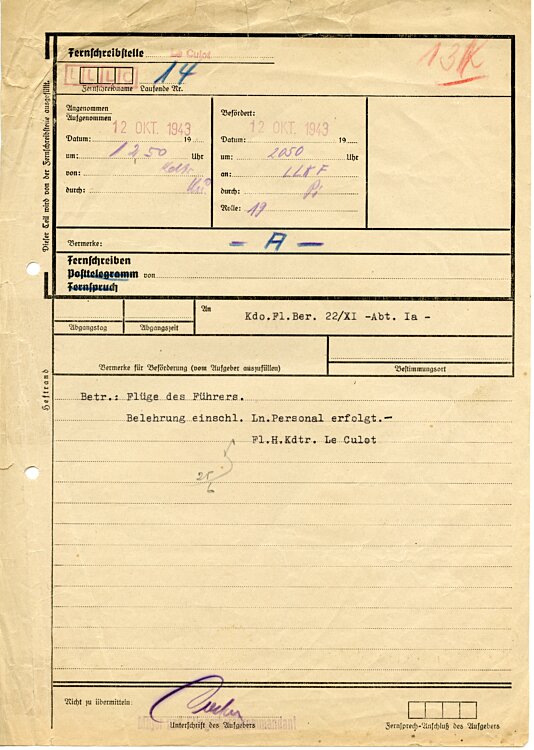
Airport Command Le Culot (Belgium) - Teletype Message dated 12.10.1943

regarding “Flights of the Führer” - instruction including signal personnel completed; used condition.
185842
20,00

Airport Command Le Culot (Belgium) - Teletype Message dated 12.10.1943

This document originates from the Flughafenkommandantur Le Culot (Airport Command Le Culot) in Belgium and is dated October 12, 1943. It is a teletype message with the highly sensitive subject “Flights of the Führer”, confirming that personnel briefings, including Luftnachrichten-Personal (Air Signal Personnel), had been conducted.

Le Culot, known today as Beauvechain, was a significant military airfield in the Belgian province of Walloon Brabant, southeast of Brussels. Following the German occupation of Belgium in May 1940, the airfield was taken over and expanded by the Luftwaffe. The strategic location of the airport made it an important base for fighter and transport units.

In October 1943, the Third Reich was in a critical phase of World War II. The Battle of Stalingrad had been lost, the Allies had landed in Italy, and the Luftwaffe was increasingly fighting defensively against Allied bomber streams. In this context, the security of the leadership gained highest priority.

The subject “Flights of the Führer” refers to the strictest security measures that applied to movements of Adolf Hitler. These teletype messages were part of a comprehensive security system that informed all military installations along possible flight routes and obligated them to absolute secrecy. The airport commands had to ensure that all personnel, especially those involved in radio communications and airspace monitoring, were briefed on security protocols.

The Air Signal Personnel played a key role in military communications and airspace surveillance. They were responsible for radio traffic, radar, navigation support, and coordination of flight movements. The explicit mention of briefing this personnel underscores the importance of radio discipline and secrecy in highly sensitive flight operations.

Teletype messages were the backbone of military communications during World War II. They enabled rapid, written transmission of orders and information over great distances. The use of teletypes ensured documented and relatively secure communication that was less vulnerable to enemy interception than radio messages.

Security briefings of this nature followed strict Wehrmacht protocols. They typically included instructions for absolute secrecy, radio silence during certain time windows, identification of aircraft, and procedures in case of unexpected events. Violations of these security regulations could be punished with severe penalties up to and including the death penalty.

The documented confirmation of completed briefings was an essential part of military bureaucracy. It served as proof that all relevant personnel had been instructed and ensured that responsibilities were clearly defined. Such documents were part of the extensive record-keeping that every military installation was required to maintain.

In autumn 1943, Hitler increasingly used his headquarters “Wolfsschanze” (Wolf's Lair) in East Prussia as well as the Führerhauptquartier “Werwolf” in Ukraine. His flight movements between various headquarters, Berlin, and other strategic locations were strictly secret and required comprehensive security precautions along the entire flight route.

Today, such documents are of considerable historical value. They document the organizational structures, communication channels, and security procedures of the German Wehrmacht. They provide insights into military bureaucracy, occupation administration in Belgium, and the increasing paranoia regarding the security of the leadership level in the later war phase.

For collectors and historians, authentic teletype messages like this are important primary sources. They complement our understanding of the daily operations of military installations far from major battles and demonstrate the complexity of military organization during World War II.