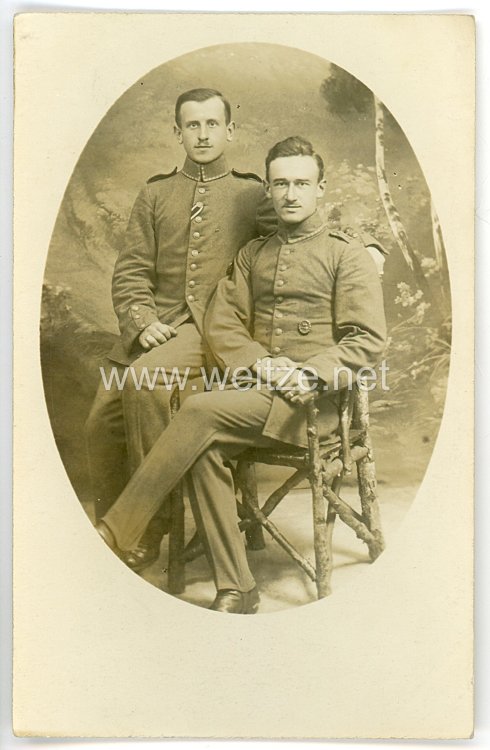
German Army Portrait Photograph, 2 Soldiers with Wound Badge

postcard size, used condition.
332242
8,00

German Army Portrait Photograph, 2 Soldiers with Wound Badge

This historical portrait photograph shows two soldiers of the German Army in postcard size, both decorated with the Wound Badge. Such photographs were widespread during World War I (1914-1918) and the Weimar Republic as well as the Third Reich period, serving both personal and propagandistic purposes.

The Wound Badge (Verwundetenabzeichen) was instituted on March 3, 1918, by Kaiser Wilhelm II and was one of the last imperial decorations. It was awarded in three classes: Black for those wounded once or twice, Silver for three or four times wounded, and Gold for five or more times wounded or blinded. The award was also granted posthumously. The badge was worn on the left breast and depicted a steel helmet above two crossed swords.

After World War I, the Wound Badge retained its validity in the Weimar Republic. On September 1, 1939, Adolf Hitler instituted the Wound Badge of World War II, which resembled the design of the imperial badge but incorporated National Socialist symbols. The criteria for award were refined: Black for one or two wounds, Silver for three or four wounds, and Gold for five or more wounds or severe head injuries.

Portrait photographs in postcard size were common in the German military since the turn of the century. The postcard format (approximately 9 x 14 cm) was standardized and enabled soldiers to send pictures to family members or keep them as mementos. Photographers in garrison towns and at the front offered their services, often in mobile studios. These images typically showed soldiers in uniform with visible decorations and rank insignia.

The depiction of two soldiers together in one photograph suggests a comradeship relationship, possibly members of the same unit or friends who wished to document their shared experience of being wounded. Wearing the Wound Badge was of particular significance to soldiers, as it symbolically represented their personal commitment and sacrifice for the Fatherland.

In the military hierarchy and honor culture of the German Reich, wounded soldiers occupied a special position. The Reich Pension Law of 1920 regulated the care of war-disabled veterans and survivors. Wounded soldiers received not only medical care but also pensions and social support. Visibly wearing the Wound Badge could bring practical advantages in civilian life, as it commanded respect and sometimes led to preferential treatment.

Photographs like this are today important historical documents. They provide insight into uniforms, decoration practices, and the self-representation of German soldiers. The “used condition” of this photograph indicates that it was preserved over decades, possibly in family possession, bearing the traces of time.

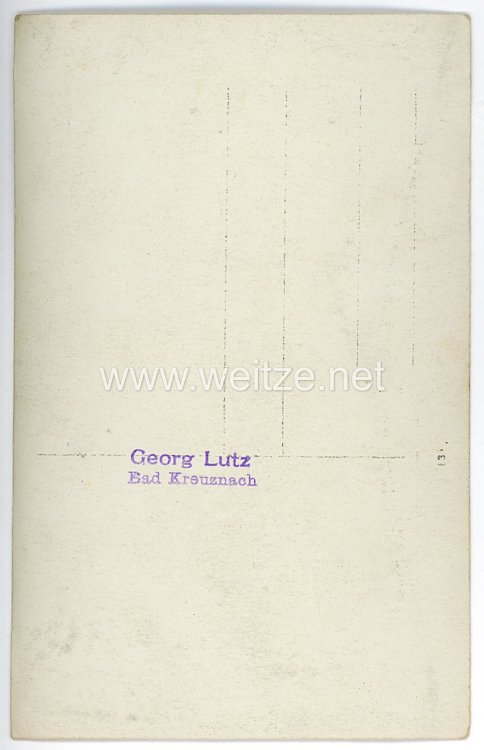
The photographic technique of such portraits followed certain conventions: The background was usually neutral or showed painted backdrops, lighting was arranged so that uniform and badges were clearly visible, and the pose was dignified and militarily correct. Many of these photographs were inscribed on the back with the photographer's stamp, date, and sometimes personal dedications.

For collectors and historians, such photographs are of interest as they document the individual perspective of war experience. Unlike official propaganda images, private portrait photographs reveal the personal side of soldiers. The distribution of the Wound Badge was considerable: During World War I, approximately 5.2 million Wound Badges were awarded, illustrating the dimension of human losses.

The preservation of such photographic testimonies is of great importance for historical research, as they help reconstruct the lived reality of ordinary soldiers and understand military everyday culture. They complement official documents and enable a more personal approach to military history.