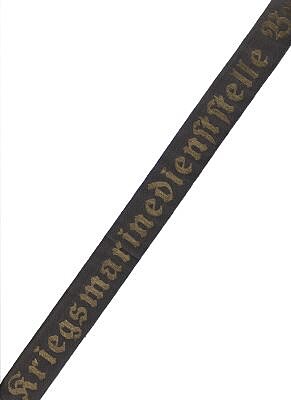
Kriegsmarine Cap Tally "Kriegsmarinedienststelle Bremen"

Worn condition, well preserved. Condition 2.
33941
80,00

Kriegsmarine Cap Tally "Kriegsmarinedienststelle Bremen"

The Kriegsmarine cap tally bearing the inscription “Kriegsmarinedienststelle Bremen” represents a fascinating artifact of German naval organization during World War II. These cap tallies were an essential component of naval uniforms, serving to identify the wearer's specific unit or duty station.

The Kriegsmarine, as the official designation of the German Navy from 1935 to 1945, evolved from the Reichsmarine of the Weimar Republic. Following the Nazi seizure of power in 1933, systematic construction of a modern naval fleet began, officially renamed Kriegsmarine in 1935. Uniform and clothing regulations were repeatedly revised and refined during this period.

The cap tally itself was traditionally a black band made of cotton or artificial silk, attached to the lower edge of the peaked cap. Its design followed maritime traditions dating back to the 19th century. The tally bore the designation of the ship, formation, or duty station in golden-yellow script. The lettering was executed in a characteristic, slightly curved Antiqua typeface, distinguishing it from the Fraktur script used by other Wehrmacht branches.

The Kriegsmarinedienststelle Bremen was one of numerous shore-based administrative and organizational units of the Kriegsmarine. Bremen, as an important port city on the Weser River, played a significant role in German naval organization. The city housed various naval facilities, including administrative offices, equipment depots, recruitment bureaus, and logistics centers. Such duty stations were essential for administrative processing, personnel management, supply operations, and coordination of naval forces.

Unlike the cap tallies of ships, which bore specific ship names (such as “Bismarck,” “Tirpitz,” or “Admiral Graf Spee”), the tallies of shore establishments indicated administrative affiliation. Personnel not deployed on ships but working in harbor commands, dockyard areas, or administrative offices wore corresponding cap tallies with location or duty station designations.

Production of these cap tallies was carried out by specialized textile companies according to precise specifications from the Army Administration and later naval clothing offices. Quality varied considerably throughout the war. Early examples from the pre-war period and early war years showed high-quality workmanship with tightly woven material and precise lettering. As the war progressed and material shortages increased, quality frequently deteriorated. Later cap tallies were sometimes manufactured from substitute materials, and the lettering appeared less precise.

Regulations for wearing caps with tallies were precisely defined in the Kriegsmarine uniform regulations. These governed not only how to wear them but also when and in which situations the peaked cap was to be worn. For enlisted men and non-commissioned officers, the cap tally was a mandatory uniform component, while officers wore different forms of headgear.

The significance of such cap tallies extended beyond their practical function. They strengthened sailors' identification with their unit and fostered esprit de corps. For naval personnel, their cap tallies were often objects of pride, especially when they came from famous ships or significant duty stations.

After the war ended in 1945, many of these cap tallies were taken by Allied soldiers as souvenirs or kept by German soldiers as mementos. Today they are sought-after collector's items for militaria collectors and historians. The authenticity of such pieces is particularly important, as numerous reproductions were also made after 1945.

The present cap tally in condition 2 (well-preserved, worn) shows typical signs of use that underscore its authenticity. Such pieces are historical documents providing insight into the organizational structure and daily life of the Kriegsmarine, serving as important testimonies to a significant, albeit dark, period of German history.

r