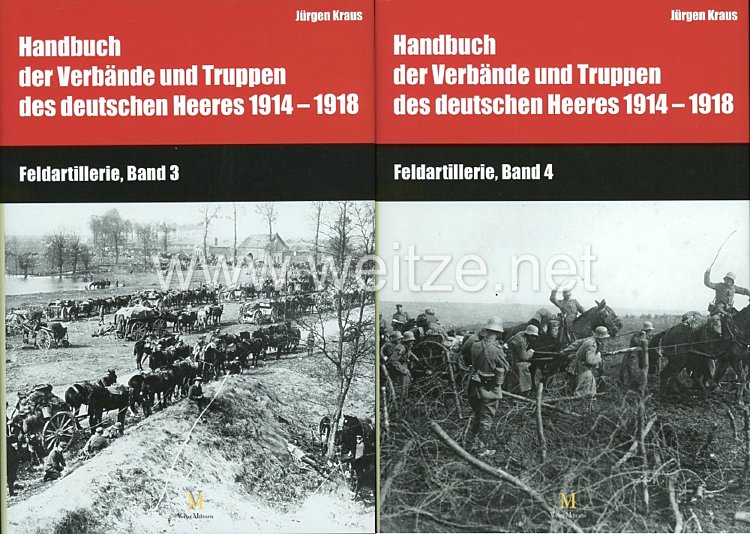
Hartwig Busche und Dr. Jürgen Kraus: Handbuch der Verbände und Truppen des deutschen Heeres 1914–1918 -Teil IX: Feldartillerie, Bd. 3 & 4 Die Munitionskolonnen der Feldartillerie
Verlag Militaria. 2 Textbände, gemeinsam 890 Seiten, Hartkarton-Einband mit Schutzumschlag, Fadenheftung. Format: 26,5×18,5 cm.
Bei Kriegsausbruch 1914 rückten insgesamt 149 Infanterie- und 296 Artillerie-Munitionskolonnen aus, die von der Feldartillerie aufgestellt worden waren. Mit pferdebespannten Fahrzeugen sollten sie die Munition von den Verteilungsstellen an die Front transportieren. Daneben besaß jede Feldartillerie-Abteilung eine leichte Munitionskolonne. Obwohl man schon vor dem Krieg mit einem hohen Munitionsverbrauch gerechnet hatte, übertraf der gewaltige Munitionsverbrauch, den das zunehmende Artilleriefeuer erforderte, doch alle Erwartungen. So steigerte sich der Monatsbedarf für eine Feldkanone von 200.000 Schuss im Jahre 1914 auf 1–7 Millionen im Jahre 1918 und für eine leichte Feldhaubitze von 70.000 Schuss 1914 auf bis zu 3,8 Millionen Schuss 1918. Für den laufenden Nachschub dieser Munitionsmengen musste auch die Anzahl der Munitionskolonnen ständig vermehrt werden, die im Jahre 1918 auf etwa 1300 anstieg. Die ursprüngliche Trennung in Infanterie- und Artillerie-Munitionskolonnen wurde während des Krieges zugunsten einer Einheits-Munitionskolonne aufgehoben. Diese Umgliederungen, Umbenennungen und wechselnden Unterstellungen werden in den vorliegenden Bänden ausführlich behandelt. Ferner sind für jede einzelne Kolonne alle wesentlichen Daten zur Aufstellung, Unterstellung und Auflösung in übersichtlicher Form dargestellt, sodass sich der Weg jeder Kolonne detailliert verfolgen lässt.
For deliveries to non-European countries, increased shipping costs may apply. We ask for a consultation. Pour les livraisons dans des pays non européens, des frais d'expédition plus élevés peuvent s'appliquer. Nous demandons une consultation.
Bei Kriegsausbruch 1914 rückten insgesamt 149 Infanterie- und 296 Artillerie-Munitionskolonnen aus, die von der Feldartillerie aufgestellt worden waren. Mit pferdebespannten Fahrzeugen sollten sie die Munition von den Verteilungsstellen an die Front transportieren. Daneben besaß jede Feldartillerie-Abteilung eine leichte Munitionskolonne. Obwohl man schon vor dem Krieg mit einem hohen Munitionsverbrauch gerechnet hatte, übertraf der gewaltige Munitionsverbrauch, den das zunehmende Artilleriefeuer erforderte, doch alle Erwartungen. So steigerte sich der Monatsbedarf für eine Feldkanone von 200.000 Schuss im Jahre 1914 auf 1–7 Millionen im Jahre 1918 und für eine leichte Feldhaubitze von 70.000 Schuss 1914 auf bis zu 3,8 Millionen Schuss 1918. Für den laufenden Nachschub dieser Munitionsmengen musste auch die Anzahl der Munitionskolonnen ständig vermehrt werden, die im Jahre 1918 auf etwa 1300 anstieg. Die ursprüngliche Trennung in Infanterie- und Artillerie-Munitionskolonnen wurde während des Krieges zugunsten einer Einheits-Munitionskolonne aufgehoben. Diese Umgliederungen, Umbenennungen und wechselnden Unterstellungen werden in den vorliegenden Bänden ausführlich behandelt. Ferner sind für jede einzelne Kolonne alle wesentlichen Daten zur Aufstellung, Unterstellung und Auflösung in übersichtlicher Form dargestellt, sodass sich der Weg jeder Kolonne detailliert verfolgen lässt.
For deliveries to non-European countries, increased shipping costs may apply. We ask for a consultation. Pour les livraisons dans des pays non européens, des frais d'expédition plus élevés peuvent s'appliquer. Nous demandons une consultation.