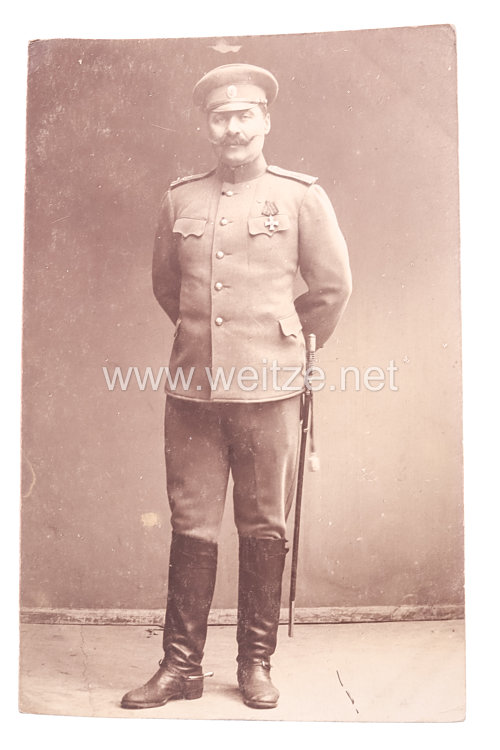
Tsarist Russia World War I Photograph of an Officer and Recipient of the Order of St. George

Circa 1916. Very fine studio photograph in field gray uniform, with the Order of St. George on the chest.
394340
85,00

Tsarist Russia World War I Photograph of an Officer and Recipient of the Order of St. George

This studio photograph from around 1916 depicts an officer of the Russian Imperial Army in field-gray uniform during World War I. Particularly noteworthy is the Order of St. George worn on his chest, one of the highest military decorations of Tsarist Russia.

The Imperial Military Order of the Holy Great-Martyr and the Victorious George was established in 1769 by Empress Catherine II and was considered the most prestigious award for valor in the Russian Empire. The order was exclusively reserved for military merit and was awarded in four classes, with the first class being the highest distinction. The criteria for award were extremely strict: the order could only be bestowed for exceptional bravery in the face of the enemy or for outstanding military leadership.

The officer's uniform in this photograph corresponds to the field-gray model introduced in the Russian army from 1914 onwards. Before World War I, Russian soldiers wore colorful uniforms, but the reality of modern warfare with machine guns and artillery made camouflage uniforms necessary. The field-gray color provided better concealment in the field and was adopted by all warring nations in various shades.

Studio photographs like this one held great significance during World War I. Officers frequently had themselves photographed in full uniform with their decorations to send these portraits to their families. These photographs served not only as personal mementos but also as testimony to military rank and honor. Professional photographers often operated their studios near garrisons and at the front to offer this important service.

The year 1916, when this photograph was taken, was a time of great military effort and increasing internal tensions for the Russian Empire. The Brusilov Offensive from June to September 1916 represented one of the most successful Russian military operations of the war but also led to enormous losses of over one million men. Despite initial successes against Austro-Hungarian troops, Russia could not achieve a decisive turn in the course of the war.

The Russian army fought on the Eastern Front against the Central Powers under the most difficult conditions. Supply shortages, inadequate armament, and the sheer extent of the front posed immense challenges. Nevertheless, Russian troops repeatedly demonstrated remarkable bravery, which was recognized through the award of the Order of St. George.

The officer corps of Tsarist Russia consisted of members of the nobility as well as career officers who had risen through the ranks. Military training took place at prestigious institutions such as the Nicholas Military Academy in St. Petersburg. Officers bore responsibility for their units and were rewarded for exceptional performance with orders and promotions.

The Order of St. George in this photograph symbolizes personal bravery and military excellence. Bearers of this decoration enjoyed high esteem in the army and in society. The statutes of the order were so strict that each award had to be thoroughly examined, and false claims could lead to severe punishment.

Photographs like this are important historical documents today. They provide insight not only into uniforms and decorations but also into the social significance of military honor in Tsarist Russia. The year 1916 marked a turning point: less than a year later, the February Revolution of 1917 would overthrow the Tsarist regime and end the centuries-old Romanov dynasty.

Such studio photographs were often kept in special albums or sent as postcards. They represented not only the individual achievements of the person depicted but also the military tradition and patriotism of that era. For military historians and collectors, these photographs are invaluable sources for researching the uniform, decorations, and social history of World War I.

r