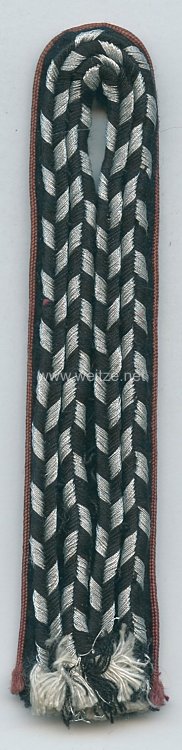
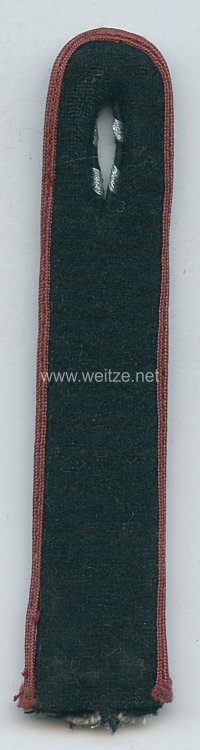
NSKK Enlisted Ranks Shoulder Strap

Motorgruppe Ostmark, wine-red piped, sew-in type, condition 2-
331540
65,00

NSKK Enlisted Ranks Shoulder Strap

This NSKK shoulder strap for enlisted men (Nationalsozialistisches Kraftfahrkorps - National Socialist Motor Corps) represents a characteristic example of the uniform equipment of this paramilitary organization of the Third Reich. The shoulder strap is attributed to Motorgruppe Ostmark and features the typical wine-red piping prescribed for this unit.

The NSKK was founded on May 1, 1931 as a subdivision of the SA and received the status of an independent formation of the NSDAP on August 23, 1934. Under the leadership of NSKK-Korpsführer Adolf Hühnlein, the organization developed into a significant institution dedicated to motorized training and the promotion of motor vehicle affairs in National Socialist Germany. By 1945, the NSKK comprised approximately 500,000 members.

The designation “Motorgruppe Ostmark” refers to the territorial organization of the NSKK after the Anschluss of Austria in March 1938. The term “Ostmark” was the official National Socialist designation for the annexed Austrian territory, used from 1938 to 1942. Motorgruppe Ostmark was established as one of several regional NSKK units and encompassed the entire former Austrian territory. Its headquarters was located in Vienna.

The NSKK uniforming followed strict regulations laid down in various service instructions and uniform orders. Shoulder straps served to identify rank and affiliation with specific units. For enlisted men – the ordinary members without leadership rank – the shoulder straps were designed relatively simply and differed significantly from the more elaborate rank insignia of leaders.

The wine-red piping was an important identifying feature and part of the NSKK's complex color system. Various motor groups and functional areas within the organization were marked by specific colors. The Waffenfarben (service colors) served for quick identification of an NSKK member's affiliation and were precisely defined in official clothing regulations. Wine-red was assigned to Motorgruppe Ostmark and differed from other colors such as the bright red of motor sports schools or the orange of technical units.

The present shoulder strap is executed as a sew-in variant, meaning it was permanently sewn into the uniform. This distinguishes it from detachable shoulder straps that were attached with buttons. The sew-in variant was common for enlisted ranks and corresponded to the practical orientation of NSKK uniforming.

The materials and manufacture of such shoulder straps also followed established standards. Typically, they were made from base cloth in the color of the uniform and finished with the corresponding colored piping. Quality could vary depending on the time of manufacture and manufacturer, with material shortages increasingly leading to quality deterioration during the war.

The historical significance of such uniform parts lies in their function as testimony to the organizational structure and ideological permeation of National Socialist society. The NSKK served not only for motorized training but also for the ideological education of its members. The organization played an important role during World War II in training drivers for the Wehrmacht and in various transport and supply tasks.

After the collapse of the Third Reich, the NSKK was banned by the Allies in 1945 and classified as a criminal organization. Uniform parts and insignia became collector's items and historical artifacts that today are preserved as material witnesses of this era in museums and private collections. Their study contributes to understanding the organizational complexity and visual propaganda of the NS regime.

The shoulder strap of Motorgruppe Ostmark thus represents a specific temporal and geographical context within NSKK history – the brief period between 1938 and 1945 when Austrian territory was integrated into the NS system as “Ostmark.”