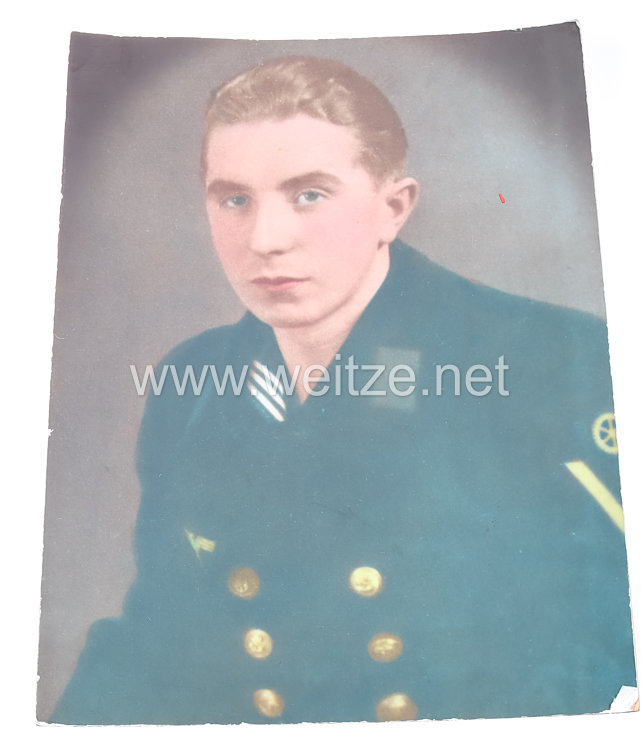
Kriegsmarine Portrait Photograph, Maschinengefreiter

Colorized, dimensions approximately 39 x 29 cm. Condition 2.

For delivery to non-European countries, increased shipping costs may apply. We ask for consultation.
For deliveries to non-European countries, increased shipping costs may apply. We ask for a consultation.
Pour les livraisons dans des pays non européens, des frais d'expédition plus élevés peuvent s'appliquer. Nous demandons une consultation.
398640
40,00

Kriegsmarine Portrait Photograph, Maschinengefreiter

Kriegsmarine Portrait Photography: Machine Gunner's Mate in World War II

This hand-colored portrait photograph of a Maschinengefreiter (Machine Gunner's Mate) of the Kriegsmarine represents a significant aspect of military documentation and commemorative culture during World War II. Such professionally produced portraits were an important part of military life, serving both personal remembrance and maintaining connections with the home front.

The Kriegsmarine and its Enlisted Ranks

The Kriegsmarine served as the naval force of the German Reich from 1935 to 1945. The rank of Maschinengefreiter designated a junior non-commissioned officer rank in the technical career path of the navy. These soldiers were specially trained in operating, maintaining, and servicing ship engine systems. The Maschinengefreiter ranked above the Maschinenmatrose (Machine Seaman) but below the Maschinenobergefreiter (Senior Machine Gunner's Mate). Identification was provided through specific rank insignia on the uniform sleeves, typically in the form of chevrons and special emblems for machinery personnel.

Portrait Photography in the Kriegsmarine

The tradition of professional military portraits in Germany had a long history dating back to the 19th century. During World War II, this practice experienced a particular flourishing. Photographers in port cities and naval bases such as Kiel, Wilhelmshaven, Bremerhaven, and Hamburg specialized in such photographs. The portraits were typically made in photo studios located in close proximity to barracks and naval facilities.

Soldiers wore their dress uniforms in these photographs with all regulation insignia, medals, and decorations. This allowed family members at home to follow the military career and achievements of their sons, brothers, or husbands. The photographs were offered in various formats, with larger formats like the present example (approximately 39 x 29 cm) being particularly suitable for display in the home.

Hand-Coloring Technique

The hand-coloring of black-and-white photographs was a widespread practice in the 1930s and 1940s. Specialized colorists manually worked on the prints with fine brushes and special color pigments or aniline dyes. Particular attention was paid to the correct reproduction of uniform colors: the characteristic navy-blue of the Kriegsmarine uniform, the golden buttons and insignia, and skin tones. These colorizations gave the portraits a special vibrancy and made them treasured keepsakes.

Social and Cultural-Historical Significance

Such portrait photographs fulfilled several important functions. They served the self-representation of the soldier in his military role and expressed pride in the position achieved and service rendered. For families, these images were often the only visual memories of their relatives in uniform, especially when they did not return from the front.

The photographs also precisely document the uniforms and rank insignia of the Kriegsmarine. They are therefore valuable sources for military-historical research, uniform studies, and the social history of World War II. The technical specialization expressed through the rank of Maschinengefreiter points to the increasing mechanization of naval warfare and the importance of qualified machinery personnel for operating modern warships.

The Machinery Personnel of the Kriegsmarine

The machinery personnel formed the technical backbone of every warship. These men worked under often extreme conditions in the engine rooms, far below the waterline. They were responsible for steam turbines, diesel engines, electrical systems, and auxiliary machinery. Training to become a Maschinengefreiter required technical understanding and practical experience. Many recruits for this career path came from craft or industrial professions.

Collector Value and Historical Context

Today, such portrait photographs are important documents of military and social history. They offer insights into the world of young men who entered service in the Kriegsmarine. The preservation and scholarly documentation of such objects contributes to understanding this historical period without glorifying the associated political and military events. They remind us of individual fates within a global conflict and serve as material witnesses of a bygone era.