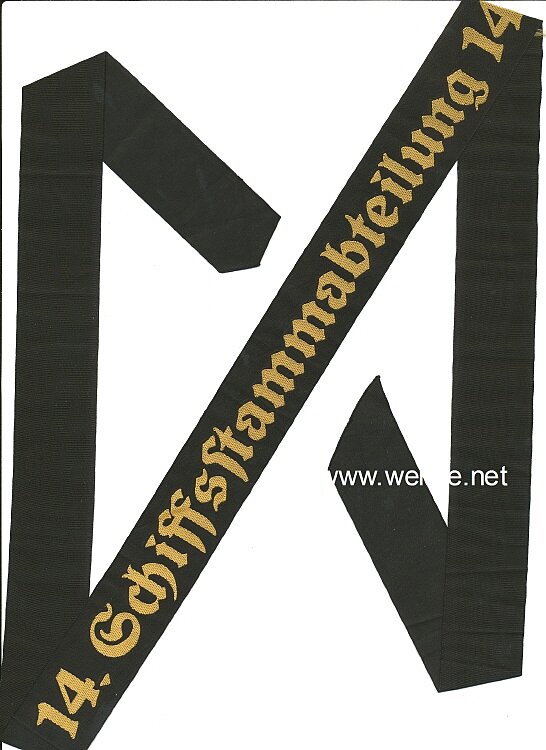
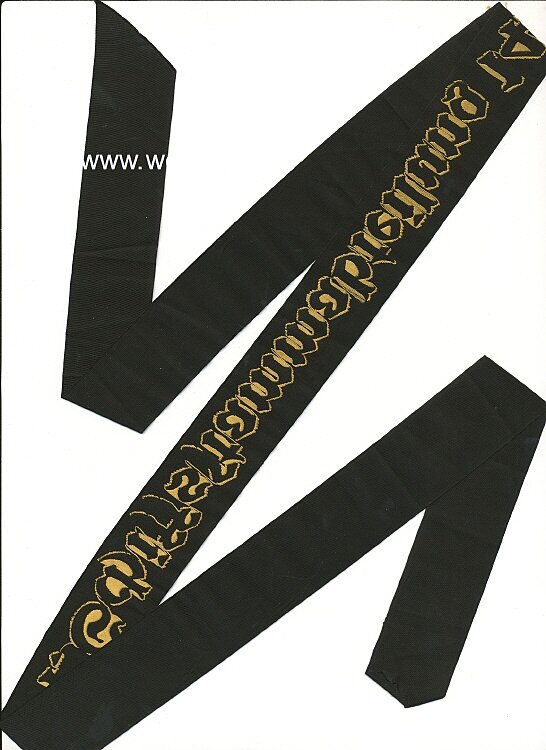
Kriegsmarine Cap Tally "14. Schiffsstammabteilung 14."

Worn condition, 110 cm long, cotton thread. Condition 2
170540
60,00

Kriegsmarine Cap Tally "14. Schiffsstammabteilung 14."

The Kriegsmarine cap ribbon bearing the inscription “14. Schiffsstammabteilung 14.” represents a significant piece of equipment from the German Navy during World War II. These cap ribbons, officially designated as Tellermützenband, were an integral part of the sailor's uniform and served both identification purposes and the maintenance of naval tradition.

The Schiffsstammabteilungen (Ship Crew Divisions) were organizational units of the Kriegsmarine that fulfilled important functions during World War II in the training, administration, and provision of naval personnel. These divisions were established to manage and train the growing number of recruits needed for service on warships, submarines, and coastal installations. The numbered designation “14. Schiffsstammabteilung 14.” indicates a specific administrative unit, with the double numbering possibly representing a sub-organization or reorganization structure within the system.

The history of cap ribbons in the German Navy dates back to the Imperial Navy of the 19th century. Following the tradition of various European naval forces, sailors wore ribbons on their caps displaying the name of their ship or unit. This tradition was continued by the Reichsmarine of the Weimar Republic and later adopted by the Kriegsmarine of the Third Reich. The Kriegsmarine's uniform regulations of 1935 and their subsequent amendments detailed the appearance and wearing of these ribbons.

This specimen was manufactured from cotton, which was the standard material for such equipment items. With a length of 110 centimeters, it corresponds to the usual dimensions necessary to wrap the ribbon around the characteristic peaked cap (also called Tellermütze) and tie it into a bow at the back of the head. The black base color with gold or yellow lettering was typical for Kriegsmarine cap ribbons and allowed for clear readability of the unit designation.

The Schiffsstammabteilungen were distributed across various locations in Germany and occupied territories. They functioned as collection points for naval personnel between assignments, as training facilities for specialized tasks, and as administrative centers for personnel matters. Sailors assigned to a Schiffsstammabteilung could stay there between ship assignments, take leave, or await their next posting. This organizational structure was particularly important for the U-boat service, where crews needed recovery time between dangerous combat patrols.

The condition of the ribbon as “worn” gives it particular historical authenticity. It was actually used by a member of the Kriegsmarine in service, making it a personal testimony of this historical era. The signs of wear tell of everyday use during one of the most conflict-ridden periods of the 20th century.

The production of naval equipment during the war was subject to strict quality controls and was carried out by various manufacturing firms in the German Reich. The lettering on cap ribbons was done through special weaving techniques or printing, with the letters designed in characteristic Fraktur script or Latin script. The gold or yellow coloring of the lettering was achieved through special types of yarn or dyes.

In the context of militaria collecting, such cap ribbons are important historical documents today. They enable researchers and historians to better understand the organizational structure of the Kriegsmarine and trace the development of various units. For collectors of military-historical items, they represent tangible connections to history that contribute to preserving historical memory.

It is important to emphasize that such objects should be viewed exclusively from historical-scientific perspectives. They serve the documentation and examination of history, not the glorification of military conflicts or ideological systems. The preservation and research of such artifacts contributes to understanding the past and serves as a warning to future generations.

The administrative organization represented by Schiffsstammabteilungen was essential for maintaining the operational efficiency of the Kriegsmarine throughout the war years. These units managed personnel records, coordinated training programs, and ensured the proper distribution of sailors to various naval commands. The existence of at least fourteen such divisions indicates the scale of naval personnel administration required during this period of intense military mobilization.