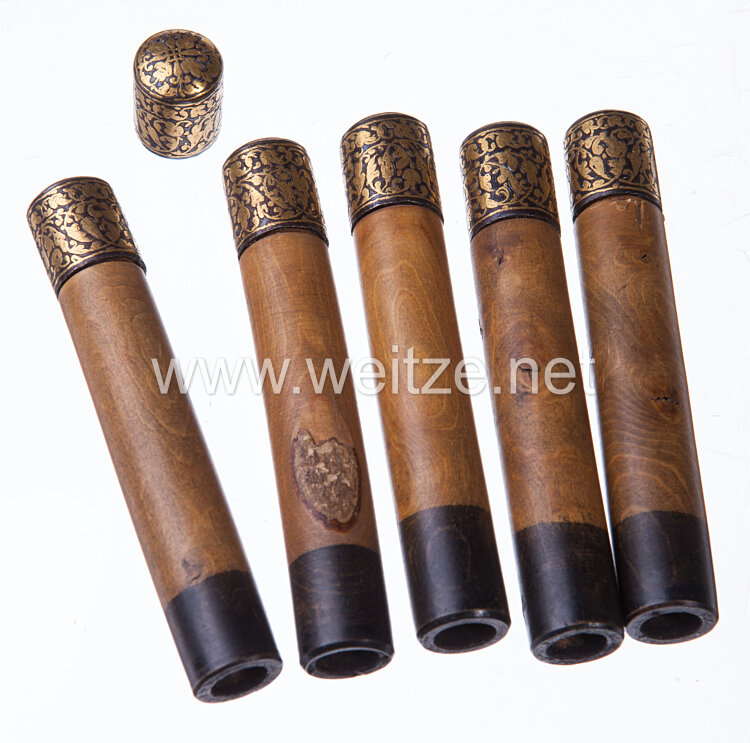
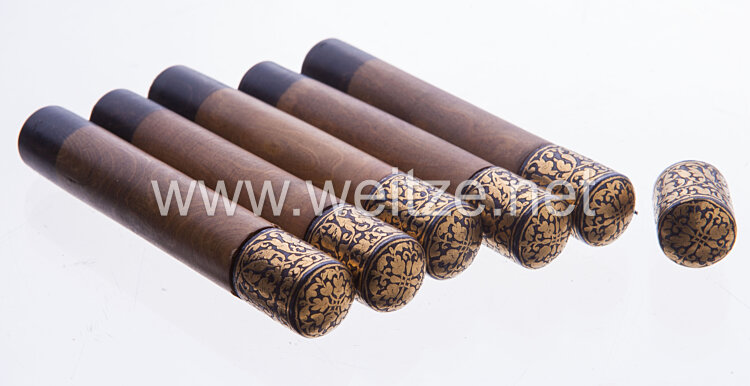
Tsarist Russia Set of 5 Decorative Cartridges “Gazyr” for Officers of Cossack Regiments

circa 1880/1890. The decorative cartridges made of wood, the decorative caps each featuring typical niello gold inlay work. Additionally one cap for another cartridge. Lightly worn, condition 2.
These “gazyr” were worn as decoration in the cartridge breast pockets of the Circassian coats of the Cossacks.
248539
500,00

Tsarist Russia Set of 5 Decorative Cartridges “Gazyr” for Officers of Cossack Regiments

The Gazyr (Russian: газыри, also spelled Gaseri or Gasiri) represents one of the most characteristic elements of traditional Cossack uniforms and embodies the unique fusion of Caucasian and Russian military traditions in Tsarist Russia during the 19th century.

These decorative cartridge holders were worn in the breast pockets of the Cherkesska, the traditional Caucasian caftan that was adopted by Cossack regiments as part of their uniform. The Cherkesska itself originated with the Circassian people of the Caucasus and became an unmistakable component of Cossack dress throughout the 19th century, particularly among regiments from the Caucasus, the Kuban, and Terek Cossacks.

The Gazyr dating from approximately 1880-1890 described here represent the refined form of this tradition as worn by officers. Unlike the functional cartridge pouches of common soldiers, officer versions were elaborate status symbols. These examples consist of wooden cores and are fitted with ornamental caps crafted in the characteristic Niello technique with gold inlay work.

Niello is an ancient metalworking technique in which a black mixture of sulfur compounds is inlaid into engraved metal patterns to create dramatic contrast. Combined with gold inlays, this created a particularly magnificent appearance that demonstrated the wearer's rank and wealth. This technique had a long tradition in the Caucasus and Russia and was especially employed in the manufacture of weapons, jewelry, and military decorative items.

Historically, gazyr evolved from actual cartridge cases. For centuries, warriors in the mountainous regions of the Caucasus carried their ammunition in individual leather holders across their chests, where it was quickly accessible. With the introduction of modern firearms and cartridges in the 19th century, the gazyr retained their position on the uniform but became increasingly decorative. The number of gazyr on a Cherkesska varied, with 8 to 16 pieces on each side of the chest being common, arranged symmetrically.

During the reigns of Tsar Alexander II (1855-1881) and Alexander III (1881-1894), Cossack regiments experienced a particular flourishing. After the end of the Caucasian War in 1864, many Caucasian elements were officially integrated into Russian military uniforms. The Cherkesska with its gazyr was worn not only by Caucasian Cossacks but also by the Imperial Guard and other prestigious units.

Officers of Cossack regiments invested considerable sums in outfitting their uniforms. While common Cossacks wore standardized gazyr made mostly from brass or simple metal, officers had their gazyr crafted by specialized artisans. Centers of this craftsmanship included cities such as Tiflis (now Tbilisi), Vladikavkaz, and workshops in Cossack stanitsas along the Terek and Kuban rivers.

The set of five decorative cartridges plus an additional cap described here is typical of surviving collections. Complete sets of 16 or more pieces rarely survived intact, as they were separated or damaged over the years. The stated condition “lightly worn, condition 2” indicates that these gazyr were actually used in service and were not merely parade pieces.

The dating to around 1880-1890 places these objects in a particularly interesting phase of Russian military history. This was the era following the great reforms under Alexander II, when the Russian military was being modernized while simultaneously preserving traditional elements. The Cossacks retained their distinctive uniforms as a sign of their special position within the imperial army.

The artistic processing with niello and gold demonstrates the high level of craftsmanship among metalworkers of the period and the importance attached to external appearance in 19th-century military culture. Each gazyr was individually crafted, and sets were often custom-made for specific officers, explaining variations in size, decoration, and quality even within similar time periods.

The cultural significance of the gazyr extended beyond mere decoration. They represented the martial heritage of the Caucasus, the proud independence of the Cossack hosts, and the romantic military ideals of the era. Foreign visitors to Russia often commented on the striking appearance of Cossack officers in their Cherkesskas studded with gleaming gazyr.

Today, authentic gazyr from the Tsarist period are sought-after collector's items. They document not only military history but also the cultural interaction between the Russian Empire and Caucasian peoples. The elaborate craftsmanship represents a tangible link to a vanished world of imperial splendor and military tradition.

The gazyr remained part of Cossack uniforms until the end of the Tsarist regime in 1917 and were even worn to some extent in the early years of the Soviet Union before finally disappearing from active service. They remain, however, an iconic symbol of the Cossacks and their unique role in Russian history, continuing to appear in traditional folk costumes and ceremonial dress to the present day.