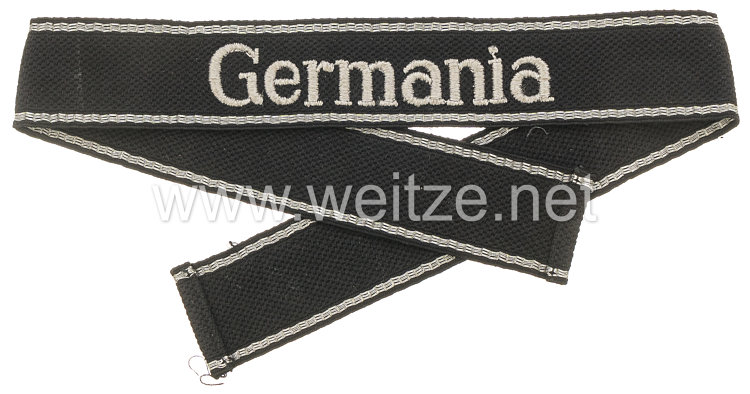
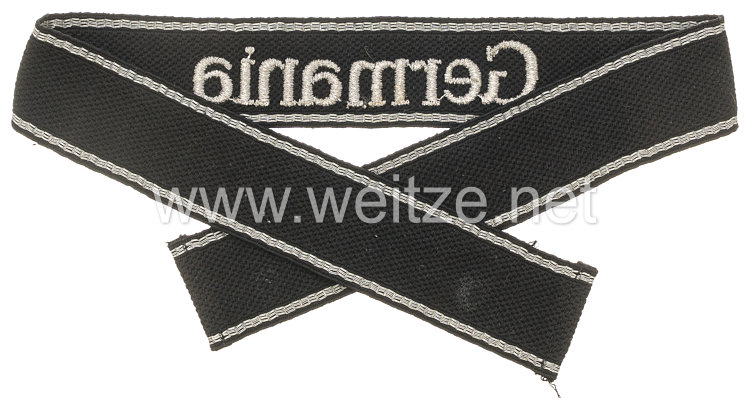
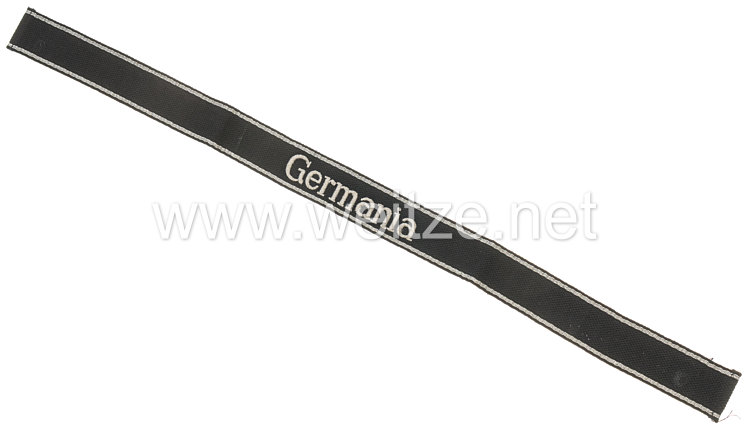
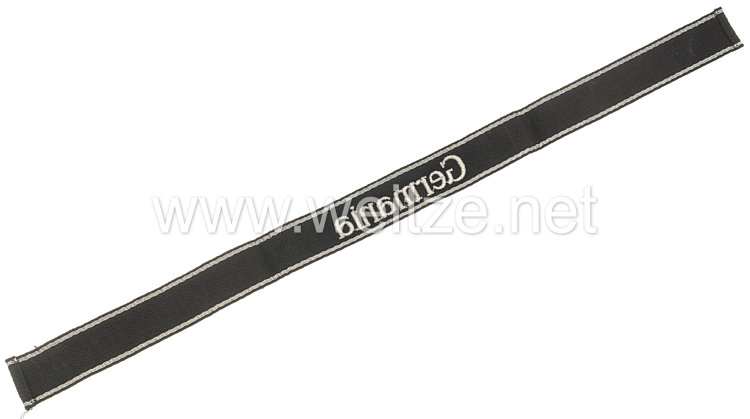
Waffen-SS Cuff Title for Enlisted Men in SS-Panzergrenadier-Regiment 9 “Germania”
The "Germania" cuff title for enlisted men and non-commissioned officers of the Waffen-SS represents a significant example of unit identification within the National Socialist military organization. This RZM-supervised machine-embroidered version was worn by members of SS-Panzergrenadier-Regiment 9 "Germania", a unit with a remarkable organizational history.
The Germania regiment traced its origins to 1934 when it was formed as SS-Standarte 3/VT from a cadre in Hamburg (Politische Bereitschaft SS 2). It was renumbered as SS-Standarte 2/VT when Hitler ordered that the Leibstandarte not be included in the numbering sequence. At the 1936 Nuremberg Parteitag, the regiment received its "Germania" designation and corresponding cuff title. In the following years, the unit participated in the annexation of Austria (1938), the occupation of the Sudetenland (1938), and served as a guard regiment in Prague (1938-1939). During the invasion of Poland (1939) and France (1940), Germania fought as part of the SS-Verfügungs-Division.
December 1940 marked a significant reorganization: the regiment was removed from what became Das Reich Division to form the cadre of the new Wiking Division, alongside the Nordic volunteer regiments Westland and Nordland. Germania served continuously with the Wiking Division through Eastern Front campaigns until the war's end. In October 1943, as part of the redesignation to 5. SS-Panzer-Division Wiking, it became SS-Panzergrenadier-Regiment 9 "Germania".
The cuff titles were controlled by the Reichszeugmeisterei (RZM), which supervised the production of NSDAP formations items from late 1934. The machine-embroidered pattern was manufactured by various producers holding RZM approval and was used from approximately 1936 through circa 1943, when machine-woven types became predominant due to lower cost. Officers received hand-embroidered versions using fine aluminum wire or bullion thread, while enlisted men and NCOs wore the machine-embroidered execution.
The physical characteristics of these cuff titles featured a black rayon band approximately 28-31mm wide with machine-embroidered lettering in white-silver-grey thread and aluminum-silver wire borders (typically 7 strands top and bottom). Average length was 49cm, with the shortest examples at 41cm and longest at 50cm. The script style changed from Gothic to Latin in December 1939. An RZM paper or woven label was typically attached to the reverse, though these were often missing. These labels could be RZM/SS paper type with rating letter, RZM symbol, manufacturer code, and SS symbol; or RZM/SS woven labels showing RZM logo, manufacturer code above production year digits, and SS symbol.
According to SS regulations, cuff titles were worn on the left sleeve and were considered a special honor identifying unit affiliation. Various manufacturers produced these under RZM supervision, resulting in slight variations in embroidery thickness and quality. Later war production shifted to machine-woven (BeVo-type) cuff titles by approximately 1943 for cost efficiency.
After Germany's defeat in May 1945, the Waffen-SS was declared a criminal organization at the Nuremberg Trials. The 5. SS-Panzer-Division Wiking, with the Germania regiment, surrendered to American forces near Radstadt, Austria on May 9, 1945. Production of SS insignia ceased in 1945. Surviving Waffen-SS insignia including cuff titles became collectors' items and are now found in museums and private collections. Original examples are now considered historical artifacts and subject to legal restrictions in some countries.
Notable bearers of the Germania cuff title included SS-Obersturmbannführer Karl-Heinz Bühler, commander of SS-Panzergrenadier-Regiment 9 "Germania" of 5. SS-Panzer-Division Wiking, who was awarded the Ritterkreuz on May 6, 1945, and SS-Hauptscharführer Josef Styr, Zugführer of 10. Kompanie/SS-Panzer-Grenadier-Regiment 9 "Germania", who received the Ritterkreuz on April 5, 1945.