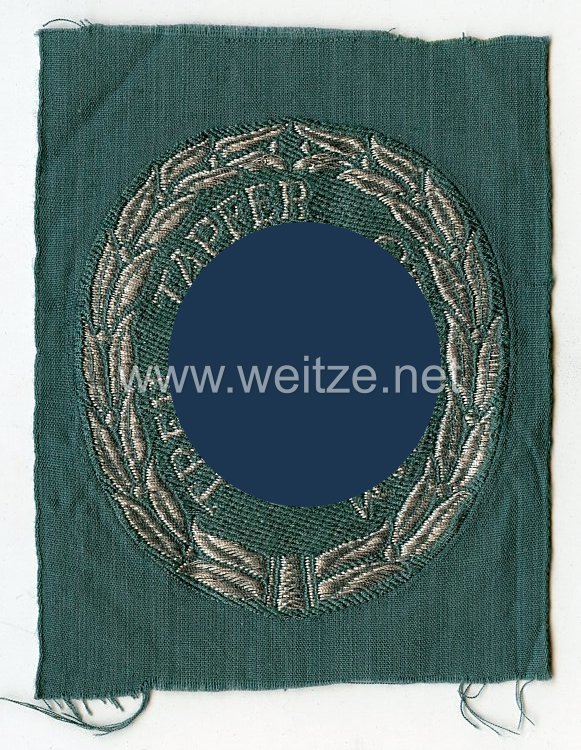
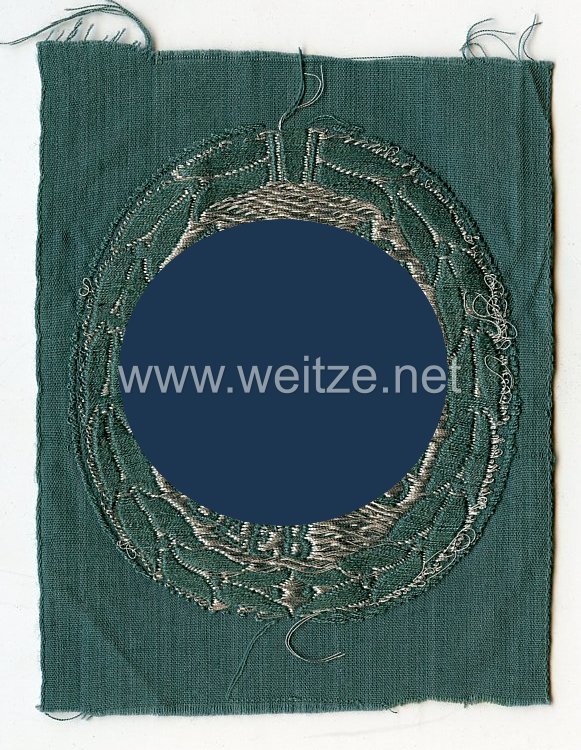
The Schutzmannschaften leader's sleeve insignia represents a dark chapter of German occupation rule in Eastern Europe during World War II. This badge, woven in Bevo metal thread on a green background, identified leadership personnel within the collaborating auxiliary police units established by German occupation authorities in the conquered eastern territories.
The Schutzmannschaften, commonly abbreviated as Schuma, emerged in the context of National Socialist expansion policy and the associated occupation regime. Following the invasion of the Soviet Union on June 22, 1941, German occupation authorities faced the immense task of controlling vast territories with limited forces of their own. The solution was found in recruiting local collaborators who, for various motives – anti-communist convictions, antisemitism, nationalist aspirations, or simple economic necessity – were willing to cooperate with the occupiers.
Reichsführer-SS Heinrich Himmler quickly recognized the potential of these auxiliary forces and systematically expanded the Schutzmannschaften in late July 1941. The legal and organizational foundation consisted of various decrees and orders that subordinated these units to the Ordnungspolizei (Order Police) and ultimately to the SS. By the end of 1942, the Schutzmannschaften reached a considerable strength of approximately 300,000 men, organized in units up to battalion size.
Recruitment took place primarily in the Baltic states (Estonia, Latvia, Lithuania), in the formerly Polish territories in the western Soviet Union, in Ukraine, and in Belarus. In these regions, the Germans encountered population groups that had partly suffered under Soviet rule and initially perceived the Wehrmacht as liberators. The occupation authorities deliberately exploited this initial sentiment to recruit personnel for their repressive policies.
The Schutzmannschaften were divided into different categories: The Schutzmannschaft des Einzeldienstes (individual service) functioned as local order police in cities and municipalities. The Schutzmannschaft der Bataillone (battalions) formed mobile operational units, while the Schutzmannschaft des Hilfsdienstes (auxiliary service) was deployed for guard and security duties. Each category had its own uniform regulations and markings, which included specific sleeve insignia.
The present leader's sleeve insignia distinguished superiors from ordinary enlisted ranks. The use of metal thread in Bevo weaving technique indicates standardized production. The company BeVo (Bandfabrik Ewald Vorsteher) from Wuppertal was one of the main suppliers of woven insignia for Wehrmacht and SS organizations. The green base color corresponded to the color codes of the Order Police and its auxiliary units.
The tasks of the Schutzmannschaften were diverse and increasingly criminal. They guarded concentration camps and ghettos, participated in the persecution and murder of the Jewish population, conducted anti-partisan operations – a euphemism for brutal retaliatory actions against the civilian population – and secured military and civilian installations. Individual Schutzmannschaft battalions became particularly notorious for their participation in mass shootings and the guarding of extermination camps such as Treblinka and Sobibor.
The distinction from the Ordnungsdienst (Order Service) lay mainly in the command structure and area of deployment. While the Ordnungsdienst operated in ghettos under Jewish self-administration, the Schutzmannschaften were directly subordinated to the German civil administration and police structures and operated in areas under German occupation.
After the war, many members of the Schutzmannschaften were held accountable for their crimes, both by Soviet and Western courts. In the Soviet Union, they were considered traitors and war criminals; many were executed or sentenced to long prison terms. The historical processing of this collaboration remains a sensitive topic in the affected countries to this day.
Such sleeve insignia are today important historical artifacts that serve as material witnesses to this dark period. They document the systematic organization of occupation rule and the integration of local collaborators into the National Socialist apparatus of repression and extermination.