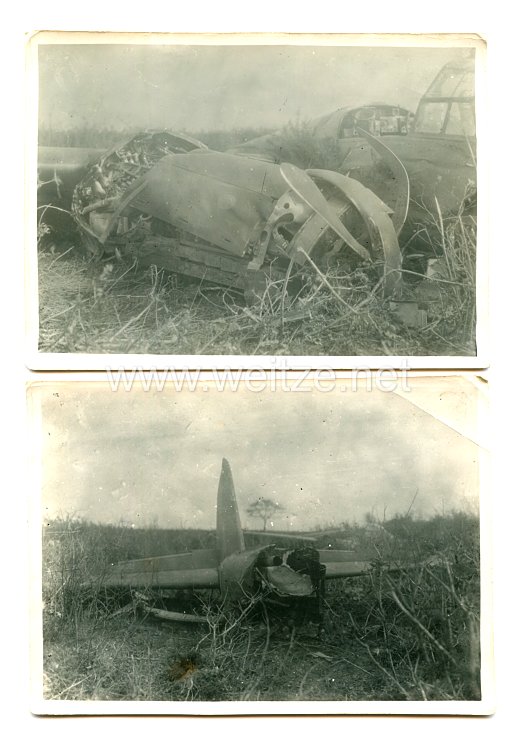
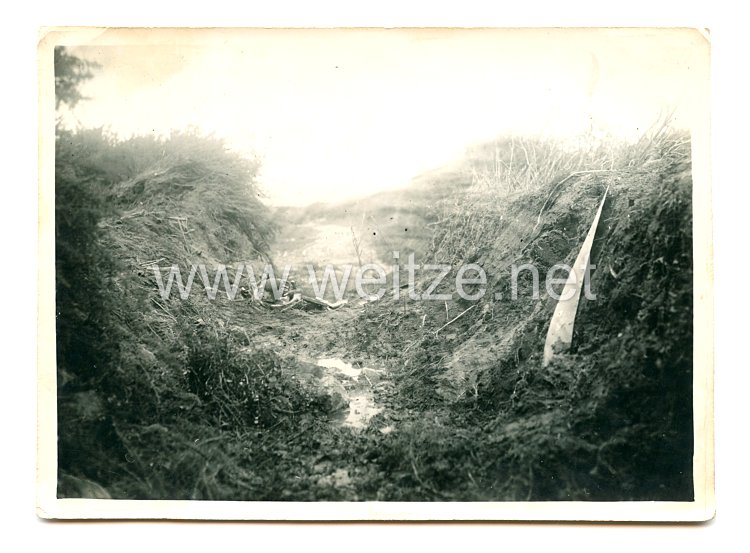
Luftwaffe Press Photo: Shot Down German Bomber
These Luftwaffe press photographs document the downing of a German bomber during World War II and belong to a significant category of propaganda material produced by both the German Wehrmacht and Allied forces. Such photographs played a central role in war reporting and public relations between 1939 and 1945.
The Wehrmacht's Propaganda Companies (Propaganda-Kompanien or PK) were established before the war began and were directly subordinated to the High Command of the Wehrmacht (OKW). These units consisted of specially trained war correspondents, photographers, and cameramen whose task was to document the war and prepare material for propaganda purposes. The Luftwaffe had its own propaganda companies that documented both successes and, to a limited extent, losses.
Interestingly, these photographs show a shot-down German bomber, which is rather unusual for German propaganda material. While Nazi propaganda primarily emphasized German successes and enemy losses, there were contexts in which German losses were also documented. This could serve several purposes: first, for factual documentation for military analysis and accident investigations; second, for heroizing fallen crews in terms of “heroic death”; and third, for internal training purposes.
The German bomber fleet included various types, including the Heinkel He 111, the Junkers Ju 88, the Dornier Do 17, and later the Heinkel He 177. These aircraft formed the backbone of German strategic and tactical bomber units. During the Battle of Britain (1940), fighting on the Eastern Front, and over the Mediterranean, these bombers suffered considerable losses from enemy fighters, anti-aircraft fire, and technical problems.
The loss rate of German bombers was particularly dramatic during certain operations. During the Battle of Britain, the Luftwaffe lost approximately 1,700 aircraft of all types between July and October 1940. On the Eastern Front, where German bombers operated against Soviet air defenses, losses increased continuously, especially after 1943 when the Red Air Force grew increasingly stronger.
Press photographs of this type were processed according to standardized procedures. After being taken by PK photographers, the negatives were developed and sent to the Propaganda Department. There, censorship and selection of suitable motifs took place. Approved photos often received a stamp and were provided with captions before being released to newspapers, magazines, or for other propaganda purposes. The format of approximately 13 x 18 cm corresponds to a common press photo format of that era.
The condition of such photos – described as “used” – indicates actual use, possibly in editorial offices, archives, or for military evaluation purposes. Many of these photos bear stamps, handwritten notes, or adhesive traces on the reverse that document their provenance and use.
From today's perspective, such press photographs are important historical documents. They provide insights into the reality of aerial warfare, the propaganda machinery of the Nazi regime, and the material culture of World War II. For aviation history, they are valuable for identifying aircraft types, damage patterns, and crash sites. For media history, they document the development of war photography and image propaganda.
The collection and preservation of such documents is of considerable scientific importance. Archives such as the Bundesarchiv in Germany, the Imperial War Museum in London, or the National Archives in the USA hold extensive collections of war photography. Private collections complement these institutional holdings and contribute to preserving historical memory.