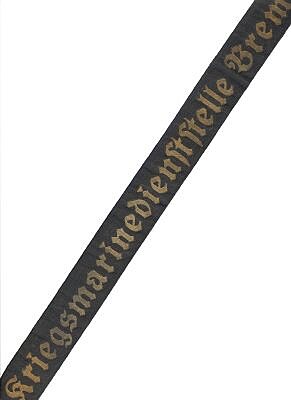
Kriegsmarine Cap Tally "Kriegsmarinedienststelle Bremen"
The Kriegsmarine cap tally bearing the inscription "Kriegsmarinedienststelle Bremen" represents a fascinating artifact of German naval military history during the Second World War. These cap tallies were essential components of the German Kriegsmarine uniform and served to identify affiliation with specific ships, fleet units, or shore establishments.
The Kriegsmarine was officially established on June 1, 1935, replacing the Reichsmarine of the Weimar Republic. Uniform regulations and equipment items were detailed in various service regulations and dress codes in subsequent years. The cap tally was worn on the peaked cap (Schirmmütze) and was typically made of black ribbon with gold-colored lettering.
The designation "Kriegsmarinedienststelle" (Naval Service Office) indicates that this was not the crew of a warship, but rather personnel assigned to a shore establishment. Bremen, as a major port city and naval base, played an important role in the Kriegsmarine's infrastructure. The city housed various naval administrative facilities, shipyards, training establishments, and supply facilities.
The naval service offices were administrative and logistical facilities responsible for administration, supply, recruitment, and training of naval personnel. Bremen contained among other facilities the naval shipyard, naval arsenal, and various administrative offices. Personnel of these establishments wore the regular Kriegsmarine uniform with corresponding cap tallies identifying their affiliation.
The manufacture of cap tallies followed standardized regulations. The black base ribbon was typically approximately 3 to 3.5 centimeters wide and was embroidered or woven with gold-colored letters in a characteristic script. The quality of execution could vary depending on the time of manufacture and available materials during the war. Toward the war's end, simplified versions were sometimes produced due to material shortages.
The wearing method of the cap tally was precisely regulated: it was placed around the cap crown, with the ends at the back featuring a small bow. The inscription should be centered on the front. For various occasions and ranks, there were specific regulations regarding cap style and wearing accessories.
The historical significance of such cap tallies lies in their function as identification markers and as part of maritime tradition. The practice of marking cap tallies with ship or unit names dates back to the 19th century and was adopted by most navies worldwide. It promoted esprit de corps and identification with the respective unit.
After the war ended in 1945, the Kriegsmarine was dissolved, and its equipment was largely destroyed or confiscated as war booty. Preserved cap tallies are therefore historical artifacts today that provide insight into the organizational structure and daily life of the Kriegsmarine. For military historical research, they are valuable sources for reconstructing the maritime infrastructure of the Third Reich.
The authentication of such objects requires knowledge of manufacturing techniques, materials used, typographic peculiarities, and aging characteristics. Original cap tallies show characteristic signs of use, material fatigue, and patina resulting from decades of storage. The lettering should be executed in the typeface typical for the period.
From a conservation perspective, the condition of such textiles is important. The materials used, particularly the gold-colored threads, can oxidize or fade over time. Proper storage under controlled climatic conditions is essential for long-term preservation.
Such artifacts serve as tangible connections to a significant period of naval history and are studied by historians, collectors, and museums worldwide. They contribute to our understanding of the organizational complexity of the Kriegsmarine and the extensive shore infrastructure that supported naval operations during World War II.