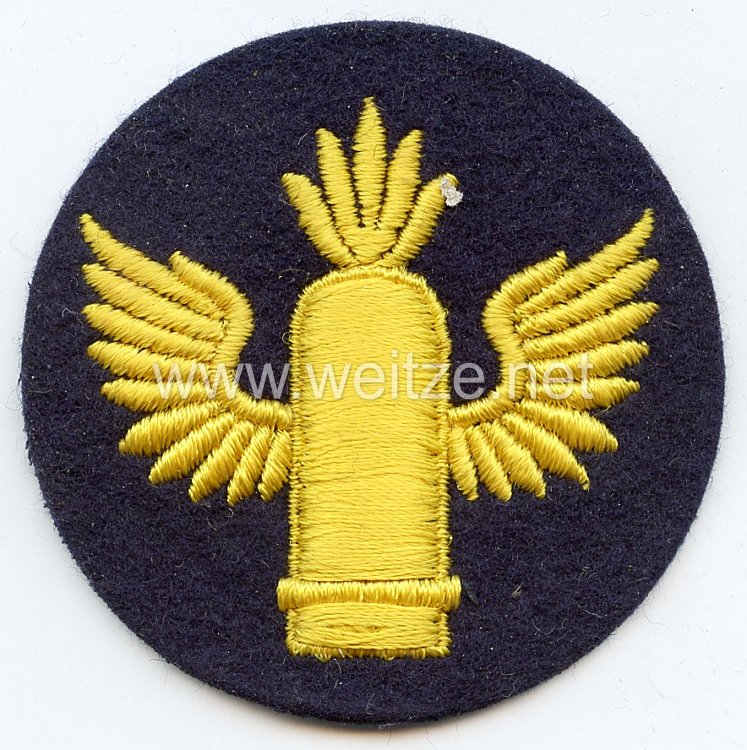
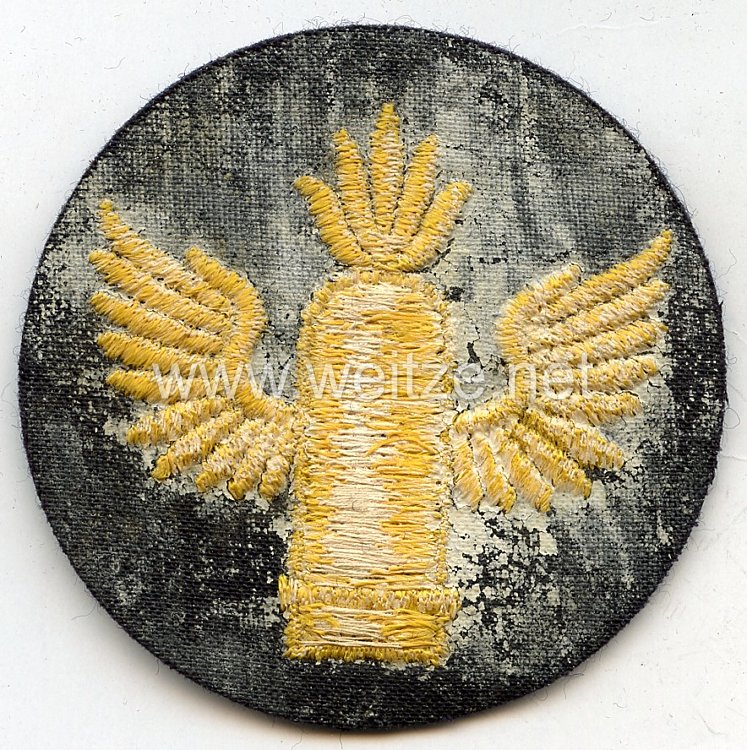
Kriegsmarine Enlisted Ranks Sleeve Insignia Naval Artillery Career Path

for the blue uniform, machine-embroidered yellow on blue. Worn condition, Condition Grade 2.
436639
15,00

Kriegsmarine Enlisted Ranks Sleeve Insignia Naval Artillery Career Path

The Kriegsmarine Sleeve Insignia for Naval Artillery Career Enlisted Personnel represents a significant example of the differentiated rank badge and career system of the German Kriegsmarine during World War II. This machine-embroidered badge in yellow on blue fabric was worn on the blue uniform and indicated that an enlisted sailor belonged to the naval artillery career path.

The Kriegsmarine, officially established in 1935 to replace the Weimar Republic's Reichsmarine, developed a complex system of career badges to identify the various specializations within the navy. Career badges (Laufbahnabzeichen) were worn on the right upper sleeve and allowed for quick visual identification of a sailor's specialty. This was particularly important in an organization that required highly specialized technical knowledge in various fields.

The Naval Artillery Career (Marineartillerielaufbahn) encompassed all enlisted men and petty officers responsible for operating, maintaining, and employing naval artillery. This was one of the most important career paths in the Kriegsmarine, as the main armament of warships consisted of various calibers of guns. Gunners had to master not only the operation of weapons but also possess knowledge of ballistics, fire control calculations, and technical maintenance.

The badge itself typically displayed crossed gun barrels or other artillery-specific symbols that clearly identified the career path. The machine embroidery in yellow on a blue background corresponded to Kriegsmarine regulations for enlisted ranks. The color yellow was traditionally associated with certain career paths in the German Navy, while the blue base color corresponded to the standard Kriegsmarine uniform.

Kriegsmarine uniform regulations were detailed in various service regulations and dress codes. The Clothing Regulations for the Kriegsmarine precisely specified which badges were to be worn by which ranks on which uniform parts. For enlisted personnel, the blue uniform was the standard service uniform worn on most occasions outside of combat duty.

The various career paths of the Kriegsmarine included, besides naval artillery, the Seaman Career, Torpedo Career, Communications Career, Medical Career, Machinist Career, and other specialized areas. Each of these careers had its own characteristic badge indicating the wearer's specialization. The system allowed superiors to recognize a crew member's qualification at a glance.

These badges were manufactured by various contractors who received orders from the navy. Machine embroidery was a cost-effective production method that nevertheless ensured adequate quality and durability. Unlike hand-embroidered badges often used for officers, machine-embroidered badges were standard for enlisted personnel.

The worn condition of a badge provides insight into its historical use. Worn examples show actual use during service and are therefore of particular historical interest. They document not only military organization but also the lives of ordinary sailors in the Kriegsmarine.

In the context of naval history, artillery played a central role in naval warfare until World War II. Although aircraft carriers and submarines became increasingly important, large-caliber guns on battleships, cruisers, and destroyers remained the main armament of the surface fleet. The training of naval gunners was intensive and required years of practice and experience.

Today, such sleeve badges are important military historical objects that document the uniform practices and organizational structure of the Kriegsmarine. They offer insights into military culture, sense of tradition, and practical requirements of naval warfare in the 20th century. For collectors and historians, they are valuable sources for understanding German naval history.

The naval artillery specialization required extensive technical training at specialized schools. Gunners learned to operate weapons ranging from small anti-aircraft guns to the massive main battery guns on capital ships. The complexity of fire control systems, especially on larger vessels, required a high level of mathematical and technical aptitude.