Spanish Cross in Gold with Swords and Diamonds

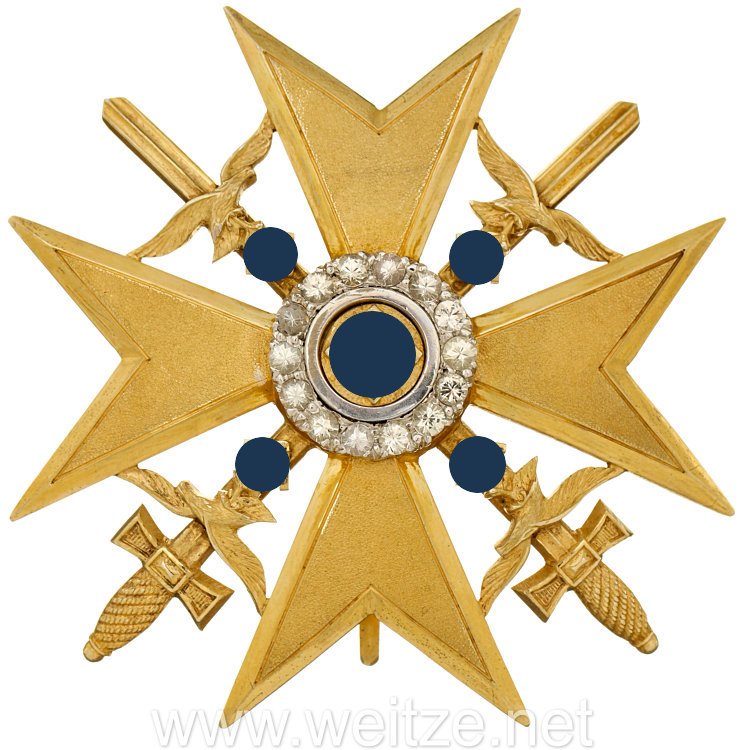
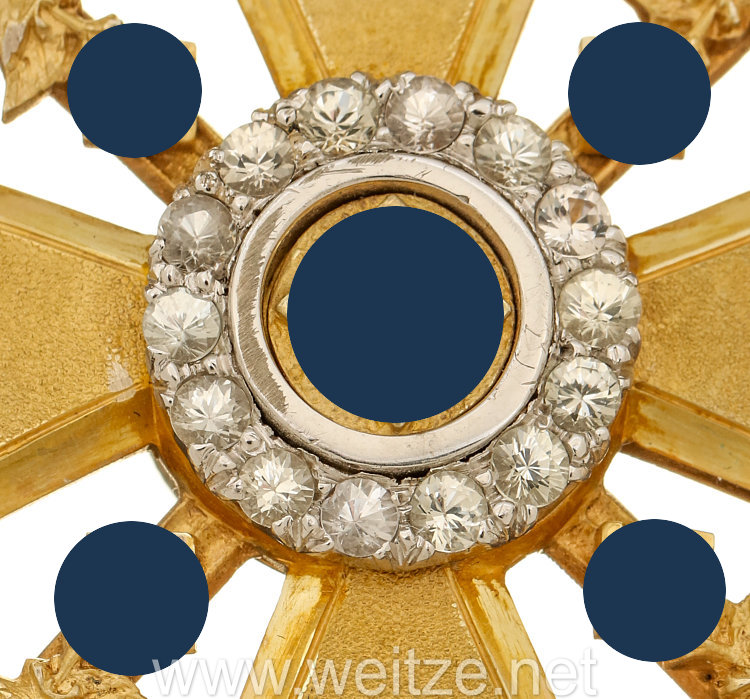
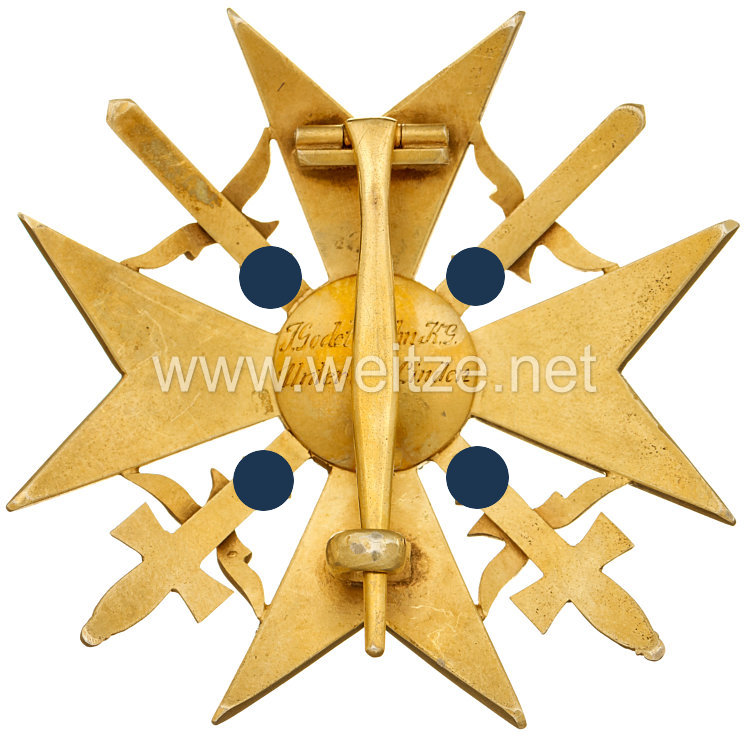
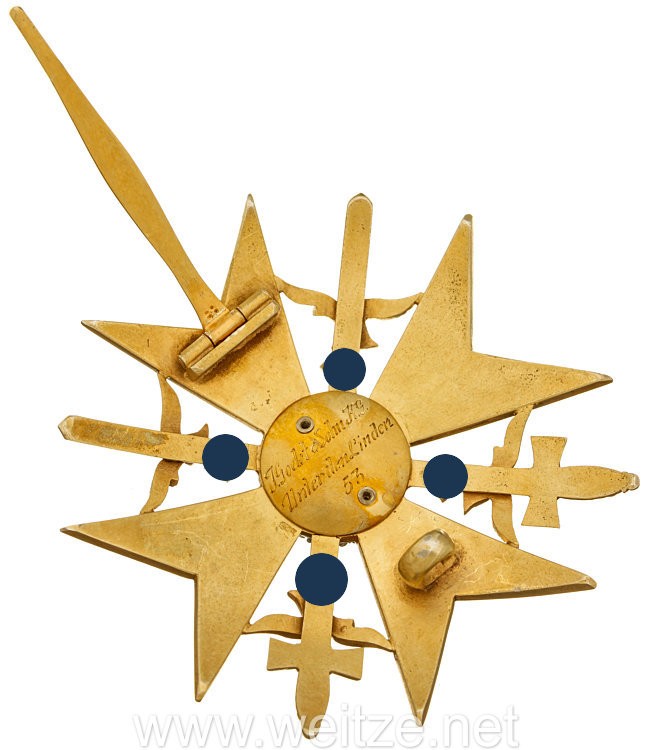
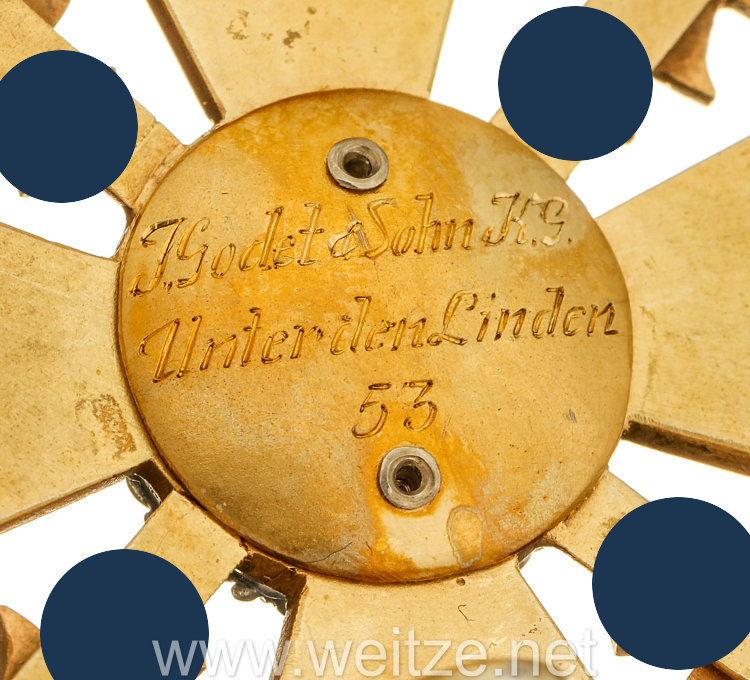
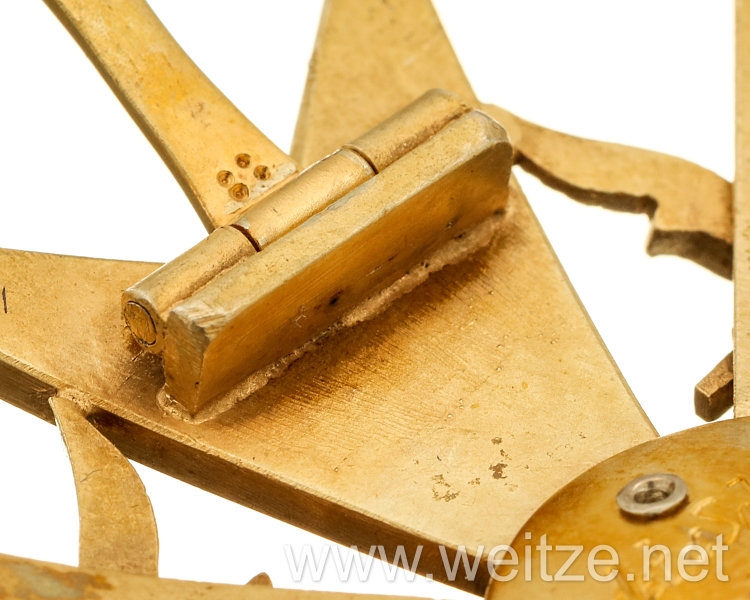
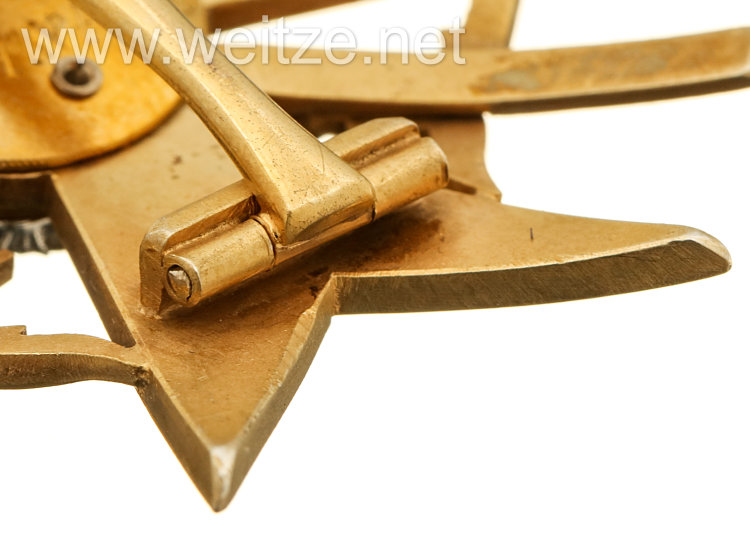
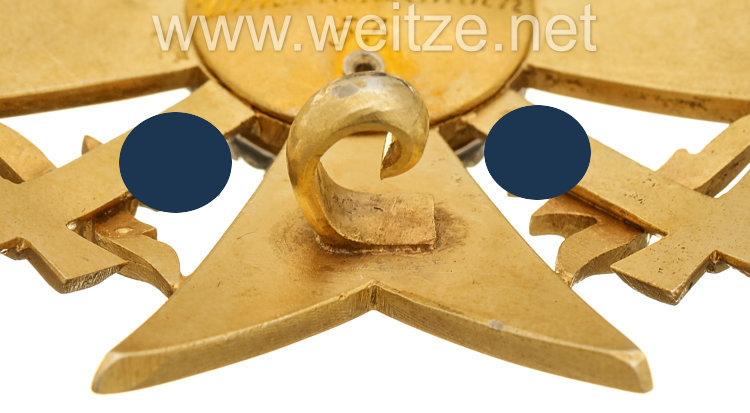
This is one of the 28 original awards conferred, circa 1939. Construction of gilt silver, 57.3 x 57.3 mm, swords 63.3 x 63.3 mm, weight 40 g. The Spanish Cross is a special execution with finely grained cross arms and wide smooth polished border. In the angles the crossed swords, upon which are mounted the Luftwaffe national eagles with polished swastikas. The medallion consists of a polished swastika with finely grained background. Surrounding it is a silver wreath with 14 white sapphires set in claws, totaling approximately 1.13 carats. The reverse is smooth golden, matte polished. The domed counter-medallion is polished with engraved maker's mark “J. Godet & Sohn, Unter den Linden 53”. The diamond wreath is connected to the front medallion with 2 hollow rivets visible from the reverse. Complete with wide pin.
The piece shows only minimal wear in excellent condition.

A total of 28 awards were made, predominantly on June 6, 1939. This badge originates from the estate of Oberst Wilhelm Ritter v. Thoma, commander of the armored troops “Imker/Drohne” of the Legion Condor, whose complete estate we had in the 1990s.
Accompanied by an extensive photographic expert opinion by Jörg Nimmergut from 2004. The piece was auctioned at Andreas Thies in 2005 and has been in a European private collection since then.
359038

The Spanish Cross in Gold with Swords and Diamonds – The Highest Decoration of the Condor Legion

Among the military decorations of the Third Reich, the Spanish Cross in Gold with Swords and Diamonds (Spanienkreuz in Gold mit Schwertern und Brillanten) occupies a singular position. As the highest grade of a decoration awarded only 28 times, it ranks among the rarest and most sought-after orders of the era. Combining the functions of a gallantry decoration and a campaign medal, it stands as a testament to Germany's military involvement in the Spanish Civil War (1936–1939).

Historical Background: The Condor Legion

With the outbreak of the Spanish Civil War in July 1936, Germany dispatched the Condor Legion, composed of members of the German air force and army, to support General Franco's Nationalist forces. The Condor Legion, composed at least publicly of volunteers, had no awards instituted during the conflict itself. This gap was addressed only after the war's conclusion: on 14 April 1939, Germany instituted the Spanish Cross as a decoration for the German airmen and soldiers who had fought in the Condor Legion during the war. The Spanish Cross thus fulfilled the dual role of a gallantry decoration and a campaign medal.

Classification and Grades

The Spanish Cross was awarded in a graduated system reflecting varying degrees of merit. The overall structure comprised six grades: Bronze without Swords, Bronze with Swords, Silver without Swords, Silver with Swords, Gold with Swords, and finally Gold with Swords and Diamonds. While the Silver and Bronze classes were awarded both with and without swords, the Gold class existed exclusively with swords. The highest grade — Gold with Diamonds — was strictly reserved for those who had demonstrated the highest achievements or outstanding leadership in action.

The Gold with Swords and Diamonds Grade

This supreme grade was awarded to members of the Condor Legion in recognition of repeated acts above and beyond the call of duty during the Spanish Civil War. It honored those who displayed great leadership skills in battle or exceptional merit. With only 28 awards, predominantly to members of the Luftwaffe, it stands in stark contrast to the Gold with Swords grade without diamonds, which was conferred 1,126 times.

The form of the Spanish Cross is based on a Maltese cross with a central medallion bearing a swastika on a roundel. Between each arm of the cross are the Luftwaffe eagle and two crossed swords placed behind the eagle symbols. The diamond class featured an additional ring around the medallion bearing 14 stones set in claws.

The Award Ceremony

While most Spanish Crosses were presented in Hamburg on 31 May 1939, the recipients of the Gold grade with Diamonds received their decorations separately in Berlin on 6 June 1939. This distinct ceremony in the Reich capital underscored the exceptional rank of this highest award grade.

Manufacture by J. Godet & Sohn

The present example bears the manufacturer's designation “J. Godet & Sohn, Unter den Linden 53.” The firm Gebrüder Godet & Co. of Berlin was one of Germany's oldest order-jewellery firms. Founded in 1761, the company was appointed Royal Court Jeweller in 1911. Its location at Unter den Linden 53, in the heart of the Prussian and later imperial German capital, was synonymous with the highest quality craftsmanship in the production of orders and decorations. The piece is manufactured from gilt silver (Silber vergoldet).

Notable Recipients

Among the 28 recipients of the Spanish Cross in Gold with Swords and Diamonds were some of the most prominent military figures of the Second World War. The flying aces Adolf Galland and Werner Mölders, both of whom had demonstrated exceptional skill during the Spanish Civil War, were among those decorated, as was the later Field Marshal Hugo Sperrle. The three commanders of the Condor Legion — Hugo Sperrle, Hellmuth Volkmann, and Wolfram von Richthofen — also received the Spanish Medalla Militar with Diamonds, along with Wilhelm Ritter von Thoma. Von Thoma commanded the Panzer unit of the Condor Legion during the Spanish Civil War and received his Spanish Cross in Gold with Swords and Diamonds on 6 June 1939 in Berlin, signed by A. Hitler.

Post-War History

Following the end of the Second World War, the wearing of Nazi-era awards was banned in 1945. While the Federal Republic of Germany reauthorized certain decorations in de-Nazified form for official wear in 1957, the Spanish Cross was not among those reauthorized. It thus remains exclusively a collector's piece and historical artifact of a turbulent chapter in European history.

This example, crafted by one of Germany's most venerable order-jewellery houses and representing one of only 28 decorations awarded at the highest grade, constitutes an extraordinary piece of twentieth-century military decoration history.