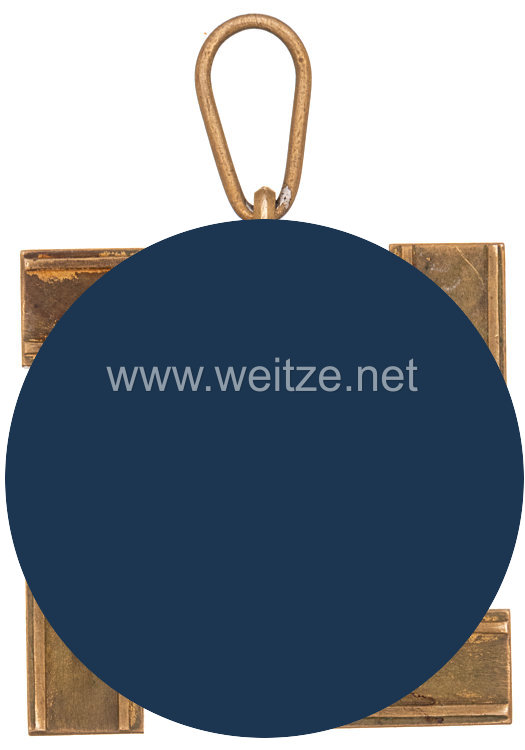
SS Long Service Award 1st Class in Gold

Cross for 25 years of service, tombac, gilding worn off. With a ribbon bar section. Worn condition, Grade 2.
The 1st Class is extremely rare.

The Long Service Awards for the SS were instituted on January 30, 1938, on the 5th anniversary of the National Socialists' seizure of power by Reich Chancellor Adolf Hitler. Eligible for the award were all units of the SS-Verfügungstruppe, the Totenkopfverbände, and the SS-Junkerschulen. On October 21, 1938, the appearance of the Long Service Award was established by decree.
The award consisted of 4 classes. The 1st Class was awarded after 25 years of service, the 2nd Class after 12, the 3rd Class after 8, and the 4th Class after 4 years of faithful service.


426438
7.500,00

SS Long Service Award 1st Class in Gold

The SS Long Service Award 1st Class in Gold for 25 years of service ranks among the rarest decorations of the Third Reich. This extraordinary rarity is explained by the historical fact that only twenty years passed between the founding of the SS in 1925 and the end of World War II in 1945 – a timespan barely sufficient to accumulate the required 25 years of service.

The SS Long Service Awards were instituted on January 30, 1938 by Reich Chancellor Adolf Hitler on the fifth anniversary of the National Socialist seizure of power. This establishment occurred at a time when the SS under the leadership of Heinrich Himmler had already risen to become one of the most powerful organizations of the Nazi state. The award was intended for members of the SS-Verfügungstruppe (SS Dispositional Troops), the Totenkopfverbände (Death's Head Units), and the SS-Junkerschulen (SS Officer Candidate Schools).

On October 21, 1938, a decree established the exact appearance and award conditions. The system comprised four grades: The 1st Class was awarded after 25 years of faithful service, the 2nd Class after 12 years, the 3rd Class after 8 years, and the 4th Class after 4 years of service.

The badge itself took the form of a cross and was manufactured from Tombak, a copper-zinc alloy particularly well-suited for the production of medals and decorations. The 1st Class was fully gilded, while the lower classes featured different surface treatments. The cross was worn on a characteristic black and white ribbon.

The extreme rarity of the 1st Class can be mathematically demonstrated: An SS member would have had to enter service no later than 1913 to accumulate the required 25 years by 1938. Since the SS was only founded in 1925 as the Schutzstaffel (Protection Squadron), only individuals who had previously served in other organizations and whose service time could be credited under certain conditions could qualify. Even with generous crediting of earlier service periods, the number of eligible recipients remained extremely small.

The award practice was strictly regulated. Beyond mere length of service, faithful service and an impeccable record were required. Disciplinary punishments or political unreliability could lead to exclusion from the award. The decoration had to be worn on the uniform according to precise regulations.

From today's perspective, these awards are significant historical documents that provide insight into the award system and hierarchical structures of the SS. The preservation of such objects in military historical collections and museums serves scholarly research and the documentation of this dark period in German history. The condition of most surviving examples shows clear signs of wear, as they were actually worn.

The manufacture of these awards was carried out by various authorized makers who had to maintain strict quality standards. Each piece underwent several production steps, from striking the Tombak blank through gilding to attaching the suspension device. The craftsmanship of these pieces was generally of very high quality.

After 1945, these awards were prohibited as part of denazification. The possession, wearing, and public display of Nazi memorabilia was strictly regulated in Germany. Today, such objects may only be collected and presented for scientific, documentary, or educational purposes.

r