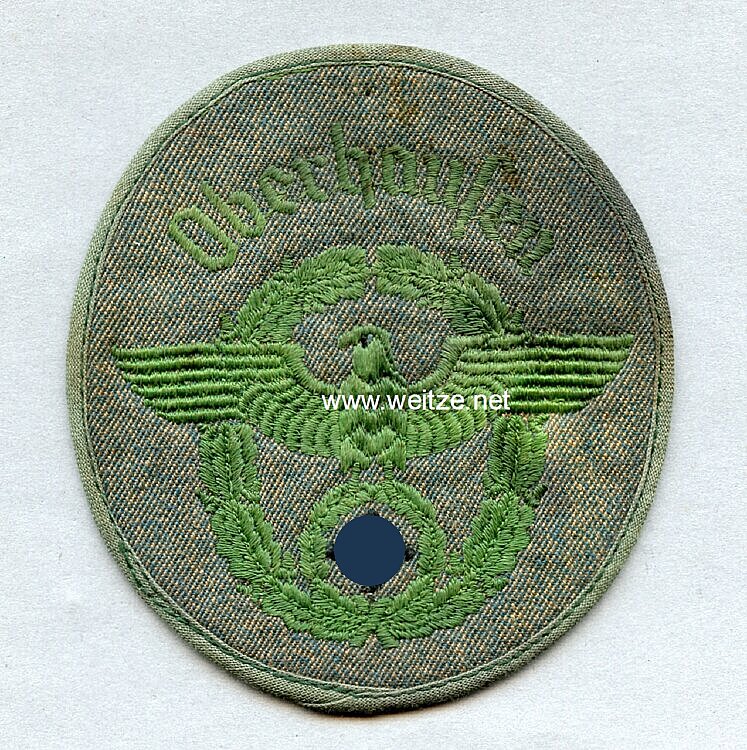
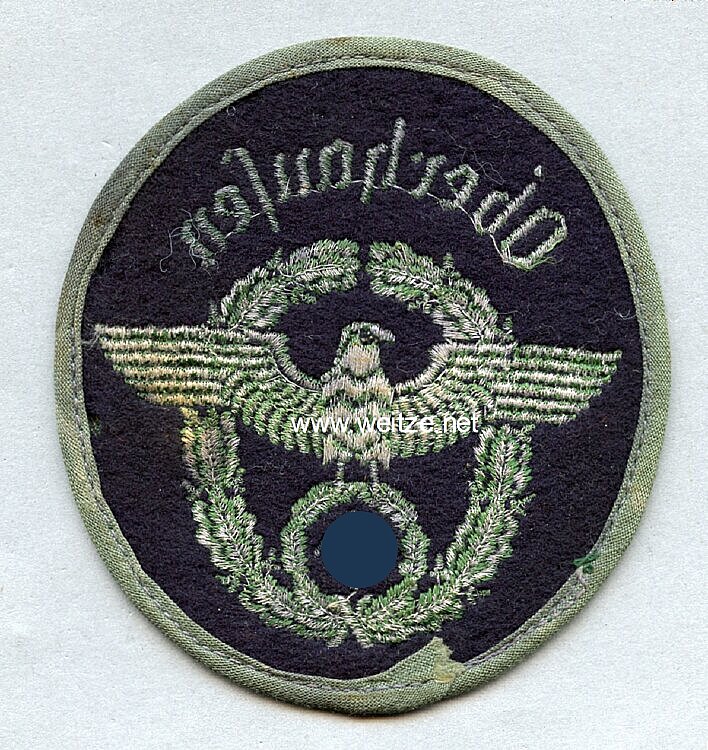
Police Sleeve Eagle for the Schutzpolizei “Oberhausen”
The Police Sleeve Eagle for the Schutzpolizei bearing the location designation “Oberhausen” represents a significant artifact of German police history during the period of National Socialism (1933-1945). This machine-embroidered insignia, manufactured for the drill uniform jacket, embodies the institutional structure and symbolic uniformization of German police forces during that era.
The Schutzpolizei, frequently abbreviated as Schupo, formed one of the three main pillars of the German Order Police alongside the Criminal Police (Kripo) and the Gendarmerie. Following the Nazi seizure of power in 1933, the German police underwent gradual centralization and coordination. In 1936, through the appointment of Heinrich Himmler as Chief of German Police, the complete integration of police forces into the SS system and the National Socialist state was achieved.
The uniformization of the Schutzpolizei was subject to strict regulations defined in various uniform regulations and dress codes. The sleeve eagle, worn on the right upper arm, served as an important national emblem and identification mark. The version for the drill jacket was particularly practically oriented: The drill uniform was primarily worn in summer and during duties requiring robust and washable clothing. The machine-embroidered process enabled cost-effective production while maintaining sufficient durability.
The marking with the place name “Oberhausen” is of particular historical significance. The city of Oberhausen in the Ruhr region held considerable strategic importance during the National Socialist period as an industrial location. The local Schutzpolizei was not only responsible for general maintenance of order but also played a role in enforcing National Socialist laws and regulations. Police presence in industrial cities like Oberhausen was particularly intensified to suppress worker protests and secure the war economy.
The eagle symbol itself followed National Socialist iconography with the characteristic national eagle (Hoheitsadler) holding a swastika in its talons. This symbolism was systematically implemented on all uniforms and insignia of state organs after 1933. The stylistic execution of police eagles differed from those of the Wehrmacht or other organizations through specific details in representation.
The technical execution as a machine-embroidered insignia was typical for the war and pre-war period. While high-ranking officers and ceremonial uniforms often received hand-embroidered insignia of better quality, machine-manufactured variants were produced for the mass of enlisted personnel. This enabled the necessary mass production at acceptable costs. Attachment to the drill jacket typically occurred through sewing, with the insignia applied directly to the fabric.
The stated condition 2-3 indicates a worn example showing signs of use. Such objects are authentic testimonies of actual daily service and differ from unworn warehouse stocks. The signs of wear can be of various nature: fading of colors through sun exposure, wear from washing, mechanical deterioration, or discoloration.
After the end of World War II in 1945, all uniform items and insignia bearing National Socialist symbolism were banned by the Allied occupation powers and largely destroyed. Surviving examples are today mainly found in museums, archives, or private collections and serve historical research and education.
For military-historical research, such objects are significant as they document the organizational structure, uniformization practices, and regional distribution of police forces. They enable conclusions about production methods, material usage, and the implementation of central regulations at the local level. The location designation makes the insignia a specific testimony to Oberhausen's history during the Nazi period.
In contemporary perspective, such objects serve as sobering examples of the instrumentalization of state institutions by totalitarian regimes. The police, which should actually serve to protect citizens, was transformed into a tool of oppression and persecution. The scholarly examination of these relics contributes to understanding this dark period of German history.