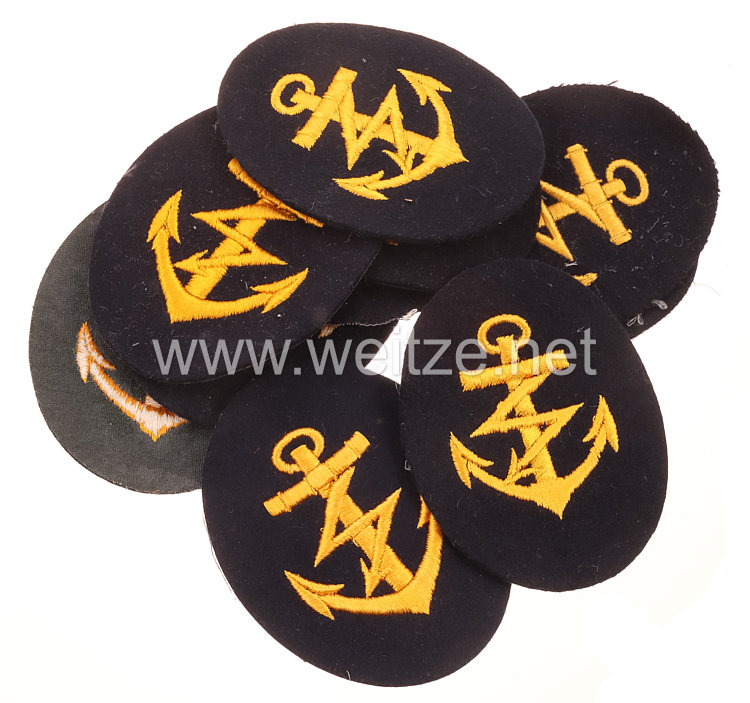
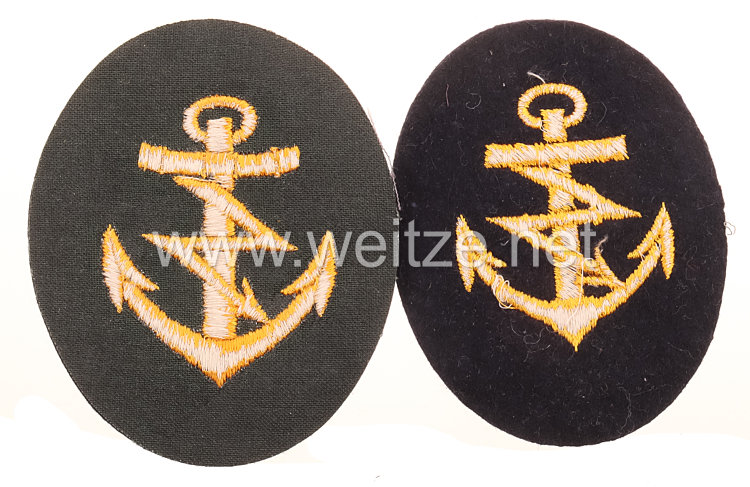
Kriegsmarine Sleeve Insignia Career Path Radio Petty Officer (Funkmaat)
Price per piece: 10 Euro.
Condition may vary.
The Kriegsmarine sleeve badge for radio petty officer (Funkmaat) represents a fascinating example of maritime uniform insignia from the Third Reich era. These career path badges were essential components of the German Kriegsmarine's uniform regulations between 1935 and 1945, serving the immediate identification of rank and specialty of naval personnel.
The Kriegsmarine, which officially emerged from the Reichsmarine on June 1, 1935, developed a complex system of uniform insignia that integrated both traditional elements of the Imperial German Navy and new National Socialist symbols. The career path badges (also called trade badges) were worn on the left upper arm of the uniform blouse and indicated the bearer's professional specialization within the navy.
The Funkmaat (radio petty officer) belonged to the communications specialist career path, which played an increasingly important role in modern naval warfare. With the growing significance of radio technology, radar technology, and electronic warfare during World War II, radio operators and communications technicians became indispensable members of every ship's crew. The rank designation “Maat” corresponded to the petty officer rank and represented the middle leadership level among enlisted ranks.
The badge described here was intended for the blue blouse, which was part of the Kriegsmarine's working and shipboard uniform. The Kriegsmarine distinguished between different types of uniforms: parade uniform, walking-out uniform, and working uniform. The blue blouse was worn during daily service aboard ship and during work, while the darker jacket uniform was prescribed for official occasions.
The manufacture of such sleeve badges was carried out by various manufacturers throughout the Reich territory. The badges were typically hand-embroidered or machine-embroidered onto a fabric base. Depending on the career path, the symbols differed considerably: mechanics wore gears, artillerymen wore crossed gun barrels, and radio operators wore characteristic symbols associated with communications technology, frequently stylized lightning bolts or radio waves.
The manner of wearing was precisely specified in the Kriegsmarine's uniform regulations. The career path badge was attached to the left upper arm approximately 10 centimeters below the shoulder seam. The position and method of attachment were precisely regulated to ensure uniformity throughout the entire fleet. The badges were usually sewn on, with sailors often doing this themselves or having it done by comrades.
During the war, production and quality of uniform components were subject to increasing restrictions. Material shortages meant that simpler versions were often produced towards the end of the war. This also explains the variation in condition of different specimens mentioned in the object description. Early wartime productions generally show finer workmanship and higher quality materials than later pieces.
The historical significance of such career path badges lies not only in their military function but also in their value as material witnesses of a bygone era. They document the organizational structure of the Kriegsmarine, technical specialization within the naval forces, and the craft tradition of uniform manufacturing. For military historians and collectors, they are important sources for researching everyday life in the German Kriegsmarine.
After 1945, collecting and trading such military historical objects in Germany was initially viewed critically. Today, trade in Kriegsmarine badges is legal as long as no unconstitutional symbols according to Section 86a of the German Criminal Code are displayed. Career path badges without swastikas do not fall under this provision and can therefore be collected and traded. They serve historical education and the preservation of material culture.
The authentication of such badges requires expert knowledge, as the market is also characterized by reproductions and forgeries. Genuine period badges exhibit specific characteristics in material, workmanship, and signs of aging that experienced collectors can recognize. The quality of embroidery, the type of base fabric, and the colors used provide important clues to authenticity.
In naval historical research, these badges help reconstruct the personnel structure and technical organization of the Kriegsmarine. They provide insights into how the German Navy adapted to the technological requirements of modern warfare and how it organized its personnel according to increasingly specialized functions. The existence of specific badges for radio operators underscores the recognition that electronic communications had become a critical component of naval operations by World War II.