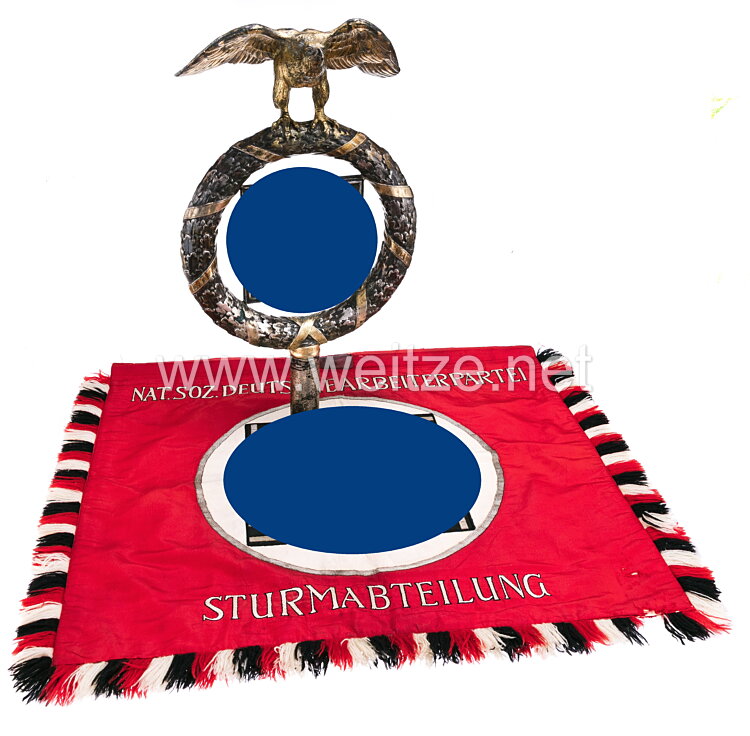
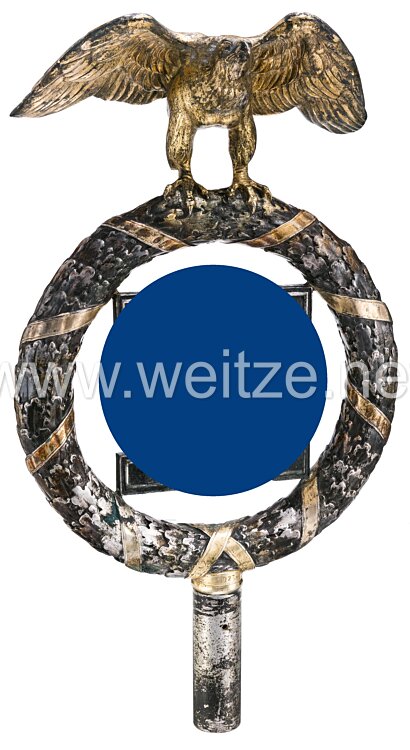
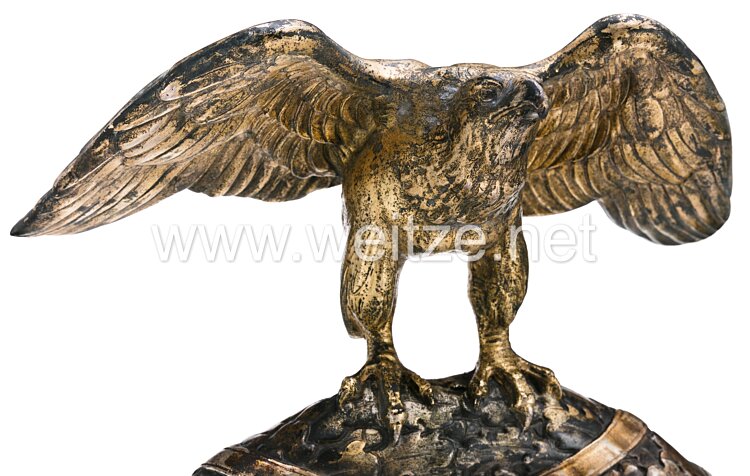
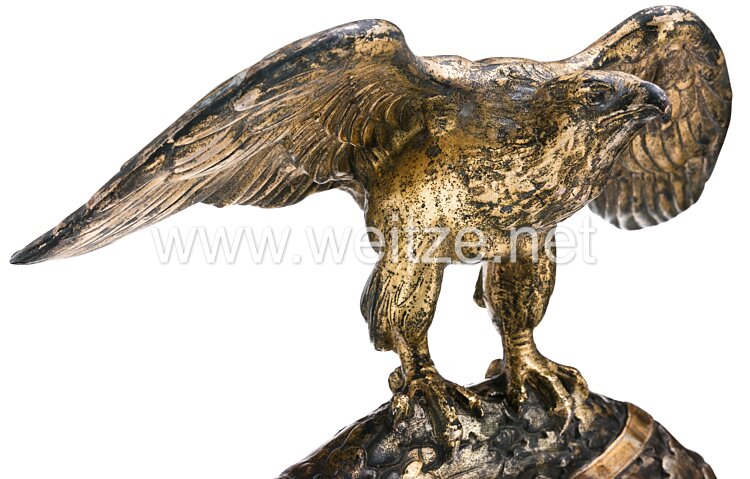
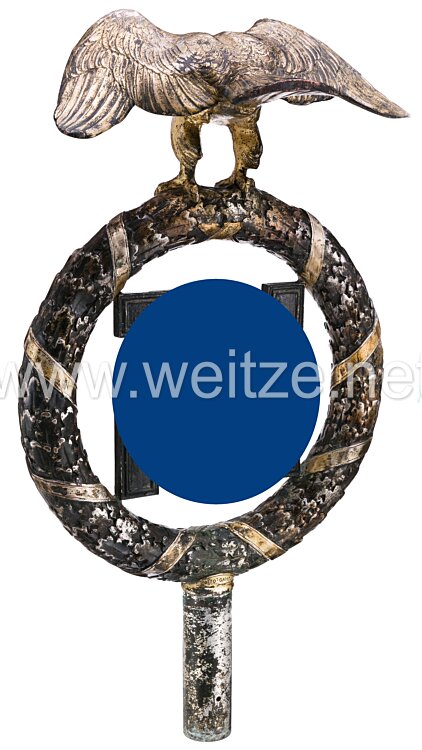
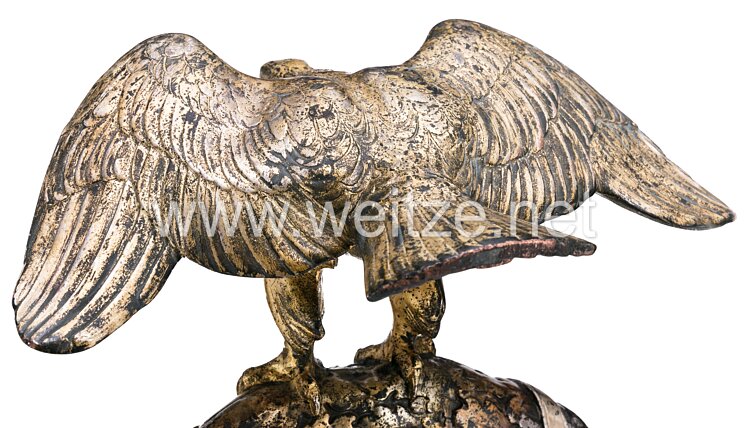
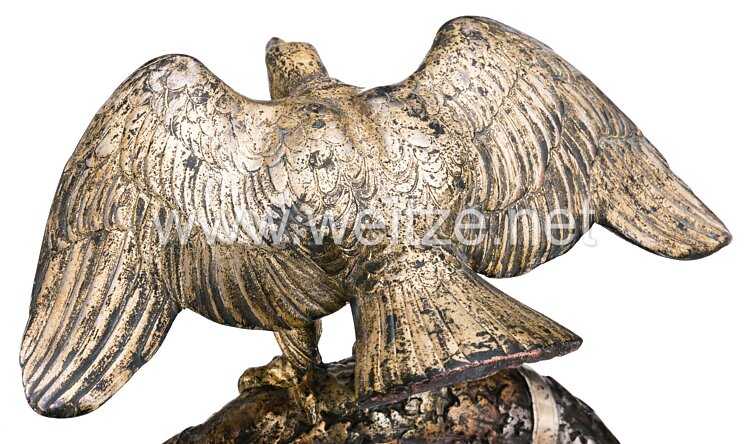
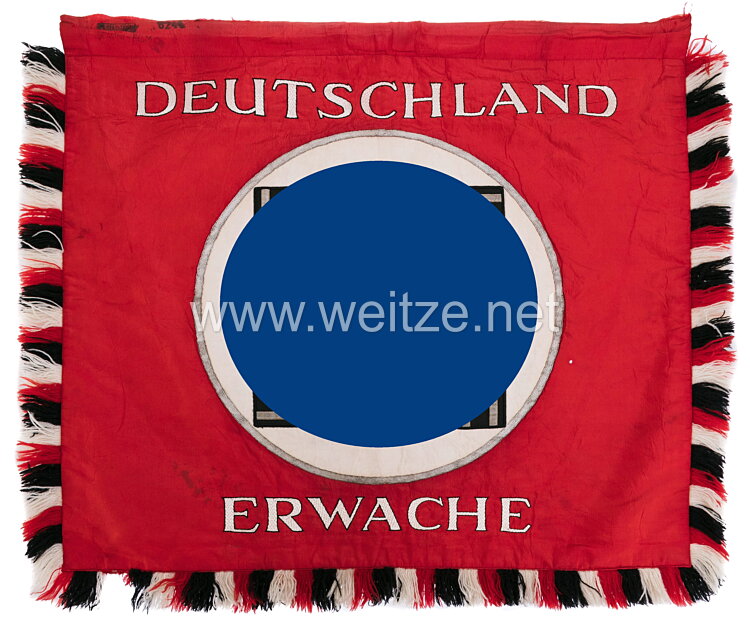
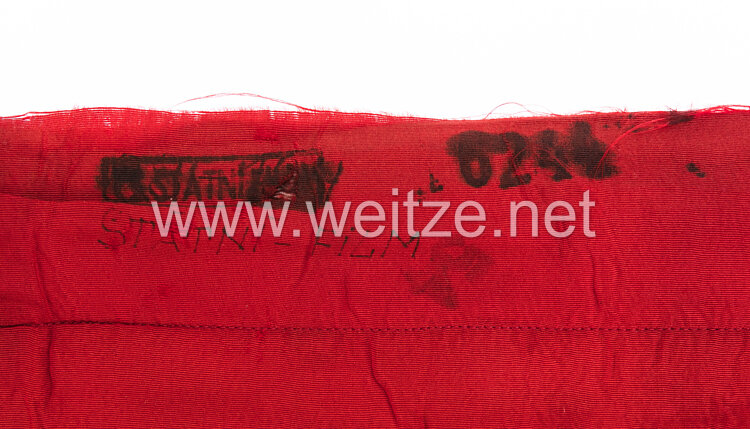
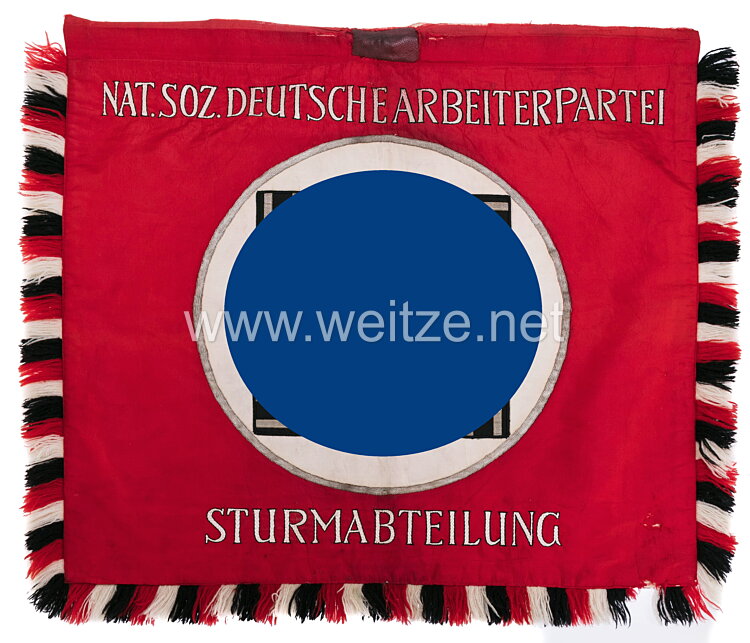
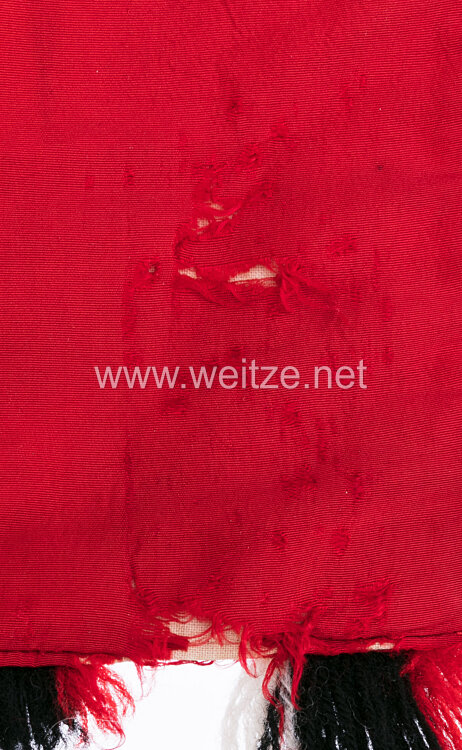
The “Deutschland Erwache” (Germany Awake) Standarte of the Sturmabteilung and Schutzstaffel ranks among the most significant and rarest relics of National Socialist Party organization. This standard consists of two main components: the gilded Standartenadler (standard eagle finial) and the Standartentuch (standard flag) made of red silk. Within the hierarchy of NS symbols, these standards occupied an outstanding position, as they were ritually consecrated through contact with the Blutfahne (Blood Flag).
The first four “Deutschland Erwache” Standards were introduced for the first time at the first Parteitag held in January 1923. After the failed putsch in November 1923, the SA was banned and reactivated in February 1925. The Blutfahne was a Nazi Party swastika flag that was carried during the attempted coup d'état on November 9, 1923, in Munich, during which it became soaked in the blood of a fallen SA man. It subsequently became one of the most revered objects of the Nazi Party and was used in ceremonies in which new flags for party organizations were consecrated by being touched by it.
The flag was that of the 5th SA Sturm. Andreas Bauriedl, an SA man marching alongside the flag, was killed and fell onto it, staining the flag with his blood. Jakob Grimminger, born on April 25, 1892, was later appointed to be the official bearer of the Blutfahne. He had served in the German Army during the Great War with sufficient distinction to be awarded the Imperial Iron Cross, 2nd Class. After the war he joined the Nazi Party and was an early member of the SS. He participated in the Munich Putsch of November 9, 1923, and later attained the rank of SS-Standartenführer and was also appointed a Councillor for the City of Munich. Grimminger survived the Second World War and the period of post-war Allied occupation, after which he is believed to have managed to obtain work as a street sweeper. He died in Munich in obscurity and poverty on January 28, 1969, at the age of seventy-seven.
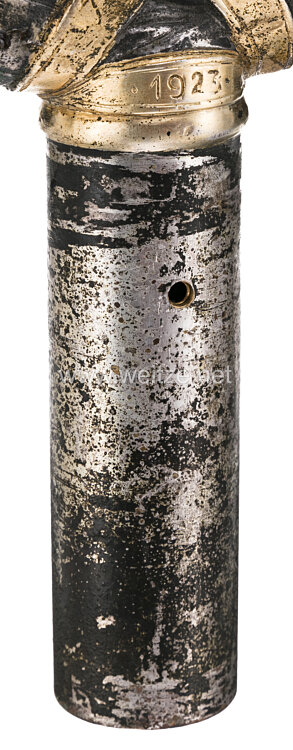
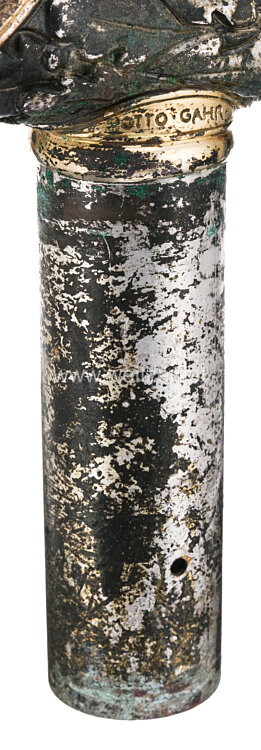
The Standartenadler for these “Deutschland Erwache” Standarten was first introduced in 1935. The standard was manufactured by Otto and Karolina Gahr of Munich, who were famous for manufacturing the eagles of the NSDAP standards and were commissioned by Hitler to make the coveted Deutschland Erwache Standards. The eagle bears the foundation date “1923” on the front of the sleeve (Tülle)—a reference to the first four standards from January 1923—and the manufacturer marking “Otto Gahr” on the reverse.
The standard eagles of the SA-Reiterstandarten differed slightly from the eagles of the SS-Reiterstandarten, the NSKK-Motorstandarten, and the NSFK-Standarten. While all eagles were gilded and the oak leaf wreaths with swastikas were all silvered, the sleeves of the SA-Reiterstandarten were silvered, significantly longer, and had a different mounting device, whereas the sleeves for the SS-Reiterstandarten, NSKK-Motorstandarten, and NSFK-Standarten were gilded.
The SA standard “Deutschland Erwache” is red with a black-white-red fringe and a white disc in the centre. A black swastika is featured on the disc, together with the words “Deutschland erwache” (awaken, Germany) on the obverse. The reverse shows the words “Nat. Soz. Deutsche Arbeiterpartei” (National Socialist German Worker's Party) and “Sturmabteilung” (Storm Troop).
In Nazi Germany, the Standarte was a paramilitary unit of the Nazi Party (NSDAP), Sturmabteilung (SA), NSKK, NSFK, and Schutzstaffel (SS). Translated literally as “Regimental standard,” the name refers to the flag paramilitary formations carried in formations and parades. The members of the SA were tasked with protecting party leaders at political rallies and meetings from the paramilitary forces of opposing political factions. The SA was first utilized on November 4, 1921.
In 1935, SS-Standarte “Deutschland” received its Deutschland Erwache standard. SS-Standarte “Germania” received its Deutschland Erwache standard in 1936. About 400 Deutschland Erwache standards were made and consecrated with the Blood Flag by Adolf Hitler.
The Blutfahne vanished after its last public display. Its current whereabouts are unknown, but it is generally assumed to have been destroyed amidst the Allied bombing of Munich in 1945. The Blutfahne was last seen in public at the Induction Ceremony of the Volksturm on October 18, 1944. Most “Deutschland Erwache” Standarten were destroyed after 1945, only a handful of pieces have survived. Most of these were destroyed by the Soviets, making this standard an extreme rarity.