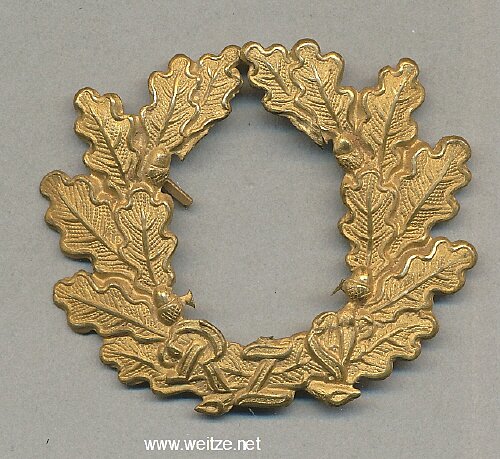
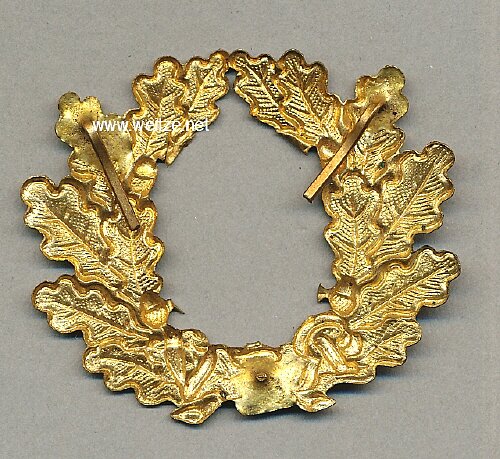
Weimar Republic Cap Wreath for an Official of the Reichszollverwaltung (Reich Customs Administration)

gilt cap wreath, condition 2
212737
40,00

Weimar Republic Cap Wreath for an Official of the Reichszollverwaltung (Reich Customs Administration)

The cap wreath for an official of the Reich Customs Administration from the era of the Weimar Republic (1919-1933) represents a significant chapter in German administrative history. These gilt insignia served as rank badges and symbolized the authority of state customs officials during a period of profound political and economic upheaval.

Following the end of World War I and the abdication of Kaiser Wilhelm II in November 1918, the Weimar Republic emerged as Germany's first parliamentary democracy. The new republic inherited not only a politically destabilized country but also a complex administrative system that needed to be reformed and adapted to the new democratic structures. The Reich Customs Administration played a central role in this process, as it was responsible for collecting tariffs and controlling the movement of goods across borders – an essential task during economically turbulent times.

The uniforming and identification of customs officials followed precise regulations set forth in various decrees and ordinances. The cap wreath as part of the service cap was an essential identifying mark that designated the wearer as a representative of state authority. The gilding of the wreath emphasized the official character and dignity of the office. Unlike military rank badges, which were often made of silver or other metals, the golden coloring was typical for civil servants of higher ranks.

The Reich Customs Administration of the Weimar Republic faced enormous challenges. The Treaty of Versailles of 1919 had not only imposed territorial losses on Germany but also substantial reparation payments. In this context, the customs administration had to reorganize border controls while simultaneously contributing to the stabilization of state finances. The hyperinflation of 1923 represented another massive burden that also complicated the procurement and manufacture of uniform parts and insignia.

The design of the cap wreath followed traditional German models dating back to the 19th century. Typically, such a wreath consisted of stylized oak leaves or laurel branches, which in German symbolism stood for strength, permanence, and state authority. The craftsmanship was carried out by specialized manufacturers who specialized in the production of militaria and official insignia.

The organization of the Reich Customs Administration was hierarchically structured. There were various service ranks, from simple customs assistants through customs inspectors to higher administrative officials. Each rank had its specific uniform regulations and badges. The cap wreath was a status-indicating element that, together with other uniform parts such as shoulder pieces, buttons, and collar patches, provided a complete picture of the rank hierarchy.

The quality of execution – here rated as condition 2 – provides information about the preservation of the object. In the grading scale for military and civil antiques, condition 2 typically denotes a well-preserved piece with minor signs of wear that has largely retained its original gilding. This speaks to careful preservation over the decades.

With the Nazi seizure of power in 1933, the Weimar Republic came to an end. The customs administration was integrated into the National Socialist system of rule, and its uniform regulations were changed accordingly. Cap wreaths from the Weimar era thus lost their official validity and were replaced by new insignia with National Socialist symbolism. This makes originals from the Weimar period sought-after historical collectibles today.

For collectors and historians, such objects are of particular value as they represent authentic testimonies of a specific historical epoch. They provide insights into administrative structures, material culture, and the self-representation of the Weimar state. The scholarly study of such insignia contributes to understanding everyday history and the functioning of state institutions in the interwar period.

r