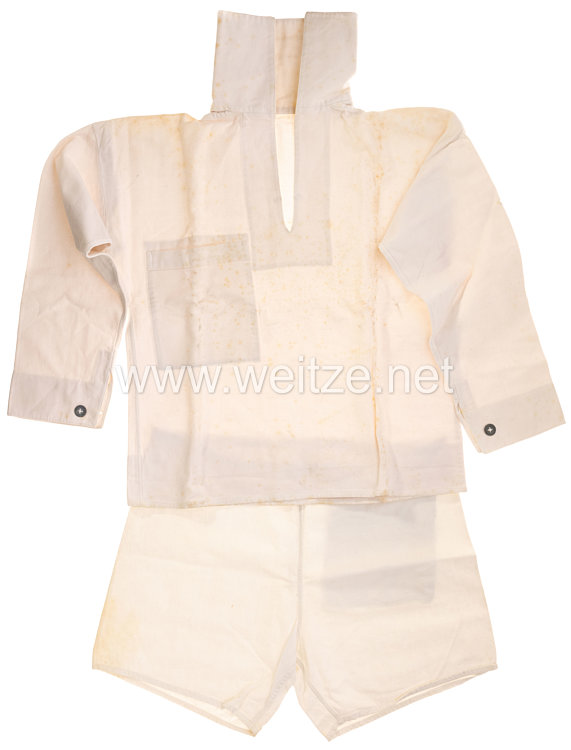
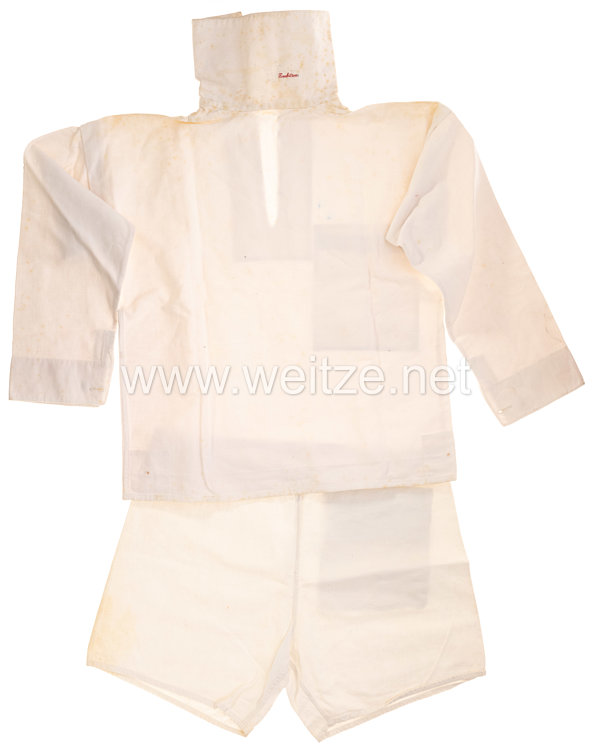
Reichsmarine Work Shirt and Shorts for a Sailor
The shirt and shorts have been washed and fluoresce under UV light. Condition 2.
These garments – a work shirt and short trousers made of light linen – represent the typical working uniform of a sailor in the Reichsmarine during the Weimar Republic. The Reichsmarine, Germany's navy between 1919 and 1935, was severely restricted by the Treaty of Versailles and was only permitted to maintain a limited number of ships and personnel.
The work shirt, often referred to as Tackelpäckchen in naval terminology, is made from undyed linen, a robust and durable material that was excellently suited for heavy physical labor aboard ship. With an overall length of approximately 57 cm and a chest circumference of about 106 cm, it conformed to the standard measurements of naval clothing of that era. The undyed linen was not only cost-effective to produce but also practical, as it could be washed frequently without losing quality.
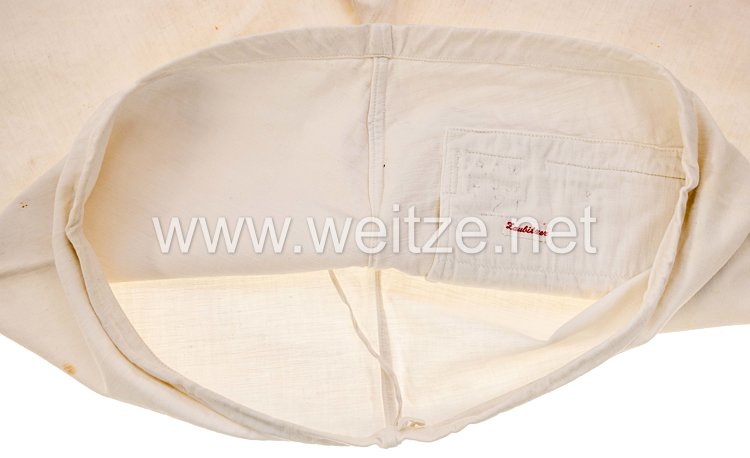
The short trousers made of white linen complemented the work outfit and were particularly suitable for work in warmer climates or in the engine room, where temperatures often became unbearably high. With a waist circumference of approximately 88 cm and an overall length of 37 cm, they offered maximum freedom of movement during physically demanding tasks.
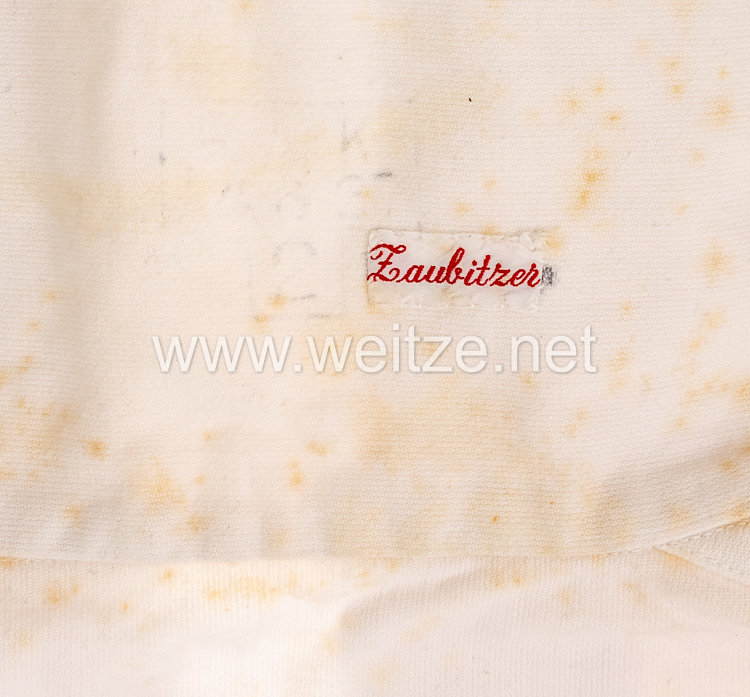
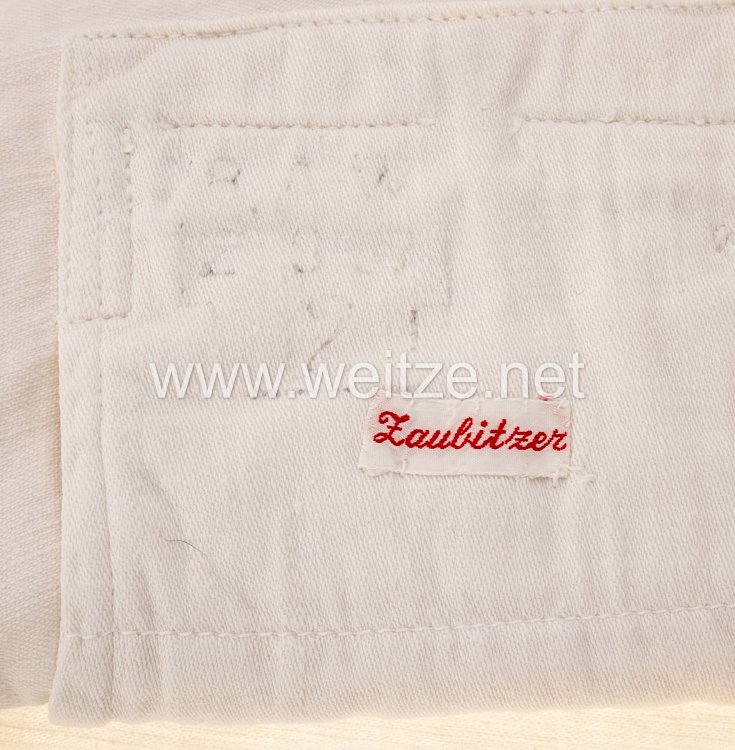
Both garments bear the owner's label with the name “Laubitzer,” indicating the original owner. This personalization was common practice in the Reichsmarine to identify individual sailors' equipment and prevent mix-ups. The chamber stamp visible on the trousers, “B.-A.-W..... 29 ?” suggests an issue or registration in 1929, possibly through the Clothing Office Workshop or a similar administrative unit.
The working uniform of the Reichsmarine differed significantly from the representative dress uniform. While the parade uniforms consisted of dark cloth with characteristic collars and insignia, the working clothes were designed purely for functionality. Sailors wore these simple linen outfits during the numerous daily tasks aboard ship: deck scrubbing, coaling, painting work, in the laundry, or in the engine room.
The linen used was a traditional material for naval clothing. It was breathable, absorbent, and dried relatively quickly – important properties in the humid environment of a warship. The light color also had the practical advantage of making dirt easily visible, which promoted hygiene aboard ship.
The fact that both garments fluoresce under UV light indicates the use of optical brighteners or detergents used in later years during cleaning. This is a common phenomenon with historical textiles that have been washed multiple times over the decades.
The Reichsmarine of the Weimar Republic was a professional force with high quality standards. After World War I and the drastic restrictions of the Treaty of Versailles, particular emphasis was placed on discipline, training, and equipment maintenance. The navy was allowed a maximum of 15,000 men and only a limited number of ships. This led to a highly professionalized force in which every individual sailor was well-trained.
The supply of clothing and equipment was handled by the Naval Supply Office and its subordinate agencies. Each sailor received a basic kit upon enlistment, which included various uniforms, work clothes, and personal equipment items. The marking with names and stamps was part of a sophisticated logistics system.
Such work clothing items are relatively rare today, as they were worn as utilitarian objects until they became unusable and were then discarded. Representative uniform pieces were more likely to be preserved, while simple work clothes were usually lost. This makes surviving examples valuable historical documents of maritime everyday life.
The condition rating of 2 indicates good preservation, although the pieces were obviously worn. The ability to identify the original wearer, “Laubitzer,” by name gives these objects a special personal note and makes them more than just anonymous uniform parts – they tell the story of an individual sailor in the German Navy of the interwar period.