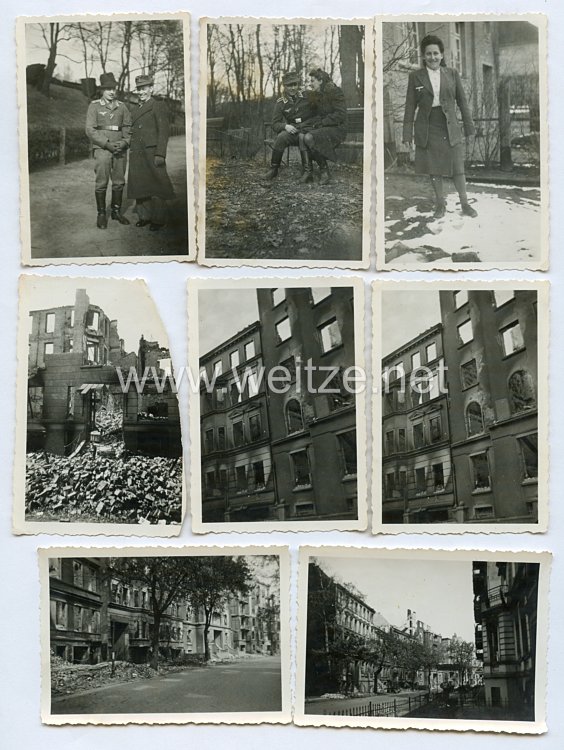
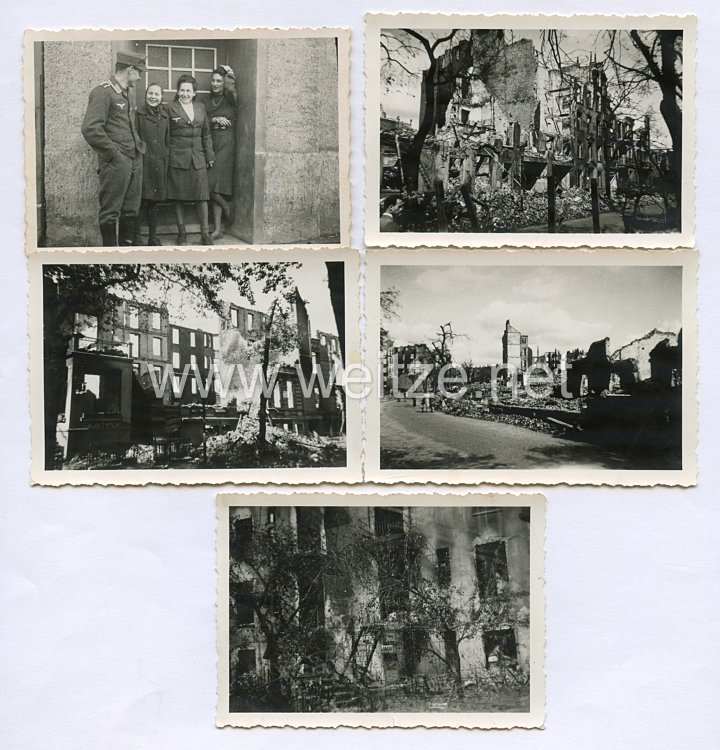
Luftwaffe Photo Group, Non-Commissioned Officer in a Destroyed German City
This collection of 13 photographs documenting a Luftwaffe Unteroffizier (non-commissioned officer) in a destroyed German city provides a compelling glimpse into the reality of World War II on German soil. Such photographic evidence is of invaluable historical significance, as it documents the devastating effects of the air war and the final years of the conflict.
The German Luftwaffe, officially established in 1935, played a central role in German warfare. The Unteroffizier depicted here belonged to the non-commissioned officer corps, which formed the backbone of military organization. NCOs were responsible for smaller units and formed the link between enlisted personnel and the officer corps. They served in all areas of the Luftwaffe, from aircrew to anti-aircraft units, ground personnel, and technical services.
Photography played an important role during World War II, both for military purposes and private documentation. Soldiers frequently carried private cameras to record their experiences. Simultaneously, official Propaganda Companies (Propagandakompanien or PK) conducted professional war reporting. This collection appears to be of a private nature, making it particularly valuable as it offers unfiltered impressions of wartime daily life.
The depiction of a destroyed German city points to the dramatic turning point of the war from 1943 onwards. The Allied bomber offensives, particularly the Combined Bomber Offensive by the British RAF and American USAAF, led to the systematic destruction of German cities. Major cities such as Hamburg, Dresden, Cologne, Berlin, and numerous others were severely hit by area bombing. Operation Gomorrah against Hamburg in July 1943 and the bombing of Dresden in February 1945 are particularly well-known examples.
For members of the Luftwaffe, confrontation with destruction at home held special significance. Originally conceived as an offensive force, the Luftwaffe increasingly had to assume defensive duties. Flak units (anti-aircraft artillery) were massively expanded to protect cities, sometimes employing Luftwaffe auxiliaries and civilians. Nevertheless, destruction could not be prevented.
The Unteroffizier's uniform followed the Luftwaffe uniform regulations, which differed from those of the Army and Navy. The characteristic blue-grey uniform, introduced in 1935, was intended to emphasize the independence of the service branch. NCOs wore specific rank insignia, typically braid and chevrons on the lower sleeves. The exact design changed during the war, with simplified field variants often worn later.
Photographic collections like this provide insights into various aspects: The war destruction demonstrates the extent of Allied air superiority in the final war years. The fields of rubble document not only military defeat but also humanitarian catastrophes, as millions of Germans lost their homes and hundreds of thousands died in air raids. They simultaneously document the presence of military personnel in these ruins, whether during cleanup operations, transit, or as part of homeland defense.
From 1944 onwards, Luftwaffe units were increasingly deployed as ground troops, as the Luftwaffe could barely fulfill its original tasks due to material and fuel shortages. Luftwaffe Field Divisions were formed, often poorly trained for ground combat, and deployed on various fronts. This explains the presence of Luftwaffe personnel in unusual contexts.
The historical value of such photographs is considerable. They serve as primary sources for researching daily wartime life, destruction, uniforms, and individual experiences. For urban history research, they can help identify specific locations and buildings and document the degree of destruction. For military history, they offer insights into equipment, organization, and Wehrmacht presence on the home front.
The preservation of such photographic estates is important for collective memory and scholarly research, even if their condition is described as used, which is typical for materials that are 80 years old.