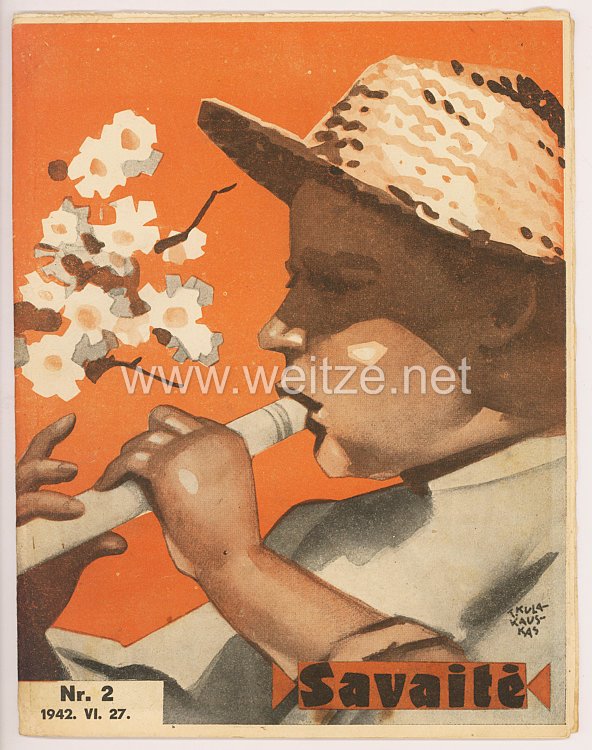
Third Reich / Lithuania - Magazine "Savaitė" - Volume 1942 No. 2

Condition 2-.
377337
25,00

Third Reich / Lithuania - Magazine "Savaitė" - Volume 1942 No. 2

The magazine “Savaitė” (in English: “The Week”) represents a significant historical document from the period of German occupation of Lithuania during World War II. This issue No. 2 from the year 1942 documents a complex and tragic period of Lithuanian history when the country was under German control and collaboration structures between local and German authorities became manifest.

Following the German invasion of the Soviet Union in June 1941 as part of Operation Barbarossa, Lithuania, which had been under Soviet rule from 1940 to 1941, was occupied by the Wehrmacht. The Baltic region was administratively assigned to the Reichskommissariat Ostland under the leadership of Hinrich Lohse. Lithuania formed its own Generalbezirk Litauen (General District Lithuania) with headquarters in Kaunas, led by General Commissioner Adrian von Renteln.

German occupation policy in the Baltic states pursued several objectives: economic exploitation of the region, Germanization of certain areas, and implementation of National Socialist racial and extermination policies. In this context, publications like “Savaitė” played an important role in the propaganda and information policy of the occupying power.

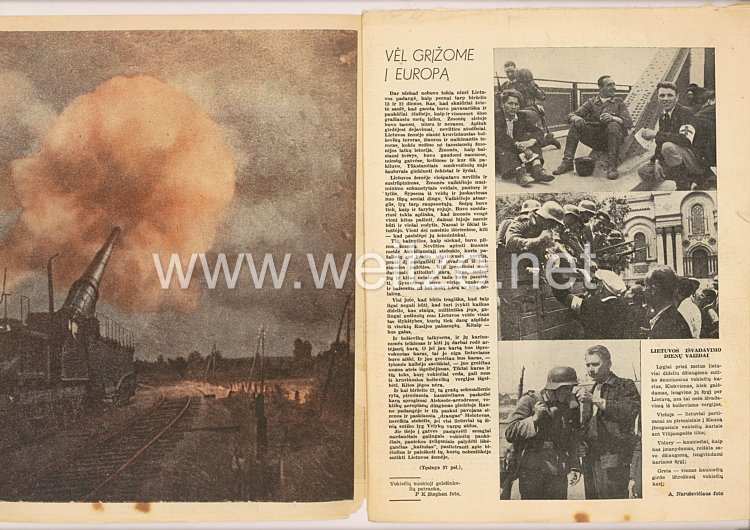
“Savaitė” was a Lithuanian-language illustrated weekly newspaper that appeared during the German occupation period. Such publications served multiple purposes: they were meant to inform the Lithuanian population about the “new order,” legitimize the German occupation, and spread anti-communist and antisemitic propaganda. At the same time, German authorities attempted to achieve a certain level of acceptance among the population by using the Lithuanian language and involving local editors.

The year 1942, from which this issue originates, marks a particularly dark phase of the occupation period. By this time, the systematic persecution and murder of Lithuania's Jewish population was already far advanced. The Einsatzgruppen, particularly Einsatzgruppe A under the command of SS-Brigadeführer Franz Walter Stahlecker, had already murdered tens of thousands of Jewish people together with Lithuanian collaborators. The Vilnius Ghetto had been established in 1941, and mass extermination continued throughout 1942.

The press under German control did not report truthfully on these crimes but instead spread National Socialist ideology and attempted to justify occupation policies. Magazines like “Savaitė” typically contained articles about the war on the Eastern Front, economic topics, cultural contributions, and propaganda against the Soviet Union and Judaism.

Collaboration between German occupation authorities and segments of Lithuanian society was complex and contradictory. While some Lithuanians viewed the German occupation as liberation from Soviet rule and hoped to regain national independence, it quickly became clear that National Socialist Germany would not grant genuine autonomy. Nevertheless, Lithuanian collaborators participated in German occupation administration, police units, and even in murder operations against Jews and other persecuted groups.

The year 1942 was also characterized by increasing mobilization of the Lithuanian population for the German war economy. Workers were deported to Germany, agricultural products were confiscated, and the entire economy was oriented toward the needs of the Wehrmacht. The press played a central role in propagating these measures and attempting to present them as necessary for the “struggle against Bolshevism.”

For historical research, magazines such as “Savaitė” are important sources for understanding the propaganda mechanisms of the occupation period and reconstructing everyday reality under German rule. They document not only the official line of occupation policy but also provide insights into cultural, social, and economic aspects of life in occupied Lithuania.

After the war, Lithuania was again occupied by the Soviet Union and remained part of the USSR until 1990. The process of coming to terms with the history of the German occupation period and collaboration remains a sensitive topic in Lithuania to this day. Documents such as this issue of “Savaitė” are important testimonies of this dark period and remind us of the complexity of historical events and the necessity of differentiated historical examination.

r