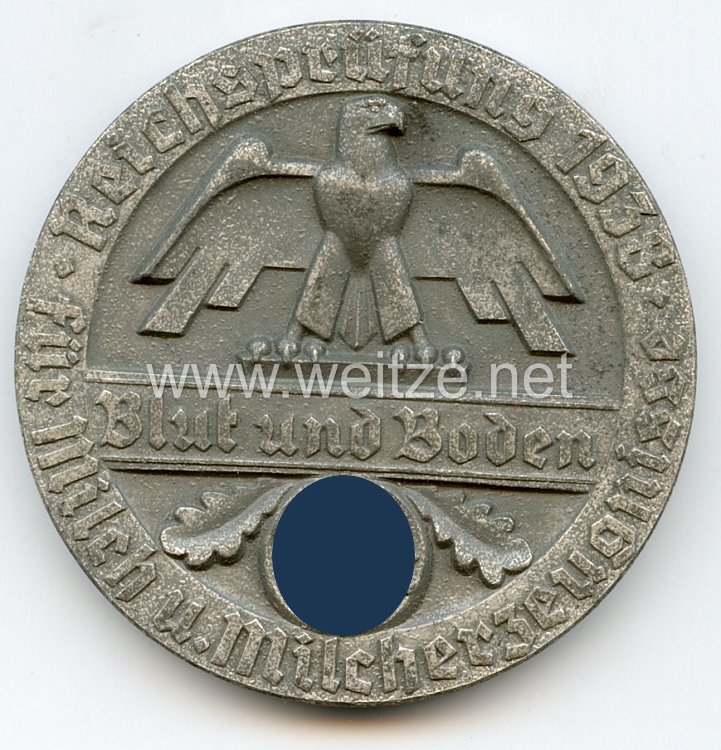
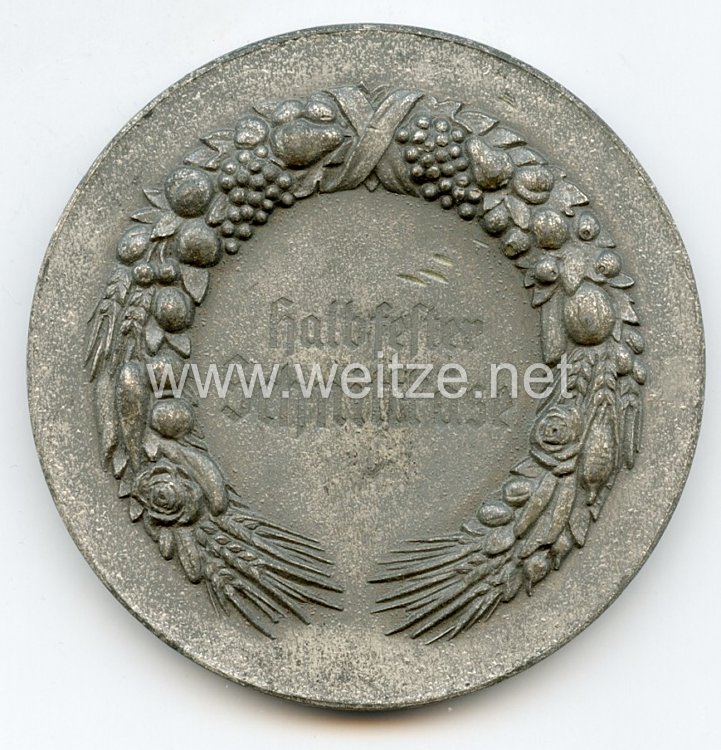
Reichsnährstand “Reichsprüfung 1938 für Milch u. Milcherzeugnisse”
This medal originates from the Reichsnährstand (Reich Food Estate) award system and documents a success at the Reich Examination 1938 for Milk and Dairy Products. This silver winner's medal for semi-hard cheese is a fascinating testament to National Socialist agricultural policy and its efforts toward quality standardization in German food production.
The Reichsnährstand was established on September 13, 1933, through the Reich Food Estate Law and was led by Richard Walther Darré as Reich Peasant Leader. This organization was far more than an agricultural interest group; it represented a compulsory corporation to which all persons involved in the production, processing, and distribution of agricultural products had to belong. The Reichsnährstand embodied the Nazi ideology of “Blood and Soil” and was intended to secure the autarky of the German Reich in food supply.
The Reich Examinations were systematic quality competitions conducted annually in various categories. The 1938 examination for milk and dairy products was part of a comprehensive system for promoting and controlling food quality. These competitions served multiple purposes: they aimed to improve the quality of German agricultural products, encourage producers' performance, and simultaneously demonstrate the superiority of German agriculture under National Socialist leadership.
The category “Semi-hard Cheese” was a specific classification within German cheese production. Semi-hard cheeses are characterized by a water content of 61-69% in the fat-free cheese mass and include popular varieties such as Butterkäse, Edam, or Gouda. Cheese production had a long tradition in Germany, and standardization through the Reichsnährstand was intended to both strengthen domestic production and reduce imports of foreign products.
The medal itself was made from fine zinc and has a diameter of 60 mm. The use of zinc instead of genuine silver was typical for the period, particularly from the mid-1930s onward, when the German Reich increasingly struggled with raw material shortages. Despite its silver appearance, it is a silver-plated or silver-colored coated zinc alloy. These material-saving measures were part of preparations for the coming war and the Four-Year Plan policy initiated in 1936 under Hermann Göring.
The year 1938 was a significant year in the history of National Socialism. It marked the “Anschluss” of Austria in March, the Sudeten Crisis in autumn, and the Munich Agreement in September. Despite increasing military expansion and war preparations, the regime continued its domestic programs, which included agricultural quality competitions. These served to maintain a sense of normalcy domestically and demonstrate economic strength.
The awarding of such medals carried considerable prestige. Winners were published in trade journals and local newspapers, and the awards could be used for advertising purposes. This not only increased sales of the award-winning products but also strengthened the bond between agricultural producers and the Nazi regime. The systematic recognition and reward of achievement was an important element of National Socialist governance technique.
After World War II, the Reichsnährstand and all its institutions were dissolved. The denazification policy of the Allies aimed to eliminate all structures of the Nazi regime. Medals and awards from the Reichsnährstand lost their official significance and became historical artifacts. Today, they are collector's items that provide insight into the comprehensive penetration of daily life by National Socialist ideology.
From a scholarly perspective, such objects document the Nazi regime's attempts to achieve economic autarky through control and standardization of food production. They also show how the regime instrumentalized cultural and economic aspects of German life for its ideological purposes. The preserved medals are important sources for understanding agricultural policy, economic management, and propaganda strategies of the Third Reich.
It is crucial to note that these objects should be understood within their historical context. They represent a period of totalitarian control where even agricultural competitions served political purposes. Modern scholars and collectors approach such items as educational tools that help illuminate the mechanisms through which authoritarian regimes sought to control every aspect of society, from military matters to the production of cheese.