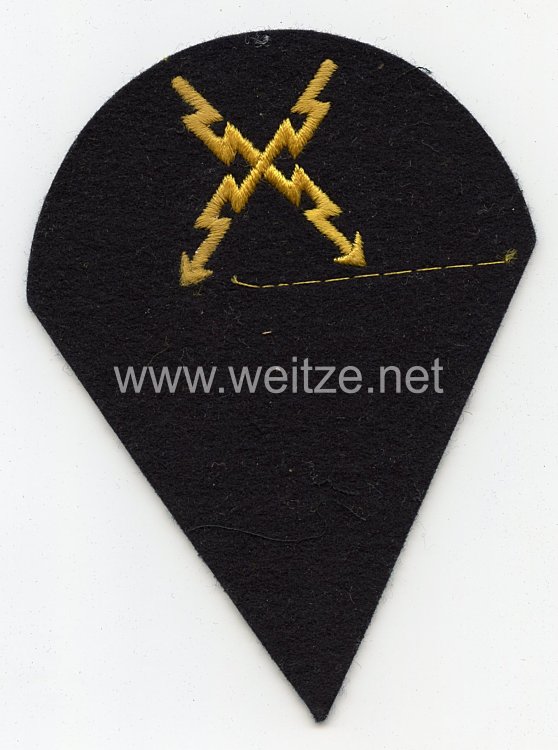
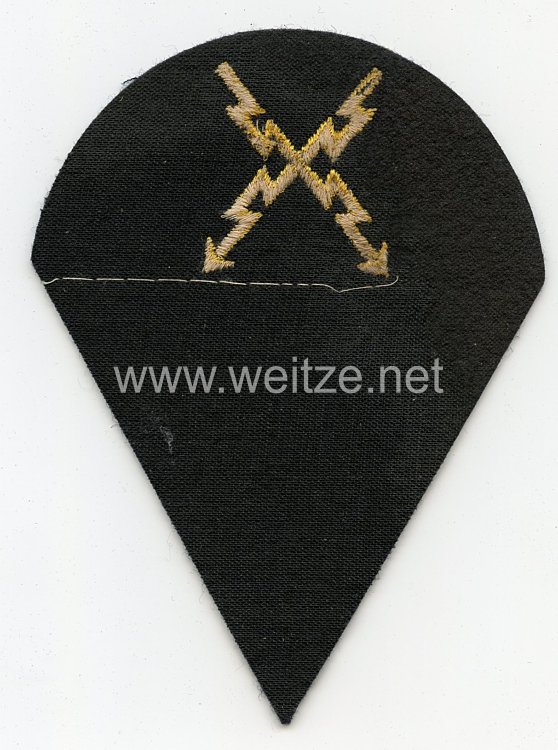
Kriegsmarine Career Insignia Enlisted Personnel Teleprinter Operator
The Kriegsmarine Career Badge for Enlisted Personnel in Teleprinter Service represents a fascinating example of the specialized identification systems used during World War II in the German Navy. These badges served to make visible the specific training and function of enlisted ranks within the complex organizational structure of the navy.
The Kriegsmarine, as the maritime arm of the Wehrmacht from 1935 to 1945, developed a sophisticated system of career badges to identify the various specializations within its ranks. These badges, also known as activity badges or specialist badges, were worn on the left upper sleeve of the uniform and enabled quick identification of a sailor's expertise.
The Fernschreiber (teleprinter operator) was a crucial function in 20th-century modern naval warfare. Teleprinter technology revolutionized military communications by enabling the rapid transmission of written messages over long distances. Unlike radio telegraphy, which used Morse code, teleprinters could transmit and receive directly readable text messages, significantly accelerating communication and reducing transmission errors.
The execution for the Colani refers to the manner of wearing on the blue working uniform of the Kriegsmarine, the so-called Colani or drill suit. This working uniform was worn during daily service aboard ship and during practical work. Career badges for the Colani were typically manufactured in a simplified version, often sewn directly onto the fabric or made as sewn-on cloth badges, in contrast to the more elaborate metal versions for dress uniforms.
The introduction of specialized career badges in the Kriegsmarine occurred gradually during the 1930s. According to the Naval Uniform Regulation (Marineuniformvorschrift - MUV) and subsequent amendments, precise specifications for the design, size, and manner of wearing these badges were established. Each badge was designed to symbolically represent the specific activity – in the case of the teleprinter operator, typically through the depiction of a teleprinter device or corresponding technical symbols.
Training as a teleprinter operator in the Kriegsmarine was comprehensive and demanding. Recruits had to learn not only the operation of complex teleprinter devices but also acquire knowledge in encryption techniques, message protocols, and maintenance of the sensitive electromechanical equipment. Teleprinter operators frequently worked in the communications centers of warships, submarines, and coastal stations and played a central role in the navy's chain of command.
The foxing on the reverse side mentioned in the description is a characteristic aging phenomenon in textiles and cloth badges. These brownish spots result from moisture and fungal growth and are commonly found on military textiles from the World War II era. While they impair the aesthetic appearance, they represent authentic testimony to an object's provenance and age.
Condition 2 in military-historical collector evaluation typically denotes a well-preserved condition with slight signs of use or minor defects, such as the foxing in this case. This is quite an acceptable state of preservation for an object over 75 years old.
The significance of such career badges extends beyond their purely functional role. They represent the highly specialized nature of modern naval warfare and the necessity of training qualified personnel for complex technical tasks. The Kriegsmarine, despite its numerical inferiority to Allied naval forces, relied heavily on technological superiority and specialized training, as evidenced by the multitude of different career badges.
For collectors and historians, these badges offer important insights into the organizational structure and technical aspects of the Kriegsmarine. They document the various specializations and the importance attached to communications technology in the military doctrine of the time. The teleprinter badge is particularly interesting as it represents a relatively modern technology that had not been in military use for long during the 1930s and 1940s.
The preservation of such artifacts serves not only the interests of military collectors but also contributes to our understanding of technological development in military communications and the daily life of enlisted personnel in the German Navy during World War II.