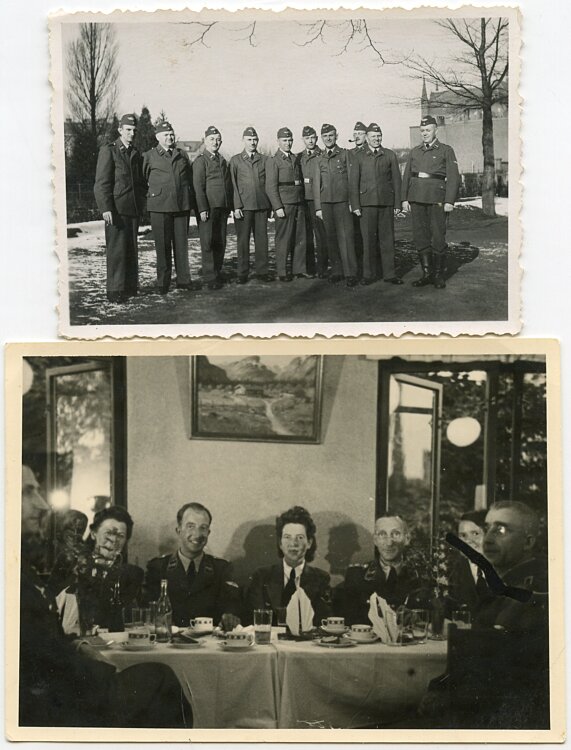
Photograph, Members of the Sicherheits- und Hilfsdienst (SHD)

, 2 photographs, condition 2
194736
10,00

Photograph, Members of the Sicherheits- und Hilfsdienst (SHD)

The photographs presented here document members of the Sicherheits- und Hilfsdienst (SHD) or Security and Auxiliary Service, an organization that played an important role in civil air defense and disaster relief in Nazi Germany during World War II.

The Security and Auxiliary Service was officially established on April 8, 1942, through a decree by SS Reich Leader Heinrich Himmler. This organization arose from the necessity to consolidate various civilian auxiliary services and protective organizations under unified command. The SHD was primarily deployed during air raids, disasters, and other emergencies, working closely with the Reich Air Protection League, fire brigades, Technical Emergency Service, and other organizations.

The structure of the SHD was organized along paramilitary lines and comprised various specialized services: the Fire Protection Service, the Medical Service, the Veterinary Service, the Decontamination Service, the Repair Service, and the Welfare Service. Each of these services had specific tasks ranging from firefighting and medical care to decontamination after gas attacks.

Members of the SHD wore characteristic uniforms that distinguished them from other organizations. The base color of the uniform was typically dark blue or gray, with specific badges and rank insignia. Photographs of SHD members are important historical documents today, as they show not only the individuals themselves but also reveal details about uniforms, equipment, and organizational structures.

Service in the SHD was often mandatory and performed as part of general service obligations. Many civilians who were not drafted into the Wehrmacht found themselves in the SHD. This particularly affected older men, women, and persons in war-essential occupations who were exempted from military service. Training included theoretical and practical instruction in first aid, firefighting, debris clearance, and other relevant areas.

With the intensification of Allied air raids from 1942/43 onwards, the SHD gained increasing importance. The organization was deployed during devastating bombing attacks on German cities such as Hamburg (Operation Gomorrah, July 1943), Dresden (February 1945), Cologne, and Berlin. SHD helpers were often the first to rescue those buried in rubble, extinguish fires, and care for the wounded after air raids.

Photographs from this period served various documentary functions. Some were produced for propaganda purposes to demonstrate the readiness and “determination to persevere” of the civilian population. Others were private snapshots that served as mementos or were sent to family members. Still others documented training or special events in service operations.

The condition of historical photographs is typically rated on a scale, with “Condition 2” generally indicating well-preserved examples with only minor signs of use. Such photographs may show slight aging effects, minimal creases, or minor discoloration, but are overall in very good condition.

From a military-historical and collector's perspective, photographs of the SHD are of considerable interest today. They document an important aspect of the home front during World War II and show the mobilization of the civilian population for “total war.” At the same time, they are testimonies to individual fates and everyday life under wartime conditions.

After the war ended in 1945, the SHD was dissolved along with other Nazi organizations. Many of its functions were taken over in the postwar period by newly founded civilian relief organizations such as the Federal Agency for Technical Relief (THW) in the Federal Republic of Germany, albeit under democratic auspices and without the ideological imprint of National Socialism.

Photographs such as these are important sources for historical scholarship and help to paint a more complete picture of German society during World War II. They remind us of the experiences of the civilian population and the comprehensive militarization of all areas of life in Nazi Germany.