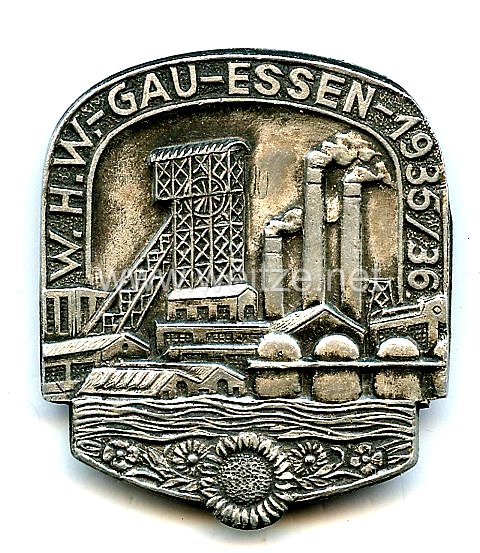
WHW - Gau Essen 1935/36
The Winterhilfswerk (WHW), or Winter Relief Organization, represented one of the most significant propaganda instruments of the Nazi regime and manifested itself in numerous collection badges produced between 1933 and 1945. This aluminum badge from Gau Essen for the collection period 1935/36 represents an important aspect of Nazi social policy and its propagandistic implementation.
The Winterhilfswerk was founded in September 1933 as a charitable organization, officially aimed at helping needy Germans during the winter months. Under the leadership of Erich Hilgenfeldt, who simultaneously directed the NS-Volkswohlfahrt (NSV) or Nazi People's Welfare, the WHW quickly developed into a massive propaganda campaign. The organization collected money, clothing, and food, with considerable social pressure to participate. Those who did not donate faced social ostracism or professional consequences.
Gau Essen was one of the administrative units of the NSDAP in the Ruhr region, Germany's industrial heartland. The region was of particular strategic importance to the regime, as heavy industry was concentrated here. Josef Terboven served as Gauleiter of Essen from 1928 to 1945 and also supervised WHW activities in his jurisdiction. The collection period 1935/36 fell into a phase of economic consolidation following the Great Depression and increasing rearmament of the German Reich.
WHW badges were manufactured in various materials, with aluminum being particularly common in the early years. The badges served as receipts for donations made and were to be worn demonstratively on lapels. This created social pressure, as anyone without a badge was recognizable as a non-donor. Designs varied greatly: there were regional motifs depicting local landmarks or cultural peculiarities, as well as Reich-wide series on various themes such as fairy tales, traditional costumes, professions, or historical personalities.
For Gau Essen, industrial motifs were often chosen, emphasizing the region's significance for the German economy. Mining, steel production, and mechanical engineering shaped the iconography of these badges. The collection period 1935/36 was the third WHW campaign and was characterized by increasing professionalization and organization. The Reich Propaganda Directorate under Joseph Goebbels centrally coordinated the campaigns, while the Gaue were responsible for local implementation.
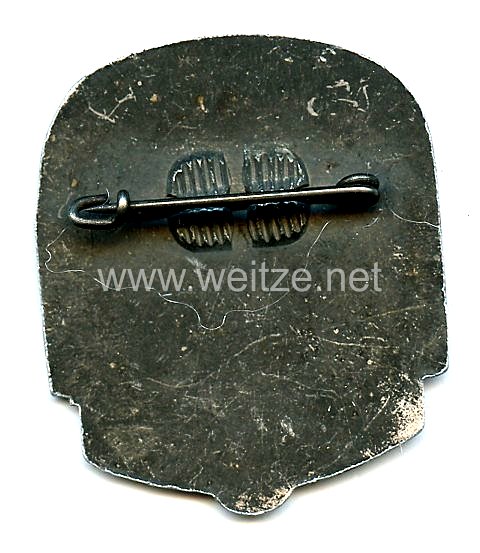
The production of millions of badges provided orders for numerous manufactories and small businesses. Quality varied considerably, from simple stamped metal badges to elaborately designed pieces made from various materials. The present aluminum badge with pin fastening corresponds to the typical construction of this period. The pin enabled easy attachment to clothing, and aluminum was an inexpensive, easily processed material.
The propagandistic function of the WHW extended far beyond actual social welfare. The regime used the campaigns to stage the Volksgemeinschaft or “people's community” – the supposed overcoming of class antagonisms through national solidarity. The monthly stew Sundays, when wealthier families were urged to eat simple meals and donate the savings, were part of this staging. Collections were effectively mandatory; businesses organized internal collections, and participation was documented.
Historical sources document that the WHW collected enormous sums – up to half a billion Reichsmarks per year in later campaigns. However, the actual use of funds often remained opaque. A considerable portion flowed into party coffers and was used for armament purposes or prestige projects. While needy Germans did receive support, the humanitarian impact bore no relation to the propagandistic effort.
From a collecting perspective, WHW badges are today significant historical documents. They document the everyday propaganda of the Nazi regime and its penetration of all areas of life. For collectors and historians, they offer insights into regional characteristics, artistic trends of the time, and the organization of Nazi mass mobilization. The condition is usually evaluated according to a scale, with condition 2 indicating a well-preserved piece with minor signs of use.
Critical engagement with such objects requires historical sensitivity. They are neither harmless collectibles nor pure propaganda instruments, but complex historical artifacts that illustrate the mechanisms of totalitarian rule and social control.