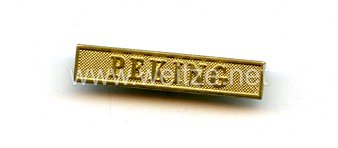
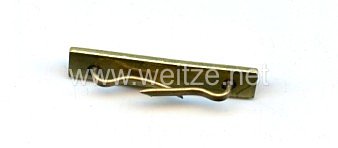
From the treasure trove:
The designation "From the Treasure Trove" with the note "Manufactured after 1945" refers to a military collectible whose historical context lies in the complex post-World War II period. This marking is of particular significance for collectors and historians, as it indicates the production period and thus the authenticity and historical value of the item.
After the end of World War II in May 1945, Europe entered a phase of reconstruction and political reorganization. The production of military equipment and uniform parts in Germany was initially strictly controlled by the Allied occupation powers. The Potsdam Conference of July to August 1945 stipulated that Germany should be completely demilitarized, which theoretically prohibited the manufacture of military goods.
Nevertheless, various categories of military objects manufactured after 1945 emerged in the post-war years. First, former manufacturers continued to produce equipment for the Allied occupation forces. Second, military objects were manufactured for paramilitary organizations such as the Federal Border Guard (founded in 1951). Third, with the establishment of the Bundeswehr in 1955 and the National People's Army of East Germany in 1956, a new era of military production began on German soil.
The term "treasure trove" suggests that this is an object possibly originating from storage inventories, attic finds, or collection liquidations. Such items raise important questions of authenticity and dating that are of central importance to collectors.
During the 1950s and 1960s, the market for military reproductions and replicas flourished. Many manufacturers, particularly in Germany, Belgium, and later in Eastern Europe, began producing replicas of historical military equipment. These served various purposes: as costume pieces for film and theater, as collectibles, or for historical reenactment groups.
The legal framework for the manufacture and trade of military objects varied considerably between the different occupation zones and later between the Federal Republic of Germany and East Germany. The War Weapons Control Act regulated the production and trade of military items in West Germany, with historical collectibles being exempt under certain conditions.
For collectors and museums, the clear identification of post-war manufactured items is of utmost importance. Material analysis, manufacturing characteristics, and markings can provide information about the actual production date. Modern synthetic materials, machine manufacturing traces, or anachronistic construction details are clear indicators of post-war production.
The designation as post-war manufacture also significantly affects collector value. While authentic wartime objects often command high prices, post-war manufactures generally have considerably lower monetary value, though they can still be of historical interest, particularly when documenting post-war production methods and collecting interests.
It is also important to note that in the immediate post-war period, many veterans and civilians attempted to repurpose military equipment for private use. Uniform parts were altered into civilian clothing, metal objects were melted down or used for other purposes. This aspect of everyday history makes post-war manufactures valuable sources for social and economic history as well.
In conclusion, the clear labeling of an object as "Manufactured after 1945" is a sign of transparency and scholarly integrity in the trade of military antiques. It enables collectors and researchers to make informed decisions and contributes to proper historical classification.